We have not had the greatest weather over the last few weeks. A few dry days, then some cold and wet weather. Staff have been changing the pace more than Adam Wainwright to get things completed for the season at Glen Echo.
EDGING OF BUNKERS
The staff began the arduous task of edging bunkers and moving sand around in them this past week. They completed Holes 1, 3, 4, 7, and 5 with a little more work to be completed. I have a video below which will give you an update of the work and what it takes to get to the finished product which I will bullet point below;
Edge the lower side of the bunkers. Use a sharpened sod shovel to reform the edge removing the sod that has grown over the old edges. Shake the excess sand from the sod.
Locate the depth of the various areas inside the bunker to determine which areas need sand and which locations need some sand moved to the more shallow areas.
Shovel the sand or if there is room use the blade on the bunker rake and push into place.
Rake the bunker and move to the next. Took 4 staff members all day to work on about 11 bunkers.
https://www.youtube.com/watch?v=rLbqJOOWHfY
Completed
VERTICAL MOWING OF GREENS
This past Monday we took advantage of the golf course being closed and vertically mowed our greens. We have a set of reels that goes on our normal greens mower that mows up and down instead of a lateral mowing that we do on a regular basis. There are 37 blades on each mower that cut straight down into the canopy of the turf. These blades are about 3/4" apart and cut through the top of the surface of the green cutting longer turf blades and pulling up small amount of thatch in the process. We only set our cutters to about a depth of 3/8" so the healing process is pretty quick. The purpose of this practice is to help stand up the blades of grass and cut off the longer leaves of bent grass. Bent grass from its name lays over and can become longer relatively speaking. The longer the blade, the more friction placed on the golf ball which slows the balls roll out.
Once we've vertically mowed, we then use a drag brush to stand the turf up and spread the sand and thatch around on the green. The regular mower than mows the green picking up a majority of the excess leaves and thatch material. First video is of the vertical mowing and 2nd is the regular mowing to clean up the material off of the green.
https://www.youtube.com/watch?v=SGZBxOAWgPM
Vertical mower, as you can see the blades are in the vertical position.
https://www.youtube.com/watch?v=dJZCu9mnPn0
FENCE INSTALL
The fencing along St. Mary's Lane was made up of a lightweight aluminum fencing which is difficult to stand up against a large area mower. Of course its important that our mowers stay away from the fence as well but at times it would bump up against it and stretch it out of shape. We will be installing an 8 gauge galvanized fence from the Wallingford gate down to the entrance to the club. A majority of this work is complete. We need to bring in another roll of fence to complete the project.
Staff stretching the fence along St. Mary's.
Look from the installed side.
TREE MANAGEMENT PLAN
Over the last few weeks, we've removed another 5-6 standing dead Pin Oaks that succumbed to the Wasp Gall that have invaded our property. We still have 2 to remove on the right of 2 and a dead Sycamore along Lucas & Hunt as weather permits. We had hoped to have all ground out stumps filled with soil and covered with sod but have not been able to get this accomplished because of the lack of lengthy periods of dry weather.
NOTCH ON THE BELT
As most of you know, I've been on a journey over the last few months to improve my physical health and along with these efforts my mental health is improved with the release of hormones and other positive effects of the weight loss, proper eating and exercise helped to create.. My participation in the GO! St. Louis Marathon was an accumulation of efforts since December 10th that have led to weight loss of about 33 pounds and exercise in which majority of it included walking of over 300 miles. During the 12 week challenge with over 130 fellow superintendents, vendors and family members, we lost over 2,200 pounds and I lost 33 total but only 23 during the start of the event on January 1. As I continued to push myself to beat personal bests in waling distance and pace, I decided to do the 1/2 Marathon at the end of February. A couple weeks later after walking along with some jogging I went over 16 miles and the die was cast to try for 26.2 miles.
My desire is for this to be a permanent change in eating and general exercise which. I still have a goal to get down to 170 pounds(11 more to go) and be at my college graduation weight. I appreciate the memberships support of me during the period. Its been a great experience to date.
Its been a while since I've made a blog post. If you follow me on other forms of social media you've seen a regular plate full of details regarding the work our hard working staff are accomplishing on a daily basis.
Weather
First and foremost, lets talk about the weather, especially the colder than normal temperatures we have experienced in late April and May. The average temperatures in April were a couple degrees above last season. Now, May 2021 is a different story. We are currently 8 degrees behind average in both daylight highs and night lows. Last May we were actually a degree above normal. More importantly, our soil temperatures have dropped since the first of May to 63 degrees.
Soil temperatures at this level are excellent for our rough grass(cool season) and greens. Our bent grass likes temperatures to be slightly warmer, especially at night but they are in full production of energy which contributes to root growth and adds to storage within the plants.
It is most difficult for our dominant short grass zoysia, especially our tees and areas of fairways with heavier cart traffic and additional shade. We've cleaned up our zoysia mowing only weekly at this time due to the lack of growth. Some of our weaker areas we will keep the mowers away completely. It appears we might begin to see some increases in heat over the weekend and into next week. We can't force the plants to grow. The systems within the plant currently are slowed because there is not enough energy to produce growth.
It is very important during this time that membership operating carts reduce traffic in fairways as much as possible. Using a 90 degree angle from the cart path to your ball in the fairway reduces traffic in the fairway. Once the ball is struck, move the cart back to the rough and cart path when possible and proceed to where you ball is located. We are still seeing a tremendous amount of traffic going from the teeing ground area directly through the rough off of the tee and into the fairways and then driving another 50 to 100 yards down the fairway. Your assistance is greatly appreciated to reduce this type of activity.
Soil and Sod
Stumps from a few trees removed were ground a few weeks ago, remnants cleaned out and this past week they will filled with soil. Yesterday and today, our staff edged the existing filled areas and laid sod to cover the spots. Six in total were cleaned up. Our contractor will be out in the next couple of weeks to grind the remaining stumps that we have on property so we can get them cleaned and covered for the summer.
Sycamore and Sweegum that were in the club lawn to the right of 9 cart path were covered with sod. Also, 9 tee, a pine tree in the club lawn and in the triangle between 5/7/main drive.
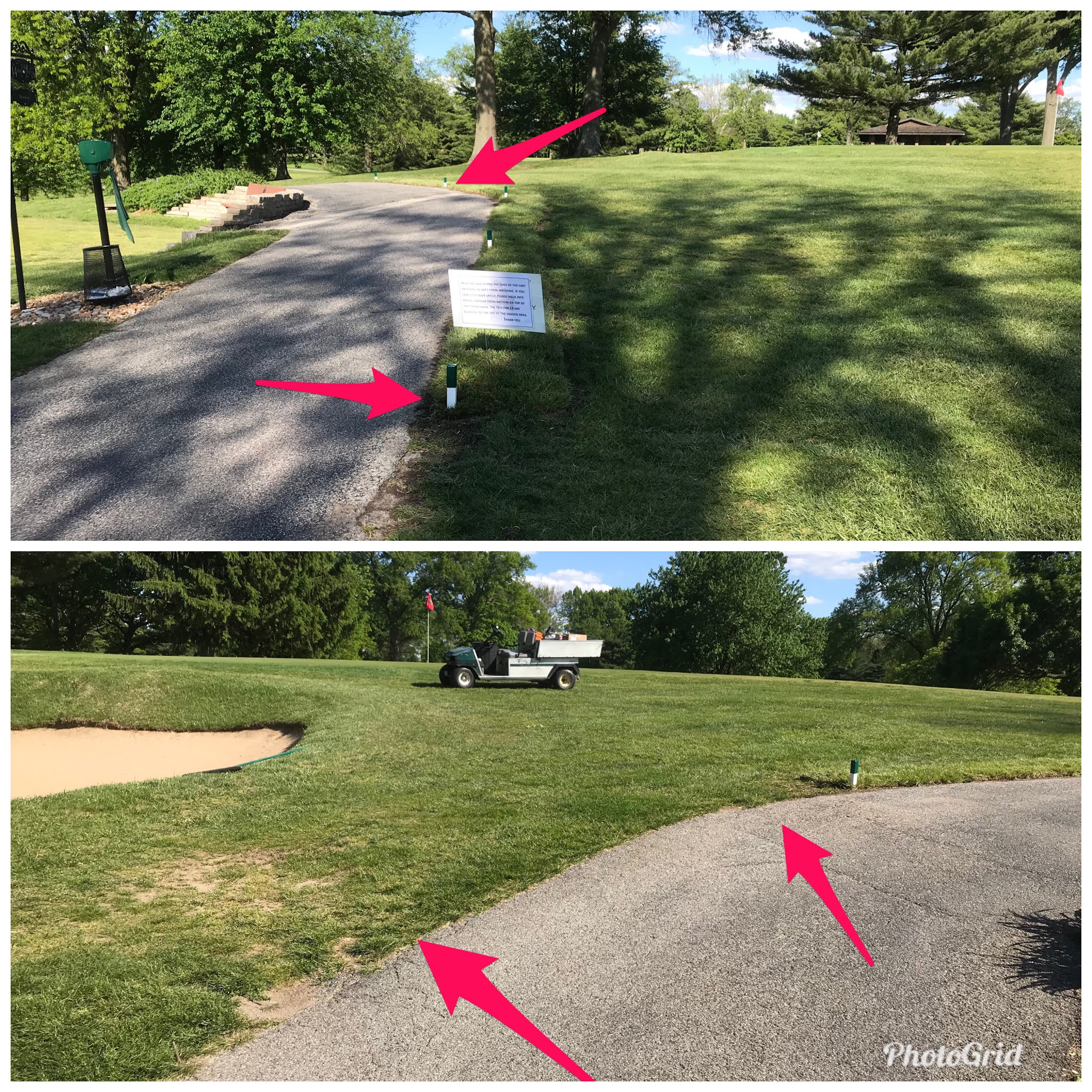
Some additional soil work was completed along some seriously compacted cart path edges behind 11, green, at 13 green and at the curve just short of 15 green by the 16th tee. We used a heavy duty tiller going as deep as 6-8". We added some black gold compost from St.Louis composting and covered with fescue sod. These areas will be kept very moist over the next week or two so it is important that we do not step into the 20" width of sod that are next to the path. Access to the green areas are still available at the top end of these renovated areas.
https://www.youtube.com/watch?v=No8JNhqkE78
From the 11th cart path going up the hill to 12 tee. We have this section roped off and are asking cart to proceed to the top of the hill at the circle turn for the 12th tee to enter the 11th green complex. This area has been very problematic because of the severe slope and the large Pin Oak that keeps this area depleted from moisture and into heavy shade. Hopefully this extra work will finally keep this area in better shape.
This area leads up to 13 green. We tilled from just above the left tee up to the top of the hill in the bottom picture. You can access the green from below or above the section. Some can step across the sod without issue but please be reminded this area will be kept wet for a week or two to help it root properly. We will also keep the tees up on the upper tee of 14 for a week or more so more the reason to pull up to the top of the sodded area.
No pictures of 15 but this area will be roped off and will be obvious for our golfers. Carts can stop short of this area and or proceed to the circle for 15 green/16 tee.
Drop Zones
We have one established drop zone at the club which is the red teeing area of hole 9. As play has increased, so has the wear and tear to this teeing ground. It is also a fairly small tee with an extension that was added a few years ago that frankly speaking needs to be renovated. Teeing grounds are not the best locations for these drop zones so a couple of changes will be occurring over the next couple of months.
On hole 9, we have rough graded in a new drop area beside the 9th red tee. We will be covering this with zoysia over the next week. Later this summer,(after July 4th, we intend to close the red tee and blue tee on #9. We will strip the sod from the tees, enlarge the red tee forward, to the right and a little off the back. We also will strip the blue tee and will extend its teeing ground to the right. We anticipate these tees will be ready for play by August 1st with the heat of the summer pushing a quick grow-in. In the meantime, we will utilize the new drop zone for the red tee/drop zone and the white tee will have the blue tee added.
New drop area to the right of 9 red tee. We still have some work to complete on the slopes and some leveling but its roughed in. We anticipate the red tee to split the different between the existing tee and the new drop zone.
The golf committee and green committee has been in discussion regarding a potential drop area to be established for the 15th hole. We will be placing a drop zone about 35' from the cart path about 10' from the Egan's Lake. It will be mowed at a reduced height of cut and a circle designating the area will be put in place.
Driving Ranges
There are signs at each driving range that mention the range will be closed early on Thursdays. This must occur so that all balls can be removed by the pro shop staff and readied for our staff to mow before the first golfers whom arrive on Friday morning at 7 am. This program is usually implemented in late April and runs into June and or until the grass begins to slow its growth. Its important that the grass be cut twice a week so staff can see the balls and remove them so they are not chopped up by the mowers.
On event day Mondays, our staff usually picks the ranges clean and mows after the groups begin play. The pro shop staff assists us with as much removal before dark on Sunday evenings. We do not close the ranges early on Sundays so our membership are not inconvenienced by our necessary operations. We appreciate your understanding during this time.
I hope you get a chance to get out and see your golf course over the next couple of weeks. Ball roll out has been pretty good I hear and hopefully the rain starts falling at night and leaves our weekends free to play golf.
Like a shutdown corner on the football field, mother nature is doing her thing for the next week or two here at Glen Echo. Below freezing temperatures and a few days of precipitation has moved us indoors to complete our course supplies refurbishing and other important duties before we get back out on the course.
Green Root Shearing
Once temperatures have moderated and all the snow and ice is gone from the course, the course will not reopen until the freeze has come completely out of the greens. I've attached a 1 minute video from the USGA regarding root shear and its effect on golf greens.
Shearing occurs when walking on thawed green surfaces and the root zone is frozen. Foot traffic on softening bentgrass greens causes the surface layer to shift with our weight and can tear roots at the junction of the thawed and frozen part of the green. The shearing off or tearing of roots that were 4-6" long to barely an inch or less causes the plant to use a tremendous amount of energy to regenerate the roots back to their mature length. Now remember that there are an average of
Keep in mind, all roots are continueing to grow and evolve during the spring season and into early summer. They are gaining root mass and extend top growth based on the supply of energy we provide. Once they've used all their energy for growth, there is usually excess energy that has no where to go so it is placed in storage to be used by the plant when production of energy does not keep up with demand. This generally occurs when soil temperatures reach around +85 and air temperature near +90 degrees during late June through early September..
Turf and Below Zero Temperatures
So will below zero weather have a negative effect on our turf? I'm glad you asked that question. Generally speaking our turf should be able to withstand these temperatures. Snow cover does provide some insulation but we only have about 1" or so covering our fairways and grens.
The turf most effected by below zero nights could be the bermuda grasss which we have invading almost all of our surfaces. It won't kill it completely but could potentially cause it to grow out from below ground. Normally bermuda begins to green up in its runners or stolons above ground. The freeze could force it to grow from rhizomes under ground because the runners on the surface on the ground could die back to below the surface. In most cases it will kill the plant completely but could delay its growth by weeks or more.
Our golf greens, cool season turf have a higher cold tolerance to severe cold. We did discontinue mowing to allow our greens to get a little fluffy. I was contemplating a mow in January but saw the long term outlook and decided to hold on until February. I'm glad I waited. Mowing in winter, especially if it is milder can signal the plants to grow which could lead to some cold temperature injury. Poa annua can be negatively effected by cold but I've never seen much winter kill in my 31 years in the business here in St. Louis.
Our zoysia grass tees, fairways have cold tolerance to about -5 to -10 degrees under normal circumstances. Without snow cover, north facing, shaded, and heavy traffiked areas could be subject to winter damage when temperatures fall into these ranges. This damage could result in slow green up and or death and in need for replacement.
Are there cultural practices which could reduce winter injury? Thank you for asking again and yes there are Best Practices that can assist in winter turf survival of zoysia grass. At Glen Echo, we do the following to improve our turf's chance for emerging unscathed in the spring.
Aeration and or slicing fairways/tees in the summer
Traffic control of carts and moving teeing grounds to reduce wear and tear. This is why we ask you to not drive directly from the teeing area to fairways because of wear and tear.
Light, the more light the better which means the removal of limbs and or trees as necessary to improve and increase light. A minimum of 5-6 hours is the best. This would also include root pruning of trees using our tractor driven root pruner
Ensure nitrogen fertilizer applications do not extend the growth of zoysia to far into the late summer/early fall which does not allow the zoysia to move into dormancy at the proper timing. Also provide adequate potassium to the zoysia through a late summer/fall which assists in winter hardiness
Reduce drought stress going into dormancy
Raise height of cut before season ends
Reduce traffic during non-growth dormancy months
Tree Management Plan
Our tree management plan is ongoing during the year. We did some significant pruning in the late summer/early fall to clean off suckers on trees and to remove lower and or dead branches that will allow more sunlight to get to our turf canopy. Our contractor is out this week removing a few trees that are on our green committee approved list that are too large for our staff to handle without being topped out. The committe has also given the green light to remove most Sweetgum trees from the property because of the immense clean up that are caused by these trees. The time and energy that will be saved from cleaning up gumballs as they drop can be moved to managing and improving other turf areas. We also have a few damaged and or weakened trees that will get our attention over the next month or so as well that we can drop on our own. Stump grinding will be completed and soil, sod and or seeding will take place depending upon where they are located.
We have one tree left in our tree nursery which will be moved this winter. We will add another 3-4 back into the nursery before spring to allow them to grow and mature for future use.
Large Pin Oak being topped today near 4-5 cart path and main road. Tree has significant wounding in lower 1/3 of main trunk and top has continued to die back.
Maple Syrup
We began the process of tapping our maple trees for their sap this past week. We had good flow the first day but the cold weather moved in and has shutdown the flow of sap. Looking at the forecast it appears the severe cold will break next week sometime and we will get temperatues above 32 which will allow for addtional flow. Attached is a video of a tree being tapped. We have about 15 trees tapped which should give us a great supply as long as temperatures moderate slowly over the next few weeks.
Sometimes you get a bit greedy. 4 buckets of excellent
flowing trees at the bottom of #3.
6 to 8 Drainage Project
The pipe between 6 to 8 cart path has been installed and the rock and dirt backfill is in place.
We still have a great deal of work to complete as the weather cooperates over the next month.
Additional soil to add as we pack it along and over the pipe
Grading and shaping of the soil
4" drainage to be installed in front of 7 tee
Sodding all areas disturbed
Our hope is to complete this as quickly as weather allows so we can get the 8th hole open for play.
December/January Weather Stats
Daytime highs in Decembr were nearly 5 degrees warmer with night temps slightly warmer. Inversely, nighttime temps in January were over 5 degrees higher than normal with daytime being slightly over. Overall, averages were about 3 degrees above for the two months.
December
TEMPERATURE (F) Observed Value Normal Depart Normal Last Year
AVG. MAXIMUM 47.4 42.5 4.9 49.5
AVG. MINIMUM 28.8 26.9 1.9 30.0
MEAN 38.1 34.7 3.4 39.7
PRECIPITATION (INCHES)
TOTALS 1.60 2.84 -1.24 1.86
January
TEMPERATURE (F) Observed Value Normal Depart Normal Last Year
I put together some pictures of trees removed in the last couple of weeks. The pictures were from November 2018 that I prepared for the green committee. It helped them locate the trees I was identifying for removal.
Most of these trees were set back from fairways, greens and tees. They reached the end of their life and needed to be removed. There are some members who want trees to have no leaves on them before they are removed. There are groups of members that when they see a tree not looking good or weakened would like to see it removed. I try to fall somewhere in the middle, not completely dead so not to be dangerous for staff and members but delay the inevitable if there is still some decent life. Everyone has an opinion right. A large tree removal is at least a 2-3 day process.
Tree on the left is a magnificent oak that we've watched drop its leaves early the last 3 seasons.
In 2019 it barely went to leaf. It was time for it to go. The tree on the right is just below the first tree on the left as you go down to 10 bridge. It should have been removed in winter of 2019 but was not. It was time for it to be removed. The loss of these 2 trees will allow us to place one new tree in an area between the trees in the future. If we are not able to get accomplished before spring it will happen next fall/winter.
The 3 large oaks on the right of #12 from 100 yards to the green are all under some significant stress. Probably all 3 planted around the same time. The top tree near 13 tee and 12 green has a tremendous amount of suckers growing on it and had severe leaf drop both this season and last. It was determined to remove this year and hope that the other delay their decline. There are two oaks that have been in the ground below and behind them that will grow to help fill in the void once the other two trees leave.
Picture of the oak next to the spillway on 13. It is before the start of the fairway on 13 and there are trees between it and 15 fairway to the left. Look at the reddish leaves from the oak behind help determine its health a year and two months ago.
This is an oak yet to be removed that will be removed this winter. It is in a clump of oaks behind 17 green and next to 16 fairway. We have another oak just like this one between 3 and 12 in the line of oaks at about 160 yards out on 12 in the same condition. Not much left, vulnerable to wind damage and or falling over at any time. Time to go sorry to say. Actually their loss will help other more crowded trees improve their spread.
A Siberian elm along the lake on 10 will be removed. We have 2 large sycamore that will be coming down as well. 1 along the main road near number 8. It is right on top of the road and has shown severe stress over the last couple of years as well as another sycamore next to 9 cart path in the club lawn will be dropped by the staff. We've watch trees for years go into decline, that is part of what I do. Most of our largest trees we contract out the topping of the tree and then drop the rest with our staff and clean up the larger limbs that cannot be chipped.
This oak had the dead wood pruned back in the winter of 2019 after this picture. You can see its weakness versus the oak to its right of the same species. We do not have the resources to continuously prune back large sections of deadwood. Once a tree has gone so far, its put on our list for removal.
There are only a hand full of courses in town that have some of the same aged trees as Glen Echo. Sunset, Norwood and Algonquin but most of those facilities have been involved in some significant removals as have most of the newer built clubs in town.
There is no doubt trees are beautiful when placed in the correct location, the proper species and the proper number. Trees like many of ours have a life span that is nearing their end. We continue to evaluate the need for trees but I am not in any hurry to over plant which is what has taken place in our past and we now must work around. A tremendous amount of resources are spent caring for trees and the effects they have on our turf grass that try to survive in their shadow. Fuel, water, fertilizer and many many man hours are spent tending to what trees do to our landscape.
We have not had many desirable golf days over the last few weeks. Warmer weather is predicted this weekend but we will remain closed through Saturday due to our greens being in various stages of thawing. Our greens should be thawed at least 3-4" before we allow play.
A couple things can happen with partially frozen greens. As you step on the surface of the green where the freeze/thaw line is very shallow, the green surface can shift or move as you take steps and the roots can tear at the demarcation line between thawed and frozen. This then forces the plants to use significant energy to grow back their to their full length into the late spring and early summer not allowing it to store energy reserves for the dreaded heat of summer. Also, the freeze line being too high will not allow moisture to drain deeper into the sand profile. The water trapped near the surface will make the surface act like a wet sponge. Foot imprinting will increase and plant tissue can be damaged from the extra soft conditions.
We understand the desire of members wanting to play but allowing a few golfers out when they should not be out could contribute to the loss of turf during the main golf season. I made a video below explaining our current situation. https://www.youtube.com/watch?v=xQ63T6vpHDg
Also in the video, I discussed our tree management plan that is taking place this winter. In the fall of 2018, I made a power point for the green committee regarding our plan for the next year or two. I put together a 3-4 minute power point showing the trees I was recommending for removal. We removed a number of the trees on approval from the committee but were not able to complete all of the removals due to time. I also felt like a few of the trees could go another year before removal so we delayed their removal to this winter. Through an arrangement that has worked well for us, we were able to get 2 more days of tree removal this winter than planned. The trees that were left from the year before declined significantly over the past year and needed to be removed. Many of our trees were planted in the 50's and 60's and are beginning to show some serious decline. Changes in climate over the last 10-15 years have not helped and has led to decline as they have aged. Record temperatures and high rainfall record years are the types of swings that don't help an aged tree population Pest issues including insects and disease along with lightning strikes and wind damage have been contributing factors as well.
I have also requested a number of tree removals over the last 11 years to improve tee and green turf. Our greens and tees have no infrastructure to assist in combating serious environmental issues. We have 1 green with modern drainage, the others only have a layer of topdressing sand that has helped us but is not adequate during severe wet conditions and heat.
Also, during the next couple of weeks you will see a few orange buckets hanging from our maple trees. Yes, yes, its time to start collecting maple sap to make some homemade Glen Echo Maple Syrup. Not sure what type of year we will have but if today's run is any indication, it might be pretty good. This next couple of warm days might slow down the production but next week with 30's and 20's should help us with our run. We need overnight temperatures below freezing and daytime temperatures to be above freezing to help the tree flow its sap properly for our collection. 43 gallons of sap to make 1 gallon of syrup!
As your fairways, tees and zoysia green surround areas dry over the next week our two, we will begin spraying non-selective weed control and pre-emergent to our fairways. You will notice a little blue tint to the fairways which assists us in seeing the area we have sprayed to reduce over spray. It will take the poa 2-4 weeks to begin to turn yellow, orange and then die. The pre-emergent will reduce the germination of crabgrass and goose grass in our zoysia surfaces.
Well, we seem to get a step or two ahead with our work and then 2 step backwards with the rainy conditions we've experiences over the last few weeks.
Before starting on some big news on the 2 tee renovation, I would like to discuss the wet conditions we have been experiencing and how it relates to cart traffic. During normal weather conditions, Glen Echo's hill's have a number of springs that emit various amounts of moisture out of our rather tightly bound soils from late winter through the spring season. With a wet winter and now spring, Glen Echo's springs have really sprung this season. When we dry enough to allow carts off the paths, we still have a number of areas that are somewhat damp. We have tried to rope off or place signage out but there are only so many signs that can be placed on a course. One thing to keep in mind, the lowest area of any hole is has the potential to be the wettest. Please allow me to give an example. #2 toward the metro track fence line has a tendency to be very wet. Within 20' or so of the fence your golf cart can end up over its axle in mud and water.
When we place a sign or signs on the course for an area to avoid, our expectation is that you give a wide berth of at least 20-30' feet to the left or right of the sign and 20-30' deep. Going directly behind a sign is not enough latitude to protect our turf. I've attached below a picturse which gives the example of what should not be done with a cart. Not trying to make an example out of someone but it is an example for future reference of how to avoid a wet area and not create tire tracks.
Tennis courts work is ongoing as the season is getting close. We are repairing the asphalt area adjacent the courts which will include filling some larger cracks with asphalt and then filling smaller cracks with liquid filler. We then intend to paint it a court green pigment. We also must add another 140 bags of clay to the courts in the next few days and then line the courts.
Skip cutting a couple of larger cracks out so we can replace with new asphalt.
Randy, Randy, Rallo and I cleaned the asphalt area and scraped the worn paint during the rain day we experienced last week.
So the big news of the day, 2 Tee surfaces and surrounding area were sodded today. We have a couple of small sections of sod on the back of the blue tee and forward off of the front tee toward the fairway that still must be completed. We will finish the remaining sodding over the next few days as weather allows. My expectation would be to hopefully open the tees on Memorial Day weekend if all things go well with temperature and not too much moisture.
White tee after tarps were pulled off Friday and was graded again by the bunker rake.
Blue tee was a bit damper but turned out ok.
Mike McNeil from Schaefer-Meyer Laser-leving the white tee Saturday morning.
Laser leveling 2 tee
https://www.youtube.com/watch?v=DCa7Dl1YyT4
Begging laying the zoysia on 2 tee. Stake and rope to help with alignment. Old tee basically pointed down right edge of the fairyway.
Finishing the white tee surface.
White tee complete
Guys working on the right bank toward the tracks with Fescue
Pinning the sod to insure it stays in place. We intend to mow the top but initially will not mow between the bank and the track area. We will evaluate this as time goes by. It is pretty significantly sloped and we do not have a riding unit that can mow this hillside.
Edging and finishing up on the tee surface.
Before laying the sod between the 2 tees.
Big roll sod being used in the off tee surface areas to help reduce washouts and save time in applications.
Mulch paths to long range and short range were smoothed and touched up over the last few days as well.
Large oak at the start of the fairway on the right of the cart path on #17 had its limbs removed today as we prepare to drop the main trunk hopefully Tuesday. This tree was severly compromised in the last storn and has signficant hollowing in at the start of the crown area which is where the limbws come out of the trunk.
This past season was a most difficult one for the trees on our property. Oak gall wasp, roller coaster of temperatures and moisture over the last 10 years with record all-time high temperatures and rainfall. Also, one thing to keep in mind a number of our trees were planted in the 40's to 60's which make them range in ages from 60 - 80 years.
We have about 20-25 trees of all sizes to remove this winter. From green ash, locust and a large number of Pin Oak plus a couple of other red oak species who haven been under tremendous decline over the last few years. In most cases, these trees are in areas or groups of trees and are not strategic such as protecting doglegs. We do have an area along the left of #1 where we lost a couple of trees that need replacement and we hope to get a couple moved in this area over the next week or two. There are a number of other large trees that have showed some distress this season and will probably die over the next few years. Just like grass plants come and go, so do our trees.
We attempt to remove trees without a contractor unless they are too tall. Once we determine that we need the contractor, we call them in for a day and they remove tops on some of the largest removals that we need assistance in dropping. This might only occur once or twice a year. Our staff saves a tremendous amount of resources doing a majority of this work.
We like to prune limbs off of trees because of the close proximity of other trees that we do not want to damage as well as the protection of valuable turf areas. I also like to take the weight off of the tree so we can direct into exactly where we want it to fall. Trees can twist and turn without warning. We are also not aware how strong or condition of the trunk in case it possibly would snap as the weight begins to move one direction or the other.
We rented a lift for a week in an effort to drop as many limbs as possible. We chip the limbs in our dump truck and save the mulch for the range walk paths and other areas on the course where they can used. We are trying to do as many as we can over a weeks time to manage our resources. We haul off the larger limbs to areas around the maintenance building where we split the good Oak for firewood. We burn significant amounts of wood in our wood burner to heat our maintenance building. We save a minimum of $ 2,500 in natural gas expense over the winter. We will then remove the large trunks after the holiday break which will take a few weeks.
We have a small crew and it takes a significant amount of effort to remove the brush, limbs and log the trunks. .
In discussions with the green committee this fall, I talked about developing a plan to replace strategic trees as necessary but to not get into a large scale tree replacement program. We have a difficult time with managing our resources when it comes to the trees on our property. The shear size of these trees on an overall small piece of property is very difficult at best to manage. It is important that we conserve resources such as water, fertilizer and the total cost in tree management. Blowing, raking, mulching and grinding and mulching and grinding some more.
Our most important asset that we have at Glen Echo is the turf grass that provides the playing surfaces for our great game.
Below is video of Gamma Tree removing the Sweet Gum next to the Pro Shop and practice green. I'm in awe of the work these guys perform. You learn to have a great appreciation for their work when you go up 40-50' doing the lower level work that we do. The removal of this tree will help to keep the practice green/cart parking area and ornamental plantings free of gum balls, leaf litter and other debris.
There are trees near 8 green partially removed (locust), Pin Oak right rough 16 230 yards from the green partially removed and another which has a large part of the crown of the tree exposed about 185 yards from the green that we have not trimmed yet but must be removed.
https://www.youtube.com/watch?v=Bm7i3ISEv1Y
Contractor from Gamma working on the pro shop tree.
4 left side of the path about 50 yards before the cross path to the field bar at 7. Tree died over the summer.
11 top of the hill right side of the cart path at start of fairway. Had significant decay.
Today's look at the pro shop after removal of the sweet gum.
#18 right side of the fairway about 230 from the green. Oak died over the summer.
This tree was about 30 yards behind the tree above in the middle of 17/18 rough.
This oak is to the left of the cart path on 2 near the green irrigation box 225 yards to 2 green. Died over the summer. There is another oak in significant decline up near the left tee on 16 which is in the same row of trees. I pruned it the best I could to make it look a little better for this season.
Oak chips used for walk paths and other needs on the course and of course the logs from the limbs only. We still have to cut the main trunks down.
I wanted to inform you of a couple of tree removals which will be occurring in the next few days.
The green committee approved the removal of the red maple at the right front area of the 11th green.
Also, the dual sassafras between #1 green and #2 tee has become severely compromised. We will be removing the left tree as well in the next few days. We were going to prune off the dead wood but after looking at the tree closely, there is not much to salvage and the safety of our staff is of utmost importance when we look at partial or full removals.
There are a number of other tree removals that will be taking place over the next few months. There are some standing dead right now and others that are compromised and will need further evaluation. We intend to do this with the assistance of the green committee and an arborist to help us evaluate their health. As an organization, we do not have the resources to plan a major tree removal program but we do have an aged group of Pin Oaks that are being compromised from a number of different things. I've had discussions in the past with our arborist and I will invite him on site in the next couple of weeks to help us evaluate some potential remedies to slow this process down.
We also intend to move a tree from the nursery into the area on the left side of #1 where we have lost a couple of trees over the late summer.
A good Tree Management Plan includes planning/paying for ongoing maintenance of the existing trees, removal of the dead/damaged/out of place trees, and preparing for replacement trees.
Below is a link to an article which has some excellent information in it regarding a Tree Management Plan.
The staff completed the tee renovation to #5 and #14. They were stripped, tilled, laser leveled, tops sodded with zoysia and perimeter with fescue. We converted one single tee pointing to 6 tee box to 2 tees pointing at the 5th green. This should assist our players with proper alignment as well as our staff when they set the markers.
We aligned 14 somewhat the best we could but we were able to increase the teeing surface across the tee. If you remember, the left side fell off somewhat and reduced the overall teeing ground.
I would expect a month of growth before these tees could be ready for play. In the meantime please resist the urge to walk on the surfaces. Extra water will be applied to get them to root and grow.
We had some extra zoysia and the staff is busy fixing damage spots in fairways. A little bit of fescue is left and we will patch a couple of prominent rough spots near greens. They are also going to remove sod from back area on 9 red tee, fill with dirt and sod with zoysia. This will allow us a larger area for a drop area for players lieing 3 after hitting the water.
We had a contractor come out on Monday/Tuesday to remove the tops of 3 large trees that have been in the process of dying the last couple of years. # 4 Elm along Lucas & Hunt, red oak at #10 tee and a large Pin Oak on the right side of 15. Since it is spring, we intend to evaluate the effects of the tree on 10. Everyone’s assumption is it will make it easier. As you play this season, your inputs that you have noticed in your playing groups will be appreciated by the green committee to make the proper decision to plant a new tree or not.
MSD contractor continues their work on #9. Glen Echo Park subdivision had combined storm water and sanitary sewers which flowed downstream and would flood areas of U-City. Their efforts are attempting to place storm water in drainage systems and sanitary where it belongs. The area to the right of the cart path will be sodded with fescue allowing it to be more natural looking and fit into our golf course. No gabian in this project. Hopefully it will be completed in the next couple of weeks giving it plenty of time to grow in for summer.
The last pic is our effort to reduce compaction on the right entrance to 10 fairway. We placed a bench across the path to request golfers to use the left cart path to enter the fairway and proceed to their golf ball. This will reduce the impacts on dormant grass as it tries to break winter's hold. We understand if your ball has gone to the right or not crossed the lake but if all players have crossed safely, please use the left path.
5 Blue Tee
Front of 5 white tee
Left side look of 14 tee. Not quite down the left side but much better than it has been.
Right side. We were able to get the top right corner to align down the right side.
Drainage area on #9.
This area will be sodded completely and will handle storm water as it comes into the golf course.
Arrow for 10 tee. Please go down the left cart path to enter fairway.