Showing posts with label green aeration. Show all posts

Monday, March 13, 2023

Greens Aeration


 Well, we've survived winter or have we. I bet if you asked our crew who spent 11 hours out on the course today that winter is still in full force but the promise of better weather is ahead. Oh it was a cold  aerating the PG and greens 1-13 today. We anticipate completing greens 14-18 on Tuesday.

Most modern greens consist of 12” of sand, 4” of pea gravel and drain lines cut into the soil subsurface with 4” slitted drain pipes that help to evacuate excess water from the root zone. 18 of the 19 greens at Glen Echo are sand capped which means there is a 4-6” layer of sand on top of the soil layer with no drain tile to move excess water from the root zones. 

The water that penetrates our greens evacuates in 2 ways. The first is moving down through the sand cap and meeting the soil layer. It will then flow with gravity out away into the green surround area. The second way our greens drain is through the holes we have placed in our greens over the last 20 years or more that penetrate into the soil layer. We then back fill the channel with sand which allows for additional water to move through the root profile and drain into the soil layer. We have placed thousands of holes into this soil layer to assist in removing excess water.

Below is a description of today's process with a couple videos and photos to show your our process.

The tines we use are 1/2” in diameter and penetrate to about 8” in depth.  

 Before we do the aeration work, we place a layer of sand on the green surface. This is done ahead of time to reduce the potential heaving of the green surface. If you aerated and then pulled a machine across the surface with a load of sand it would put some waves in the green surface.

We put approximately 1500-2000 pounds of sand per green depending upon the size.

 https://youtu.be/pb-eGeIe7Jc


 https://youtu.be/4fgH3jTjPV0


We apply a micro nutrient granular product to our greens and then move sand into the holes with a pull behind blower and backpack blowers.


We then drag the greens with a brush, roll them and fertilize with an organic chicken based fertilizer. The greens are then rolled and water is applied to begin to dissolve the fertilizer and settle the sand.

We have a second aeration planned for next week which is contracted out. I will explain this process next week but it’s used in place of the common proactive that is called core aeration. 

Our aeration process does the following for our greens:
  • Stimulates top and root growth
  • Sand assists in smoothing the surfaces and provides a fresh channel of sand for drainage and root growth.
  • Penetrates into the soil layer assisting in drainage for our greens.
  • Encourage microbial activity as the weather warms which assists in reducing thatch. The sand also assists in diluting thatch.
     

Monday, October 25, 2021

Aeration, Germination, Hibernation, Foundation

Its been a while since I've made a blog post. I'm making daily posts regarding course opening, carts and practice range restrictions or lack thereof on social media. Allow me a few moments to expand upon the work we have completed this fall so far and what there is to come.

We attempted to delay any aeration of main playing sources until we've gotten through most of our calendar of events in September and October. We began the aeration work around our greens using a 1/2" coring tine after slit seeding fescue around the greens to improve our coverage of turf grass. Our process included slit seeding, then aerating, spreading seed with a rotary spreader and then dragging in the material to make good soil contact and mowing. We should get seed germinating in the areas over the next couple of weeks and will then mature in the spring. We plan on using our rough aerator that makes a little bit larger hole a further out on the green surrounds over the next week or two which will improve its overall health as well.

We will begin to use our pull behind rough aerator in our rough soon as time and weather permits. Cores or plugs are pulled and we use a metal drag to break them up. This assists in reducing compaction and helps with stimulating new growth in our rough plants.

https://www.youtube.com/watch?v=a4cVFB2DlRQ


Greens aeration will begin on Monday, November 1st. Depending upon conditions for the first day, it might take us a 2nd day or so to finish up the last few greens. We will use our deep tine verti-drain aerator and go about 7-8" deep. The holes will be filled with sand and surfaces brushed to smooth them
out.
 https://www.youtube.com/watch?v=kQ0xEew0b9I


Our warm season turf grass zoysia was fertilized with potassium in September to assist it with winter hardiness. It thickens the cell walls and improves water and energy uptake. As zoysia goes into dormancy, it is storing energy which assists it in fighting off excessive cold temperatures.

We applied fertilizer to our cool season rough grass in the past couple weeks which will assist in providing new energy for our turf. As temperatures begin to fall, it utilizes less energy and begins to store energy for the next season. Once cold temperatures arrive in late November and early December it goes into a form of dormancy even though it is fairly green. The stored energy then allows the plant to green up a little earlier than non-fertilized turf.

A couple of weeks ago, I asked our contracted tree expert Tim Gamma to come out on property and assist me in evaluating trees that have been damaged by the gall over the past year or two that should be removed. There are 35-40 trees that were identified for removal in which 21 are Pin Oaks. There are a few Ash, Siberian Elms and Maples in which some were damaged by this summer storms and or have been scheduled for removal over the past year which make up the total number of trees. Some of these trees will be removed completely by our staff but others will require assistance from our contractor. They will top them leaving a stub and we remove the large limbs that can't be chipped and the log. Our budget does not have the funds in it to remove all the trees. GM Tim Grossman and the Board are working through the finances to determine the number of trees we can remove with the available finances. 

We made our last mowing early last week on our zoysia tees, approaches and fairways. They might grow slightly over the next week or two and will then go into dormancy as our temperatures get cold enough for frost. We have also made our large patch zoysia fungicide application over the past few weeks to reduce the effects of the disease. The fall application of the fungicide assists in reducing the severity of the disease in the spring but we also must make another application in the spring to keep the disease under complete control.


Thanks again to the Foundation for the recognition of the work accomplished over the years here at Glen Echo by our staff.     


Tuesday, March 23, 2021

Holey, Holey, Holey!!

Within the past 7 days, our staff have been to the beach and back a couple of times. No we were not on spring break but dealt with tons of sand. actually 71 tons of sand. Last Tuesday we posted the dryject work that was contracted out but our staff loaded the machines with 30 tons of sand. 

Yesterday, we connected our tractor to our Redexim Verti-drain deeptine aerator and put about 144 1/2" wide by 8" deep holes per square foot for a grand total of about 8,736,000 holes in our greens.(Yes I counted them all) The operation last week was about the same spacing so over 17,000,000 aeration holes in our greens the past 6 days. We still have 3 greens to finish, holes 16-18 and we hope to complete those on Wednesday.

Our operation included the following:

  • Topdress the green with a heavy layer of sand
  • Aerate the green
  • Use our pull behind blower and backpack blowers to blow the sand in the holes
  • Brush the remaining sand on the green surface to smooth them out.
  • Roll the greens to help smoother over the holes
This operation should assist our early season green growth in the following ways:
  • Allow moisture to enter surface more readily and assist wetter areas in drying more quickly.
  • Increase oxygen into the green profile.
  • Improve and increase root growth to combat summer stress
  • Extra sand on the surface assists in smoothing the surfaces. Of course initially the surfaces are disrupted from the tugging and pulling of the aeration equipment. 
  • Protects the crown area of the plant where roots and leaves begin their life.
It will take about a week of watering and rolling before we will mow the greens. This will allow the sand to settle and the turf to grow up through the sand canopy. The holes should be completely filled in within a couple of weeks. I anticipate the greens to back to normal around opening days for our members.

During the season, we will vent the greens with smaller tines about 3-4 times to assist in plant health. This is completed with a small 5/16" tine which goes into the surface of the green about 4-5 inches. It is usually non-disruptive to putting surfaces and the holes disappear in a couple of days but it is very important to plant health in the summer.

We will also do light and frequent topdressing which helps to smooth the surface and protect the crowns of the plants. It also improves ball roll out after a couple of days. A few videos below of the process as well as a couple of pics.

https://www.youtube.com/watch?v=zfDejFQFZ9A


https://www.youtube.com/watch?v=GOifOjolbUo
A little slomo action gives you an idea of the forces on the putting surfaces we place during aeration.

https://www.youtube.com/watch?v=Ut_al7WJ6Gk
Blowing sand into the holes. We had up to 4 guys also using backpacks to move sand into the holes


Brushed and rolled

Holes filled. Might be a stray hole or two not filled but for the most part they are all filled with sand.


Thursday, March 18, 2021

Drain/Cover, Restrict/Educate and Pound Sand

 Well, it appears we are coming out of winter in pretty good condition generally speaking. All of our turf has not awakened but I am seeing a tinge of green in some of our zoysia areas. We still have to see if some high traffiked areas are damaged from foot and or carts. More on traffic later.  

DRAIN/COVER

The drain and cover part our blog would not have occurred without some dry weather at the first of the month. This allowed us to make great progress on the drainage project from 6 cart path all the way down to 8 cart path. We finished installing of our small drain lines and covered as much as we could in sod. Over 1,800 yards of zoysia and fescue were laid in various areas. The front of 6 green approach and 8 fairway were covered in zoysia. The left rough on 8 and a few strips along the drain line in front of 7 tee were covered. The remaining areas still need some additional soil and a little bit of settling time.


Laying zoysia sod in front of 6 approach. 30 yard rolls.

After adding some additional soil to the left of 6 green Skip is smoothing it out. Still need to add more dirt to the area and more grading once the rain has stopped.

Some finish soil to help smooth out 8 fairway drainage site.

Skip grading on 8 fairway.

We used the forks on the box to break up the soil surface. We then graded with the box blade finished graded with our bunker rake. Our sod producer who was one of the owners of the company complimented us on our finish grade work. Sorry, for some reason didnt take a finish grade picture.

Big roll sodding 8 fairway.

Almost complete, had to bring in more zoysia the next day with the fescue.

Looking from the green side of 8 across the zoysia.

Big roll fescue going in on the left rough.

From 8 cart path looking across toward 7. Just waiting on some drier and warmer weather weather to get this area opened. It will need to firm considerably before we open it for play.
Signage and ropes asking you to avoid these wet areas at the bottom of 3 green.

Looking across 8 near the intersection of 7 tee cart path. With exposed soil above the newly sodded area, we decided to put some hay bales across to catch the soil from washing down on the new sod until we can get it covered with grass. Bottom right foreground are a few stips of fescue we had left over from 8 rough that we laid on solid ground that was not disturbed except from construction traffic ..

RESTRICT/EDUCATE

With the warm weather comes an increase in cart traffic. With increased cart traffic comes the need to restict cart traffic to slow the potential damage to emerging turf which is slow to awaken from its winter slumber. I made some soical media posts regarding cart traffic and the damage that can be caused from excessive wear. I thought it would be important to include it as a part of the blog post for those of you who do not follow our social media accounts.

We have various areas of the course which have springs coming out of them until the summer. There is of course just regular water weeping for short periods of time after heavy periods of rain from slopes into lower lying areas like illustrated below on 3. We have cart signs and ropes in areas on #3, #12 and #13 at this time. There could be other areas that develop over time that we will monitor and might have to place additional restrictions.


3 Fairway directing carts around wet areas next to hill side.

We have a number of holes that have permanenent stakes and decorative rope to force traffic to stay on the path until arriving past the starting points of the fairway. In most cases, carts should be driven on the path and then turn 90 degree into the fairway. Going directly from the teeing ground straight through the rough into the fairway creates signicant wear and tear at the beginning of the rough and fairway. 

Many are using these areas like they are interstate on ramps. 

We understand if you hit a shot that is short of the fairway. Its okay to take your cart to the ball and then move to the fairway. Golfers in carts are kind of like cattle and or dogs, They walk or drive the same trail, walk along the fence the same place without thinking of the damage that is occuring. Excess wear and tear costs money and time in renovation and makes the course not look its best. 

This is a pirme area of concern off of 3 cart path. The path comes straight down the hill and turns to go alongside of the fairway. The area at the bottom of the hill has a tendency to be a little wetter than other areas as well. You should not drive straight through to the fairway. 
No means NO CARTS proceed through this area. Carts should remain on the path and then turn left somewhere past the drain area to go across to your ball laying in the fairway. If its over in the left tree line, you can still cross the fairway at a 90 degree angle from the cart path.
Area at the start of eight fairway is roped off to reduce wear and tear. We have also roped off areas on  four, five and seven. As you might not be aware, this takes time away from 
the mowing team as they are mowing the rough. You have to get off your mower, take the stakes down, mow through and then get back off the mower and put them back in place. At times, a manager will be doing other things and will stop in and help remove the stakes but it takes time. I like the natural look of a course and don't like to have to put up stakes and signs but this is something we are forced to do if we want these areas to look good.

Please assist us this season in reducing cart traffic issues by following a 90 degree rule as often as possible.

POUND SAND

No, were are not saying get lost. We are pounding sand into our greens to improve the overall growth of our greens both above and below surface. Our contractor arrived on Tuesday and used three machines to do this work. Cloudy and wet conditions slowed our process but we were able to complete all nineteen greens by the end of the day. 

Dry sand is injected into the surface of the greens with a bead of water with a force of 2-3000 psi. The work is completed on 3"x3" centers. It takes about 10-15 gallons of sand for each pass on the green. Our staff had to move about 40 tons of sand in 5 gallon buckets at a time to fill the sand hoppers on the units. We normally brush and roll the greens but we had to wait until Wednesday to complete this operation. There area a number of benefits in doing this process;
  • Opens the surface of the greens to improve infiltration of moisture into drier areas and allows wetter areas to dry more quickly
  • Allows sand to be injected into the green mixing with the thatch and assisting in its control
  • Provides new pathways for roots to grow and branch/spread
  • The sand expands out wider than a normal 1/2" aeration hole as it reaches the 4-5" range of depth
  • There is not a lot of excess sand on the surface which is a positive of the process. The remaining sand is brushed into the canapy which improves protection of the crowns of plants and also helps to smooth the greens surface.
Below is an illustration from the Dryject website on how it works. Further down the page is a quick video of the process. We also intend to deep tine our greens to about 8" if the rain ever stops. We might be forced to do this over a number of days and do it when we are open. We will do everything we can to not inhibit play  I wll keep you informed as time goes by when this process will begin. This double aearation process is necessary to help improve the drainage in our greens.


Friday, November 13, 2020

Progress on 6 Approach Storm Drain

 The staff have been busy this week on our storm drain repair in front of 6 green. Everything has been ripped out and new pipe has been connected between the start of the drain to the right of 6 approach connecting to the large surface drain to the left front of the approach.

Just a reminder, the 6th hole is closed to play as is the cart path. Please proceed back to the main road with carts and drive down to the 7th tee. We understand its a par 3 and many players could hit over the area to the green but we have a big mess in front of the green and did not want to take the chance someone could be injured walking around the area trying to retrieve a ball.

Gravel for the most part has been filled in around the pipe. Still have a bit more to add. Took about 50 tons. We will be capping the area with the soil that was removed, compact and then lay the sod back in place. We hope to have the hole back open for play sometime this coming week.

We will then begin to dig from 7 tee cart path across to the surface drain in 8 fairway. 

The course was a bit leafy this week with a large leaf drop over last weekend. We have 2-3 people cleaning greens, bunkers, blowing and mulching leaves daily while our most experienced staff is tackling the drainage project. We can usually do a pretty good job but a couple of high wind days early this week  made it difficult for us to catch up. Luckily, almost all trees have dropped their leaves except for the Pin Oaks which still have at least 50% of their leaves still holding on. They are beginning their drop but it will take a few more weeks.

Also, greens were cut twice this week from the aeration that occurred on November 2-4. Hopefully the rainfall this weekend will help settle the sand a bit more. Aeration holes have filled in nicely. Ready to throw some regulator on them before we put them to bed in the next few weeks to put a little shock into the poa annua. 

Skip digging out soil along the old 3' galvanized pipe.


First 20' of about 550 feet of pipe we are laying between 6 and 8 cart path.

Dropping in the gravel at the beginning of the project.


Tom digging out at the surface drain storm water chamber at the left front of 6 approach. Large surface drains were put in place about every 120' which helps get the surface water underground. Each chamber is large enough for you to step down into where the incoming and outgoing pipe are encased in concrete and brick. We made an sleeve that slips into the chamber out of the double walled pipe. We cut off about 3 of the ridges which reduces the size small enough for the pipe to slide into the existing holes. We then put some concrete patch around it to seal it completely.

Almost ready to connect the pipes. Didn't get the completed picture but coupled the pipes together and got a nice layer of rock on the pipe to keep it in place during the rain we are expecting over the weekend.


Monday, October 26, 2020

Tumbleweeds, Timing, and Hole Poking

 Elvis Presley says listen up everyone as my dad gives you some information of what has been going on and will be going on at Glen Echo. 


As we rolled into September and then October, I thought we might see a few tumbleweeds dance across the golf course as it dried for an extended period of time for the first time this season. Of course we have come to expect it in the late summer and early fall but this year was pretty extreme. It wasn't desert hot but humidity levels of under 20% and daily winds of 10-20 mph saw our largest use of water on the course for a 40 day period. Of course we wanted the course firm and fast for The Invitational and we were able to deliver some pretty good conditions. First time I took rolling out of the equation over the 3 day event since I've been here. Didn't want ball roll out to get out of control, especially since our guests don't get to play the course as regularly as our membership.


So the timing of rainfall was helpful to replenish the soil but is now going a bit overboard since we are planning aeration of our greens this week. We plan to deeptine 8" deep with an 1/2" solid tine, fill the holes with sand, smooth them out, fertilize and let them breath. Of course, rain is dampening our parade. We will have to work with the rainfall over the next few days and see if we can get a few completed a day.


We were also planning to begin the installing the new drainage across the 6th approach during the first week of November.(Pending aeration completion and weather)  During the work in front of #6, we will be forced to close the 6th hole during this time. We hope it will take only about 5-7 working days to get the old pipe out and new pipe in and covered. This of course is all weather dependent and the pattern is looking more like some stopping and starting over the next couple of weeks. 
3' drain pipe in the waiting room along the main road. 


Tree removals along 7 pipe line that we will try to remove soon. 


The arrows designate the beginning of the project in front of 6 green. 


With the other work taking place, we will still be chasing leaves into December which will keep everyone busy.   


Monday, September 28, 2020

Plans for the Fall, The Invitational 2020


Hundreds of courses in our business host a tour or major event each year but for thousands of others, there is a local event that is the major focus for its staff.

This past week, our club and staff were given the opportunity to host our major event at the club, The Invitational 2020. The work that was completed over the many months prior to the tournament plus the weather we were given over the last couple of weeks provided for great surfaces for our members and guests to play. Congratulation to Mr. Len Toenjes and his guest Mr. Russ Hanson who won the shootout and the overall title for the event. 

We still have some great golf weather ahead over the next month or more. Most of our efforts emphasize putting our turf to rest for winter in the best condition possible so it awakens ready to grow next spring. Below are some the areas of focus we will have over the next month or two. 

Raising Height of Cut 

As our zoysia begins to go dormant, we raise our height of cut slightly to assist with wear and tear and energy storage. We have reset our fairway unit and tee mower to 3/4" which is just .150" taller than their normal height. Once the growth slows over the next couple of weeks, we will stop mowing completely for the season to allow them to get a little fuzzy for winter. I anticipate our amount of play and cart traffic will be up so the turf will get beat down a little. Drier conditions, cooler and temperatures and less sunlight help in reducing overall growth so we should still have excellent playing conditions.

We have also applied Potassium to our zoysia surfaces over the last couple of weeks to improve its ability to survive the winter onslaught of cold and frozen precipitation.

Our green turf height usually gets raised slightly during the month of November and we usually quit mowing greens after Thanksgiving depending upon the temperatures and if there is a need to continue mowing.

Aeration, When Are You Going to Aerate Greens


We will be performing the same process we did in the spring with our greens, Verti-drain deep tine aeration. Since all of our Mondays are full through the month of October, we will begin our aeration after the tournament being held on October 26th. We will do some greens each day to get the process completed. I've always been of the opinion, to do our greens past closing day to give our membership and guests the best possible putting surfaces during the best time of the year to play in regards to ball roll out and turf health.

We also will be pulling cores on our rough the next couple of weeks and will also be involved in some seeding in weaker areas of the rough. We did some initial seeding and aerating in our green surround areas a couple of weeks before the Invitational.

We will also be fertilizing our cool season rough over the next couple  of weeks. We begin last week but had an equipment malfunction and are waiting on parts so if the rough smells a bit earthy, you will understand the reason. A part of our fertilizer in organic in its origin.

Drainage Project from # 6 through #8

We anticipate to begin the storm water drain project after the first week of November. The project will begin on hole 6 from the beginning of the drain along 6 property line to the first large surface drain in the left forward area of 6 approach. We expect the first section will take us about 7 working days or so. During the work on this section, the 6th hole will be closed to all play. 

We would like to get the section that crosses 8 fairway completed next depending upon weather. This is the longest section of the project. We have some soil/dirt work to that fairway to help move water to the surface drain we exposed in the left side of the fairway. Our hope is to have some dry weather so we can move soil and get the section compacted properly and sodded. 


Below are pictures of 2 trees that will be removed during October as we prepare the area for construction of the storm water drain replacement. The ash on the left is directly over the drain pipe and the Willow oak on the right is 2' off the center of the pipe. The trench at the top will be 12' or so wide. There is a 3rd tree that is the Ash to the left front of 6 green that will not be removed but it will be severely compromised by our trench. I expect this tree to not survive the construction due to the severe damage to its root system and surface construction traffic.


Leaves, Many Leaves

It's that time of year where first leaf drop is beginning with Cottonwoods, Ash, Walnuts and other trees which are under stress and or weakened. Our main leaf drop will occur sometime in November depending upon freezing temperatures. A great deal of backpacking, vacuuming, and large blowers plus grinding up leaves back into the soil with our mowers are all a part of the process.


Enjoy your fall on the course! 


Monday, October 21, 2019

Fall Greens Aeration

Today our staff started our fall greens aeration program completing the practice green, greens 1-9 and 11-13. We will complete 10, 14-18 over the next couple of days.

Our process included the following:

  • Mowed the Greens.
  • Covered the greens with sand.
  • Used our Verti-Drain Aerator with solid tines going about 8" deep.
  • Applied a soil amendment product to the greens.
  • Blew the sand into the holes using back pack blowers and our pull behind type blower.
  • Brushed the green and rolled with our rollers.
A number of benefits occur from this operation:
  • Heavy topdressing of sand smooths out the surfaces.
  • The filled sand channels provide a oxygen filled area for roots to grow.
  • The channels assist with wetting of drier areas and allow wet areas to dry out quicker.
  • As mentioned above oxygen enters the green subgrade and assists in removing built up carbon dioxide.
  • The sand also assists to dilute thatch which forms in the top 1" of the green.
Below is a bit more detail regarding the operation.

We mow the greens to remove growth.

The greens are covered in sand so we do not track across the aerated green with a heavy load of sand.


Aerator then starts its working placing solid tines into the green at a spacing of about 3" and to a depth of 8". Below is a video of this work.  https://www.youtube.com/watch?v=kQ0xEew0b9I


We blow the sand into the holes to reduce tracking of our drag brush. We have a pretty simple drag which cannot move large amounts of sand into the holes.

Brushing greens after blowing in sand.


Monday, October 7, 2019

Winter 2020 Spring Course Preparations

Yes, the W word is coming soon as is next spring's golf season. The calendar continues to turn as are making our preparations for winter and next season.

We've been doing a number of things to prepare our warm season turf for winter dormancy.  We apply Sulfate of Potash to our tees and fairways(Zoysia Turf) to assist it with winter hardiness. We also begin raising our height of cut and reduce our mowing schedules to once a week. As the temperatures continue to cool over the next couple of weeks, will eliminate fairway mowing for the season.

Greens aeration is scheduled for October 21st unless we get rained out. Our rain date will then move to the 28th. This will be a solid deep tine aeration that we normally do every fall to a depth of about 8" or so and fill the holes with sand.

We will be spraying our close rough with a couple of light applications of Nitrogen to build up strength in our cool season rough before dormancy in late November/December to allow the plants to strengthen and come out healthy next spring.

Of course our leaf grinding and removal will be taking place over the next month to 6 weeks as necessary. We attempt to grind up as many leaves as possible back into our turf but once the supply exceeds our ability of the grass to handle an overload of leaves, we will vacuum/sweep 20 loads or more and haul them back into our dump area on the back of the range.

Its great weather over the next couple weeks as we continue to work on the course. Greens are rolling out well and course is in great shape. Come out and see us before winter catch up to us?

Monday, March 12, 2018

Grounds Work, Here Comes Spring

Greens staff, small and mighty have been pretty busy over the last few weeks with some inside work challenging them along with some work on the course. It had been decided to redo the lower level lockers in the Ladies Locker Room by painting the outsides of each locker and removing all layers of paint off of the doors including the inside which was severely peeling. We first thought we could sand blast the lockers ourselves but after the 1st 20 locker doors took almost a week to complete we gave up Sand and dust was covering almost everything in the maintenance building as well so decided to find a company to do the paint removal of the remaining 80 doors. Some examples of the work are below.


Finished Product
We then started sanding some of the rougher areas on the main parts of the lockers that we did not remove and then started hanging the doors and painting over the last couple of weeks. Some of the lockers had to have their locks changed due to back up keys not being available. The staff have a majority of the work completed in the main locker area and are now trying to finish in the small room off of the pool hall.

FAIRWAY DORMANT HERBICIDE APPLICATIONS
Work outside has been ongoing with a number of projects taking place. During the end of January or early February, most staff in the St. Louis area spray RoundUp (a non selective herbicide which kills poa annua, knot-weed) and pre-emergent (Crabgrass and Goose grass control Herbicide) that prevents these weeds from growing. Areas sprayed include our zoysia grass fairways, tees and specific green surrounds like # 1, #2, #3. You have to spray these when the turf is dormant so you don't damage green actively growing turf with Round Up which can injure green or actively growing turf.

Poa beginning to change colors and die on #10

How do these products work? Its interesting how Poa will take in the chemical on warmer and sunny days in February. There are additives within Round-Up that allows the chemical to stick on the plant and also enter the plant which are key factors for us during the winter season. The Crabgrass product attaches itself to the soil, it is very non-soluble and will stay into the soil for months creating a barrier and or preventing the full germination of the weed seedlings. Once the turf becomes active and growing, the combination of the initial control and the overall thickness and strength of the Zoysia grass which helps to shade and reduces competition of the weed plants to germinate further.

GREENS AERATION
Greens have been mowed at our near regular season height as growth occurs. We will be aerating on March 19th using the process called Dry-Ject. This is contracted out but heavily depends upon the  involvement of our staff. As the 2 units go across each green, our staff must dump 5 gallon buckets full of sand into the holding container. The sand is incorporated into the green with a 3000 psi stream of water that injects it up to 5" into the green profile. Light brushing and rolling afterward and the greens are then ready to grow in and heal over the next few days. We are evaluating if we will do a deep-tine aeration after the other process is completed. Normally we do this as well.


SCIENCE GROWING DEGREE MODELS FOR CHEMICAL CONTROL OF PESTS
Over the years, we use a scientific temperature models(Growing Degree Days GDD) to help us determine applications that we use to reduce the amount of poa annua seed heads that germinate which can effect ball roll out both in length and smoothness. These models can be used as well with insect control products, fungicide applications, and other herbicide products. The models have early, target and over for application rates based upon a accumulation of growing degree days. These are guidelines for us to follow, with some products or applications they work well but with other products its problematic at best. Poa annua seed head applications are one of those problematic models. Last year's model had us spraying around February 24th and 2016 had us spraying around March 8th based on the models. This year the models are trending for an application about now which is March 12th. These models assist us in hopefully getting maximum efficacy(desired intended result) with the products we use.

The staff is in the process of getting course amenities out such as ball washers, benches, trash cans and etc as we move toward more active golfing weather. Water coolers will be placed on holes this next week. Clean up of gumballs, leaves and other things are happening as well including some dead tree removals as staffing levels increase.

#9/GLEN ECHO PARK STORM WATER DRAINAGE WORK BY MSD
Also, a contractor is working on new storm drainage from Glen Echo Park which will drain water into 9 lake from the subdivision. This work is being completed in a MSD project to reduce the amount of storm water that enters the sanitary sewer system flooding areas down stream in the  Wilson Creek area in U-City.  Some of have you have witnessed water pouring out sewer lids on our property which runs along the lake system at Glen Echo. The contractor is responsible for doing all the work and clean up in the area when finished. We will capping off our irrigation in that area which is rarely used.  This work should be completed over the next few weeks.


TEE RENOVATION
We have a tee project planned for the end of March/first of April where we will rebuild the 5th main tee and will be leveling and grassing the left tee on 14 with Zoysia. This effort will include stripping the old grass from the tee. A contractor will till the tees and then level them for surface drainage using a Laser-Leveling tractor and grading machine. The staff will then grass tees with zoysia. Hopefully, the tees will be open for play around May 1st or so depending upon weather. Pictures forthcoming as the work begins.

Until next time, hopefully will see you out on the course!!

Wednesday, April 12, 2017

Weakness in Some Fairways and Approaches

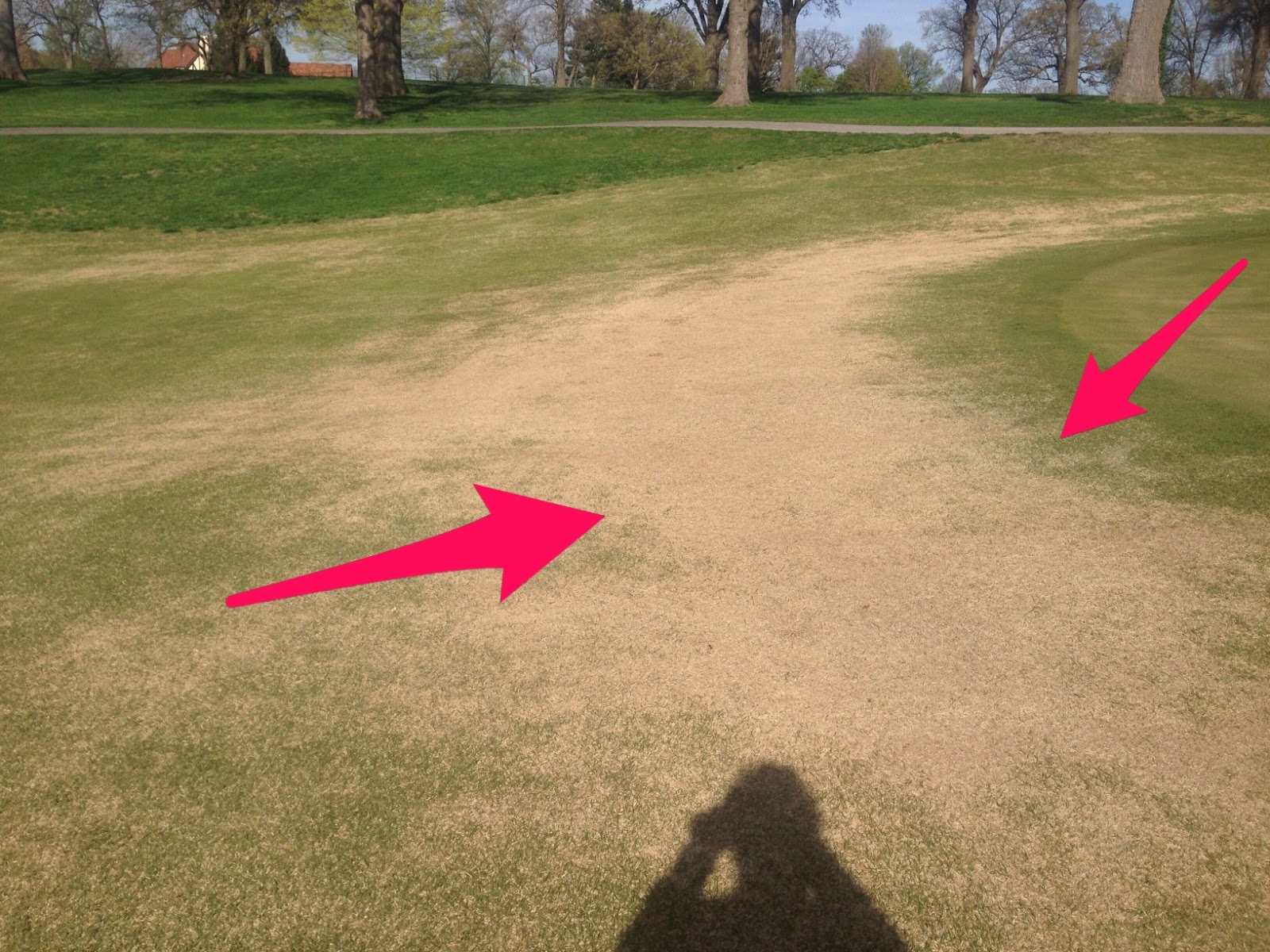
We've greened up nicely is many areas of our fairways but we do have some noticeable weakness in heavier trafficked areas such as approaches, shaded areas, north facing areas etc. There are a number of things that could be attributed to causing these issues. We talk mostly about the good and the work that takes place, every once in a while I have to talk about some bad.

I made the fall application like we normally do with our Bermuda reduction material. We were pretty dry in the fall which the Zoysia was under a bit more stress than normal. Of course going dormant, is a bit stressful as well. We normally come out of winter a bit more delayed than normal because of this spary material. The zoysia is tolerant to it but it can tinge it a little.

With the milder than normal temperatures this winter, our warm season turf staying in dormancy for our RoundUp application in February was a bit of concern. We do spray at the near lightest rate which is effective at killing the poa annua and not damaging the zoysia. The areas most effected, high traffic areas like approaches are a little thinner in dormant turf cover and more chemical material could have gotten down into the canopy and affected live tissue. We have pulled a couple of plugs and placed them in the greenhouse to see if they will green up in the next 10-14 days. If they do, we will be fine. If not, we might have to replace the approach area on a couple of holes.

The issue we are facing could have also been the 15-17 degree low temperature we had a few weeks ago when the plants were just greening up and were very susceptible to freeze damage.

Or it could have been a perfect combination of the 3 things happening all at the same time, weaker zoysia from the fall, just a bit more green up than normal in February and the cold temperatures after the early breakout of temperatures.

We will have a better feel about what is happening over the next couple of weeks. I think a majority of the spots will be fine. One thing I'm probably sure of is the Bermuda got its butt kicked as well.

Greens aeration was completed in 2 days by the guys. Looks good overall. Last major aeration work of the season besides monthly needle tining and maybe a hydrojet application in mid-summer.


# 1 green approach. This is about the width that I sprayed last fall with the Bermuda control product. Its also the width of the area sprayed in February. This also coincides with the turning area of the mowers and rollers which creates excessive wear in this area.

#2 looking across from left to right into front of the green.  Same as #1.

This is an area along #15 we always have issues with. Narrow band of area that is emersed in deep shade for  many hours of the day plus heavy cart traffic due to balls ending up on the down slope of the fairway. I did not spray this area last fall because of the weakness of the turf. Still having issues. Recommendation has been to remove at least 1/2 the trees in this area to allow more sunlight. It is also facing to the east southeast which is not a good situation for warm season turf growth.

Plugs pulled from the approach. Looks pretty weak. There appears to be life down in the stolen area but we will see for sure in 10-14 days.
2 green after aeration

2 green canopy. Holes filled.