Sunday, April 19, 2020

Extra Cart Traffic

With concern for our members and guests health during this difficult time, the use of single cart riders has been recommended for non-household related players. With an increase in total carts being used, additional wear and tear is occurring on various areas of the course.

There are a few tips I would like to remind those using carts which will assist in reducing wear and tear to our zoysia turf which is coming out of dormancy and is not actively growing. I made a video 6 years ago which will explain the pattern cart operators should use to protect our playing surfaces.

Also a reminder that there is a green post positioned 20-30 yards from the green which directs all carts to go back to the cart path. This improves turf quality on our approaches and reduces traffic away from our green surrounds.

https://m.youtube.com/watch?v=D7xEFr4GGYU


Carts should enter the fairway perpendicular to the fairway. This not only
reduces wear and tear on our rough grass before the fairway but also reduces traffic
on our zoysia fairways. It also improves the aesthetics and overall look of the course.
This is a picture at the bottom of #3 but translates to all cart path to fairway access areas.


Friday, April 3, 2020

Oops I Did It Again


No, we aren't talking Britney Spears here ladies and gentlemen, we are talking about millions of holes in our golf greens at Glen Echo CC for a second time in 7 days!!


We completed our Dry-Ject contracted service on March 23rd and we spent parts of 4 days this week doing our Verti-drain Deep-tined Aeration. Our process includes the following:

  • Burying each green with about a ton of sand
  • Then using our Verti-drain deep-tined aerator with 1/2" tines going about 8" deep into our green profile
  • We then blow the sand into the holes
  • Brush the green with a drag brush behind a cart
  • And Roll the greens
This work assists our .125" tall bentgrass (30 pieces of copy paper tall) in a number of ways:
  1. Deep channels assists water to move through the green profile. 
  2. It creates channels for new roots to form and grow.
  3. Oxygen moves into the subsurface assisting root growth and soil microbiology
  4. Reduces excessive thatch which can make a green spongy and be susceptible to foot traffic during wet conditions
  5. The additional sand assists in protecting crowns which is the growth center of the plants where roots grow down and leaf shoots grow up. The sand also assists in filling blemishes, ball mark holes and improves ball roll out

                                      
                                                 Skip topdressing our greens with sand


Russ deep-tine aerating our greens


It didn't happen if you don't show it in SLOOOOWWWMOOOOOOOO


Tom blowing sand in holes. We also use backpack blowers in tight areas.

 Pretty much the finished product. We've brushed and rolled the greens a couple more times this week which assists in spreading the heavier pockets of sand around the green surface. We expect the greens to be completely healed over the next 10-14 days. Work took about 150 man hours to complete.

Tree Management Plan includes removing dead and or dying trees throughout the season. It also includes a few planted when needed. Staff installed 3 trees on the right side of #9 red tee toward the fence line on 9. These trees were grown in our nursery over the last few years and we then transplanted them. From left to right, Black Gum, European Hornbeam and Yellowwood to replace the Carrico tree which died over the winter.

Skip mowing fairways for the first time. Not a real tight mow and used an old set of reals since there is so much small debris on the fairways. We blew and hand picked up as much as we could. This got a little bit of the winter fluff off of them. 

Friday, March 27, 2020

Sand, Holes, More Sand, More Holes and Project Updates

During this most difficult time, your grounds staff is preparing the course for what we hope will be some normalcy in the future. Our seasonal/summer staff will not be added until our club is back in full operation. We are lucky that our staff on hand including managers has over 175 years experience in working courses with a majority of that being at Glen Echo.

As weather improves, we will be finishing the project that was started last fall which includes zoysia around the back of 5 green and grassing the 6th green complex with zoysia. This funding is provided through the foundation and has already been allocated for this project from 2019. We hope to have the tee open sometime around May 1st if the weather cooperates. I would expect to have the sod completed around the greens by May as well.

We had initially planned to renovate the 4th and 12th tee complex but under the current situation it was determined to postpone this project. We have not determined a new date but it will be no earlier than October 1st since member guest is at the end of September. 

This past Monday, the staff was involved with our contracting company @DryjectofTennessee to aerate our greens. Our spring process involves the Dry-ject system which shoots a stream of water and sand at 3,000 psi into our greens staring from the surface and ending about 5" into the existing sand profile

Out staff’s involvement was to load 5 gallon buckets of dry sand into the aeration machine hopper. We used about 30 tons of sand. That is too many buckets of sand to count over the 10 hour period the operation took to complete. We also brushed the greens once they dried and they were rolled the next day since we ran out of time.

Hopper area where kiln dried sand is dumped. Sand is released through the holes and is then injected down into the green.

Chad Gamble, owner operator. Been a tough season for his business with cancellations beginning to fill his phone from our existing health crisis.

We hope to do a deep tine aeration of our greens early next week. This will consist of the green being covered in sand and then a half inch tine will push through the green surface to about 8” of depth.Our greens do not have modern drainage and must drain through our 4-6" sand profile and through the holes that are filled with sand. Deep tine aeration has been a life savor for our greens assisting in water removal from surfaces. Modern green architecture consists of an elaborate drainage system consisting of 10-12" of sand, gravel and drain tile. Our 9th green is the only one on property with this type of system.

The staff have been replacing damaged heads around our greens. The new system has been in the ground now for 13 seasons. Mowers and equipment going over top of them break the outer top casing which can effect the way the head operates. Our mower can also catch the corner of the head and damage it further.
You can see this head is missing almost 1/2 of the top part of the casing which rests on the soil/sod surface.


Russ working on a head at the corner of 4 green. Jason was involved in this production as well. Hopefully will be finished today.


Thursday, February 6, 2020

Weather Stats for December/January

Temperatures were above normal for December and January. Day temperatures were way above in December
and night temperatures were way above for January. Below in rainfall and average in snowfall
for December with January having higher than normal rainfall and snowfall about normal.                                          

TEMPERATURE (F)
                                  Normal          Depart           Last 
            OBSERVED VALUE        Value            From            Year
                                                  Normal 
              DEC    JAN        DEC   JAN       DEC    JAN       DEC   JAN              
AVG. MAXIMUM 49.5    42.5      42.5   39.9      7.0    2.6      47.4  38.5
AVG. MINIMUM 30.0    28.8      26.9   23.7      3.1    5.1      30.5  22.9
MEAN         39.7    35.7      34.7   31.8      5.0    3.9      39.0  30.7

PRECIPITATION (INCHES)
             1.86    6.49      2.84  2.40      -0.98  4.09      3.98  2.93

SNOWFALL (INCHES)
TOTALS        5.1    4.9       4.4    5.6        0.0  -0.7       1.7   12.5
SINCE 7/1     6.6    11.5      5.1    10.7       1.5   0.8       6.9   19.4


...DECEMBER MONTHLY Records

TIED 10TH MOST OCCURRENCES WITH A HIGH TEMPERATURE GREATER THAN OR
EQUAL TO 60 DEGREES (7 DAYS).

...DAILY...

RECORD SNOWFALL OF 2.4 INCHES SET ON 12/16. PREVIOUS 1.8 SET IN 2000.


...JANUARY MONTHLY RECORDS...

6TH WETTEST JANUARY ON RECORD (6.49 INCHES).

TIED 2ND MOST OCCURRENCES WITH AT LEAST ONE HALF INCH OF PRECIPITATION
(5 DAYS).


...DAILY...

RECORD PRECIPITATION VALUE OF 2.16 INCHES SET ON 01/10. PREVIOUS 2.09 IN 1975.

Saturday, February 1, 2020

Tree Management 2020


I put together some pictures of trees removed in the last couple of weeks. The pictures were from November 2018 that I prepared for the green committee. It helped them locate the trees I was identifying for removal.

Most of these trees were set back from fairways, greens and tees. They reached the end of their life and needed to be removed. There are some members who want trees to have no leaves on them before they are removed. There are groups of members that when they see a tree not looking good or weakened would like to see it removed. I try to fall somewhere in the middle, not completely dead so not to be dangerous for staff and members but delay the inevitable if there is still some decent life. Everyone has an opinion right. A large tree removal is at least a 2-3 day process. 


Tree on the left is a magnificent oak that we've watched drop its leaves early the last 3 seasons.
In 2019 it barely went to leaf. It was time for it to go. The tree on the right is just below the first tree on the left as you go down to 10 bridge. It should have been removed in winter of 2019 but was not. It was time for it to be removed. The loss of these 2 trees will allow us to place one new tree in an area between the trees in the future. If we are not able to get accomplished before spring it will happen next fall/winter.


The 3 large oaks on the right of #12 from 100 yards to the green are all under some significant stress. Probably all 3 planted around the same time. The top tree near 13 tee and 12 green has a tremendous amount of suckers growing on it and had severe leaf drop both this season and last. It was determined to remove this year and hope that the other delay their decline. There are two oaks that have been in the ground below and behind them that will grow to help fill in the void once the other two trees leave.


Picture of the oak next to the spillway on 13. It is before the start of the fairway on 13 and there are trees between it and 15 fairway to the left. Look at the reddish leaves from the oak behind help determine its health a year and two months ago. 


 This is an oak yet to be removed that will be removed this winter. It is in a clump of oaks behind 17 green and next to 16 fairway. We have another oak just like this one between 3 and 12 in the line of oaks at about 160 yards out on 12 in the same condition. Not much left, vulnerable to wind damage and or falling over at any time. Time to go sorry to say. Actually their loss will help other more crowded trees improve their spread.


A Siberian elm along the lake on 10 will be removed. We have 2 large sycamore that will be coming down as well. 1 along the main road near number 8. It is right on top of the road and has shown severe stress over the last couple of years as well as another sycamore next to 9 cart path in the club lawn will be dropped by the staff. We've watch trees for years go into decline, that is part of what I do. Most of our largest trees we contract out the topping of the tree and then drop the rest with our staff and clean up the larger limbs that cannot be chipped. 


This oak had the dead wood pruned back in the winter of 2019 after this picture. You can see its weakness versus the oak to its right of the same species. We do not have the resources to continuously prune back large sections of deadwood. Once a tree has gone so far, its put on our list for removal.


There are only a hand full of courses in town that have some of the same aged trees as Glen Echo. Sunset, Norwood and Algonquin but most of those facilities have been involved in some significant removals as have most of the newer built clubs in town. 

There is no doubt trees are beautiful when placed in the correct location, the proper species and the proper number. Trees like many of ours have a life span that is nearing their end. We continue to evaluate the need for trees but I am not in any hurry to over plant which is what has taken place in our past and we now must work around. A tremendous amount of resources are spent caring for trees and the effects they have on our turf grass that try to survive in their shadow. Fuel, water, fertilizer and many many man hours are spent tending to what trees do to our landscape. 


Friday, January 31, 2020

Winter Play, Trees. and Sap, lots of Sap

We have not had many desirable golf days over the last few weeks. Warmer weather is predicted this weekend but we will remain closed through Saturday due to our greens being in various stages of thawing. Our greens should be thawed at least 3-4" before we allow play.

A couple things can happen with partially frozen greens. As you step on the surface of the green where the freeze/thaw line is very shallow, the green surface can shift or move as you take steps and the roots can tear at the demarcation line between thawed and frozen. This then forces the plants to use significant energy to grow back their to their full length into the late spring and early summer not allowing it to store energy reserves for the dreaded heat of summer. Also, the freeze line being too high will not allow moisture to drain deeper into the sand profile. The water trapped near the surface will make the surface act like a wet sponge. Foot imprinting will increase and plant tissue can be damaged from the extra soft conditions.

We understand the desire of members wanting to play but allowing a few golfers out when they should not be out could contribute to the loss of turf during the main golf season. I made a video below explaining our current situation. 
https://www.youtube.com/watch?v=xQ63T6vpHDg


Also in the video, I discussed our tree management plan that is taking place this winter. In the fall of 2018, I made a power point for the green committee regarding our plan for the next year or two. I put together a 3-4 minute power point showing the trees I was recommending for removal. We removed a number of the trees on approval from the committee but were not able to complete all of the removals due to time. I also felt like a few of the trees could go another year before removal so we delayed their removal to this winter. Through an arrangement that has worked well for us, we were able to get 2 more days of tree removal this winter than planned. The trees that were left from the year before declined significantly over the past year and needed to be removed. Many of our trees were planted in the 50's and 60's and are beginning to show some serious decline. Changes in climate over the last 10-15 years have not helped and has led to decline as they have aged. Record temperatures and high rainfall record years are the types of swings that don't help an aged tree population Pest issues including insects and disease along with lightning strikes and wind damage have been contributing factors as well.

I have also requested a number of tree removals over the last 11 years to improve tee and green turf. Our greens and tees have no infrastructure to assist in combating serious environmental issues. We have 1 green with modern drainage, the others only have a layer of topdressing sand that has helped us but is not adequate during severe wet conditions and heat.

Also, during the next couple of weeks you will see a few orange buckets hanging from our maple trees. Yes, yes, its time to start collecting maple sap to make some homemade Glen Echo Maple Syrup. Not sure what type of year we will have but if today's run is any indication, it might be pretty good. This next couple of warm days might slow down the production but next week with 30's and 20's should help us with our run. We need overnight temperatures below freezing and daytime temperatures to be above freezing to help the tree flow its sap properly for our collection. 43 gallons of sap to make 1 gallon of syrup!

https://www.youtube.com/watch?v=bL8jQBIKqrI

As your fairways, tees and zoysia green surround areas dry over the next week our two, we will begin spraying non-selective weed control and pre-emergent to our fairways. You will notice a little blue tint to the fairways which assists us in seeing the area we have sprayed to reduce over spray.  It will take the poa 2-4 weeks to begin to turn yellow, orange and then die. The pre-emergent will reduce the germination of crabgrass and goose grass in our zoysia surfaces.


Monday, January 27, 2020

Maintenance Storm Drain Repair

It’s been a couple weeks and a couple of days of a major storm water repair project for the grounds staff at Glen Echo. A 3’diameter galvanized pipe gathers water from about 30 acres above the grounds maintenance building and dumps it into the right side creek just past the red tee on #1. The pipe was 220 feet long and runs within about 5-10’ from our maintenance building, under our car parking area, driveway and greenhouse. It sits at a depth of 5 feet at the beginning to about 12’ as it dumps into the creek. We’ve evacuated well over 100 tons of soil, rock and asphalt as we prepared the new pipe channel.

We have the pipe installed and are 2/3 of the way in getting the pipe completely buried. We still have some large debris piles in our parking area that will be moved to the long driving range back lot area.
Over the month of February, we have to get the greenhouse vase pad made and build the greenhouse against the building as we prepare for the new growing season of landscape plants. They will arrive by the 1st of March.

Sinkhole in the greenhouse 
Bottom 1/3 of pipe was rotted out. Galvanized pipe is guaranteed to last 25 years according to manufacturer’s. This pipe was in the ground for over 50 years


Greenhouse being removed. Greenhouse was built against the building for sunlight maximization, utilization of existing heat source and electricity.


We actually used a walk behind asphalt cutter since we had to cut 440’ of asphalt.


Our initial dig hole to locate our problem. Pipe rotted out at bottom was the verdict.


Guys digging and chipping out old pipe from headwall and enlarging opening for new pipe.


Began project with our backhoe digging the more shallow end to save time when large unit arrived.


Big rig digging.


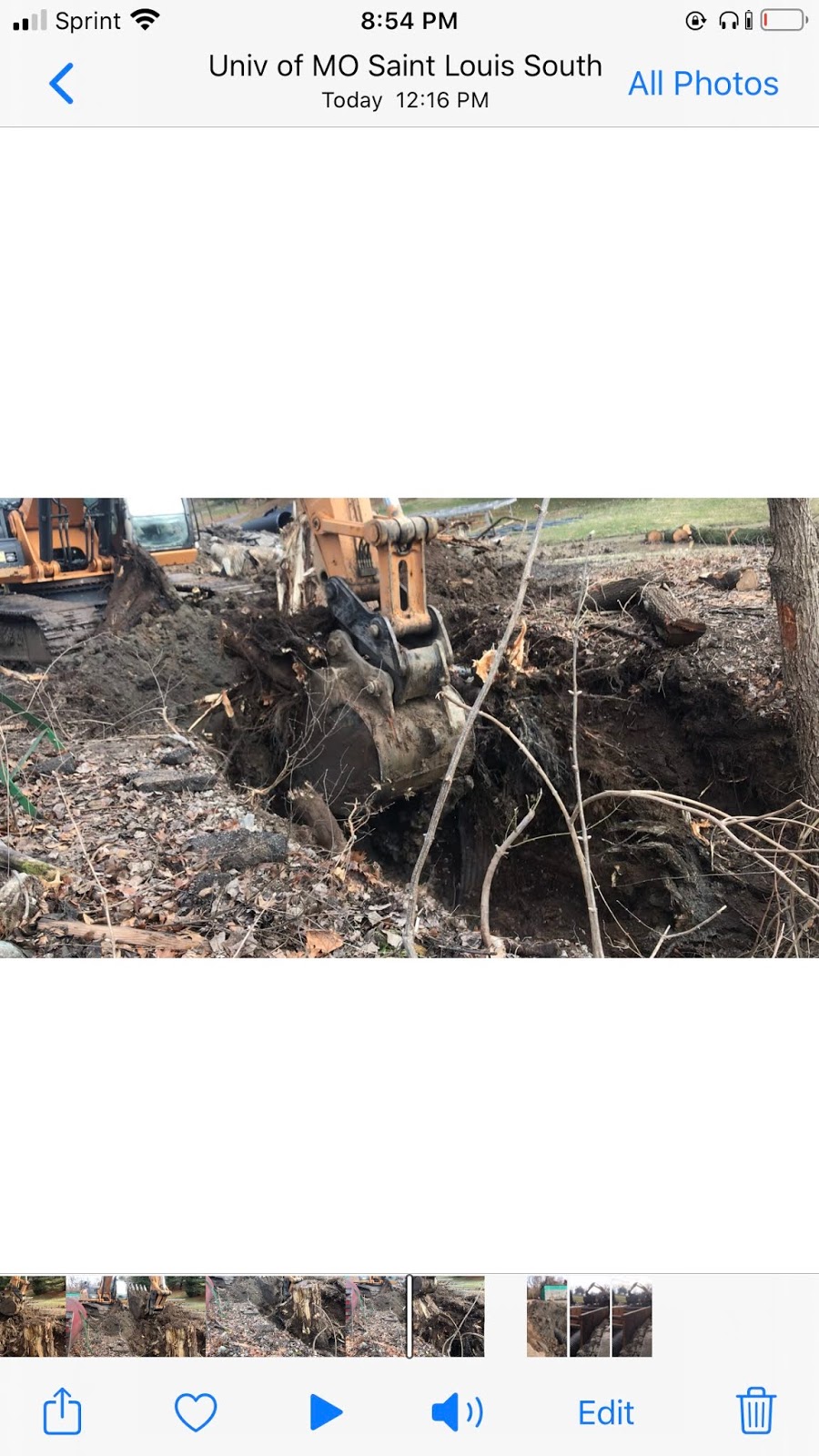
Rented trackhoe in action working on the large tree root wad.


Large tree root wad at end of pipe that had to be removed. Took Skip over 8 minutes to dig out the remaining stump with the very large trackhoe that was rented

Pipe remnants after being dug out.


We attempted to reduce the total width of the dig but many sections along the building collapsed during the  work on the project.


Soil remnants that will be stored for future use in the back of the range.

Gravel used to help backfill the pipe. Most of this material was used and  recycled from the MSD project that was done along the metro link tracks and 1 fwy in 2012