Showing posts with label warm season grass. Show all posts

Thursday, May 13, 2021

Yep its Weather, Getting Dirty/TIlling Deep, Zoning Out, and Early Range Shutdowns


 Its been a while since I've made a blog post. If you follow me on other forms of social media you've seen a regular plate full of details regarding the work our hard working staff are accomplishing on a daily basis.

Weather

First and foremost, lets talk about the weather, especially the colder than normal temperatures we have experienced in late April and May. The average temperatures in April were a couple degrees above last season. Now, May 2021 is a different story. We are currently 8 degrees behind average in both daylight highs and night lows. Last May we were actually a degree above normal. More importantly, our soil temperatures have dropped since the first of May to 63 degrees.

Soil temperatures at this level are excellent for our rough grass(cool season) and greens. Our bent grass likes temperatures to be slightly warmer, especially at night but they are in full production of energy which contributes to root growth and adds to storage within the plants. 

It is most difficult for our dominant short grass zoysia, especially our tees and areas of fairways with heavier cart traffic and additional shade. We've cleaned up our zoysia mowing only weekly at this time due to the lack of growth. Some of our weaker areas we will keep the mowers away completely. It appears we might begin to see some increases in heat over the weekend and into next week. We can't force the plants to grow. The systems within the plant currently are slowed because there is not enough energy to produce growth.

It is very important during this time that membership operating carts reduce traffic in fairways as much as possible. Using a 90 degree angle from the cart path to your ball in the fairway reduces traffic in the fairway. Once the ball is struck, move the cart back to the rough and cart path when possible and proceed to where you ball is located. We are still seeing a tremendous amount of traffic going from the teeing ground area directly through the rough off of the tee and into the fairways and then driving another 50 to 100 yards down the fairway. Your assistance is greatly appreciated to reduce this type of activity.

Soil and Sod 

Stumps from a few trees removed were ground a few weeks ago, remnants cleaned out and this past week they will filled with soil. Yesterday and today, our staff edged the existing filled areas and laid sod to cover the spots. Six in total were cleaned up. Our contractor will be out in the next couple of weeks to grind the remaining stumps that we have on property so we can get them cleaned and covered for the summer.

Sycamore and Sweegum that were in the club lawn to the right of 9 cart path were covered with sod. Also, 9 tee, a pine tree in the club lawn and in the triangle between 5/7/main drive. 

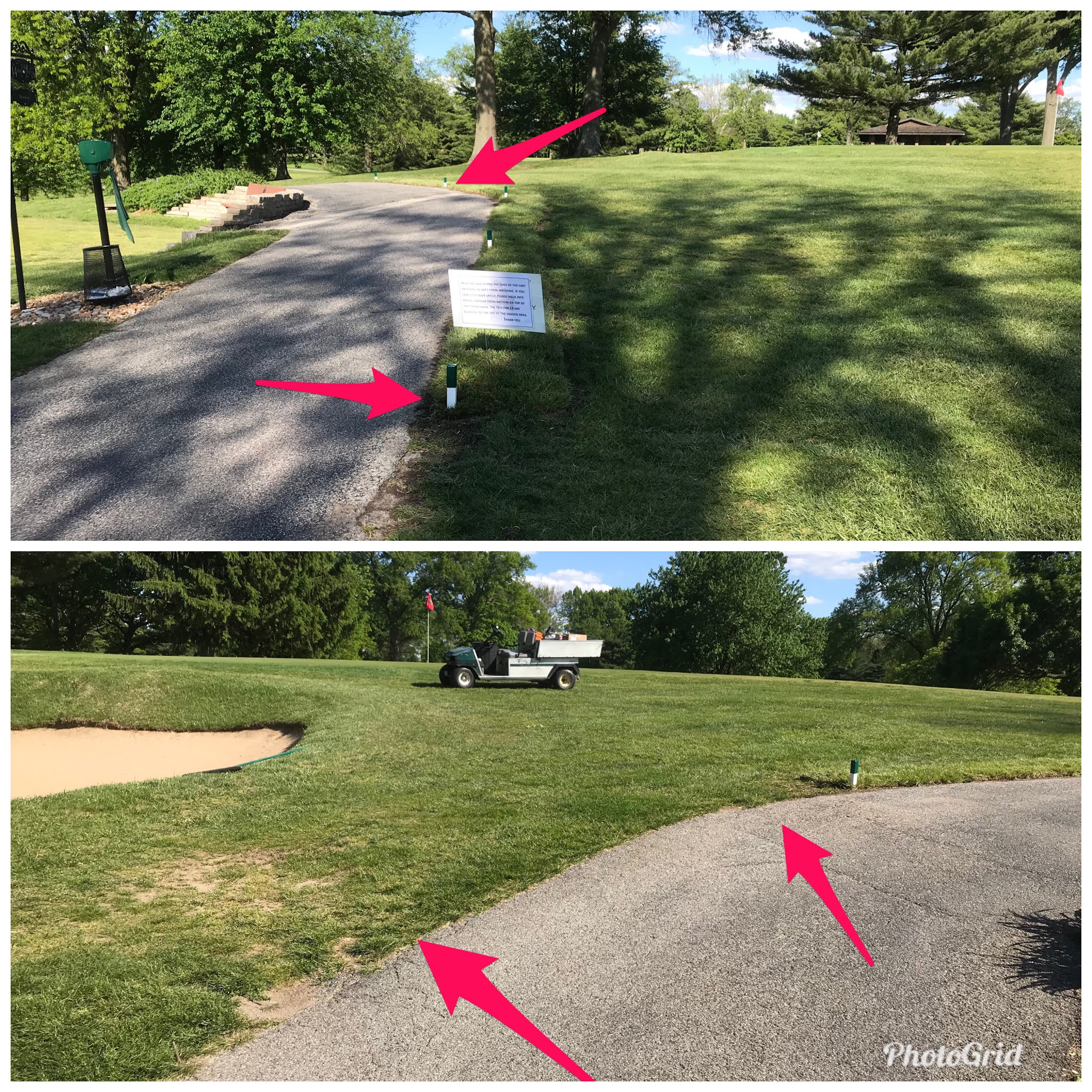
Some additional soil work was completed along some seriously compacted cart path edges behind 11, green, at 13 green and at the curve just short of 15 green by the 16th tee. We used a heavy duty tiller going as deep as 6-8". We added some black gold compost from St.Louis composting and covered with fescue sod. These areas will be kept very moist over the next week or two so it is important that we do not step into the 20" width of sod that are next to the path. Access to the green areas are still available at the top end of these renovated areas.

https://www.youtube.com/watch?v=No8JNhqkE78


From the 11th cart path going up the hill to 12 tee. We have this section roped off and are asking cart to proceed to the top of the hill at the circle turn for the 12th tee to enter the 11th green complex. This area has been very problematic because of the severe slope and the large Pin Oak that keeps this area  depleted from moisture and into heavy shade. Hopefully this extra work will finally keep this area in better shape.

This area leads up to 13 green. We tilled from just above the left tee up to the top of the hill in the bottom picture. You can access the green from below or above the section. Some can step across the sod without issue but please be reminded this area will be kept wet for a week or two to help it root properly. We will also keep the tees up on the upper tee of 14 for a week or more so more the reason to pull up to the top of the sodded area.


No pictures of 15 but this area will be roped off and will be obvious for our golfers. Carts can stop short of this area and or proceed to the circle for 15 green/16 tee.

Drop Zones

We have one established drop zone at the club which is the red teeing area of hole 9. As play has increased, so has the wear and tear to this teeing ground. It is also a fairly small tee with an extension that was added a few years ago that frankly speaking needs to be renovated. Teeing grounds are not the best locations for these drop zones so a couple of changes will be occurring over the next couple of months. 

On hole 9, we have rough graded in a new drop area beside the 9th red tee. We will be covering this with zoysia over the next week. Later this summer,(after July 4th, we intend to close the red tee and blue tee on #9. We will strip the sod from the tees, enlarge the red tee forward, to the right and a little off the back. We also will strip the blue tee and will extend its teeing ground to the right. We anticipate these tees will be ready for play by August 1st with the heat of the summer pushing a quick grow-in. In the meantime, we will utilize the new drop zone for the red tee/drop zone and the white tee will have the blue tee added.

New drop area to the right of 9 red tee. We still have some work to complete on the slopes and some leveling but its roughed in. We anticipate the red tee to split the different between the existing tee and the new drop zone.


The golf committee and green committee has been in discussion regarding a potential drop area to be established for the 15th hole. We will be placing a drop zone about 35' from the cart path about 10' from the Egan's Lake. It will be mowed at a reduced height of cut and a circle designating the area will be put in place. 

Driving Ranges

There are signs at each driving range that mention the range will be closed early on Thursdays. This must occur so that all balls can be removed by the pro shop staff and readied for our staff to mow before the first golfers whom arrive on Friday morning at 7 am. This program is usually implemented in late April and runs into June and or until the grass begins to slow its growth. Its important that the grass be cut twice a week so staff can see the balls and remove them so they are not chopped up by the mowers. 

On event day Mondays, our staff usually picks the ranges clean and mows after the groups begin play. The pro shop staff assists us with as much removal before dark on Sunday evenings. We do not close the ranges early on Sundays so our membership are not inconvenienced by our necessary operations. We appreciate your understanding during this time.


I hope you get a chance to get out and see your golf course over the next couple of weeks. Ball roll out has been pretty good I hear and hopefully the rain starts falling at night and leaves our weekends free to play golf.


Monday, October 7, 2019

Winter 2020 Spring Course Preparations

Yes, the W word is coming soon as is next spring's golf season. The calendar continues to turn as are making our preparations for winter and next season.

We've been doing a number of things to prepare our warm season turf for winter dormancy.  We apply Sulfate of Potash to our tees and fairways(Zoysia Turf) to assist it with winter hardiness. We also begin raising our height of cut and reduce our mowing schedules to once a week. As the temperatures continue to cool over the next couple of weeks, will eliminate fairway mowing for the season.

Greens aeration is scheduled for October 21st unless we get rained out. Our rain date will then move to the 28th. This will be a solid deep tine aeration that we normally do every fall to a depth of about 8" or so and fill the holes with sand.

We will be spraying our close rough with a couple of light applications of Nitrogen to build up strength in our cool season rough before dormancy in late November/December to allow the plants to strengthen and come out healthy next spring.

Of course our leaf grinding and removal will be taking place over the next month to 6 weeks as necessary. We attempt to grind up as many leaves as possible back into our turf but once the supply exceeds our ability of the grass to handle an overload of leaves, we will vacuum/sweep 20 loads or more and haul them back into our dump area on the back of the range.

Its great weather over the next couple weeks as we continue to work on the course. Greens are rolling out well and course is in great shape. Come out and see us before winter catch up to us?

Saturday, June 22, 2019

Blues, Stimulation, and Getting Tight


What a whirlwind the last two months have been if you are a sports fan in our fair city. Great run for our St. Louis Blues as Pierre Laclede can attest outside city hall last weekend!!! #LGB

Speaking of stimulation which our Blues did plenty, we have finally been turning to the good side of weather over the last few weeks even though Friday and Saturday have been wash outs for the most part.

Glen Echo is a warm season golf course. Our largest area of fine mowed turf are our fairways and tees which account for almost 30 acres of warm season grass, mostly zoysia. The bermuda grass which I have a love/hate relationship with is required to help round out our course and fill in where we have voids in cool season fescue, poa annua and bent grass which invades our rough. The long cold winter has slowed its emergence in higher traffic areas but warmer temperatures are beginning to help it fill in where we need it.

There were enough gaps in the rain during Stanley Cup winning week so we could apply fertilizer on the fairways/approaches which will improve green up and also begin to help the turf fill in as needed. Most areas where we have needed to replace turf in fairways occurred from some of our bermuda eradication work last fall and some winter kill of both bermuda and a little zoysia. Also we experienced a few thin areas in north to east facing slopes 10 and 12 approach and also from excessive shaded conditions.We still have a few more places to do some sod patching on fairways, intermediate, and a few green approaches and surrounds. As temperatures increase which increases soil temperatures, this will also speed up growth of our warm season grasses. We did modest fertilizer application around the greens to improve fill in of the bermuda and give the cool season turf just a bit of energy to fight through the rest of the summer. We will do some additional spray-able and granular apps along weaker fairways and around all fairways in the first pass of the rough.  This will improve color and thicken the rough for the summer. Oh joy he's going make the rough rougher, yes, yes I am.

I think overall our rough is about in the best shape I can remember since arriving in August of 2008. Still fighting some weeds in various parts but are getting some good kill throughout the property. applications.


We had hoped to begin aerating fairways on Monday but it appears we will be too wet. We will try next Monday on our closed day which allows us to get a full day in. We will also do some individual fairways this upcoming week if we begin to dry down.The fairway aeration program should improve the turf in a number of ways:
  1. Reduce thatch through increased microbial soil activity
  2. Increase water penetration and drying down in wetter areas
  3. Assist with disease management including fairy ring
  4. Stimulate turf growth
  5. Reduce compaction in our fairways soil
  6. Breaking of the cores will help to fill in small imperfections in  surface areas.
Russ mowing 2 fairway.
From behind #2 green

The course continues to tighten and improve as we work our way into the first week of summer. Tree trimming, tree removal, sodding, aeration, and just general clean up of all areas are ongoing 

 I've included a Countdown Timer on the main page of the blog for the upcoming Invitational Member/Guest coming up in July. Amazing to think we are less than 30 days away from this great event.

Thursday, March 21, 2019

Collar/Approach Renovation and Bunker Work

The staff has had busy week. We removed the false front bent grass approach on #10 and used the bent for collar repairs on holes 3, 4, 5, 6, 18 and the practice green. Over the last few years we have been converting these approaches to zoysia grass.  There are a number of reasons that this is being done:

  • Less chemical applications since the approaches are now zoysia. This will reduce our overall chemical use which is good for the environment.
  • Zoysia requires less water which will make the approaches more firm and allows the ball to release forward onto the green instead of hitting the more heavily watered bent grass approach and stopping.
  • Our collars are mowed with a walk mower which takes more time to mow than the riding mower we can use on the approaches. We have converted them to a single pass mow which reduces labor which can used on other areas of the course. 
We still have larger approaches on 7, 13, and 15 that will be completed over the next couple of weeks. We reduced the size of 2 and 11 a few years ago but they are still larger than the single lap collars we have converted. We will attempt to remove these if time allows. If we run out of time, they will be worked on this fall.
Laying zoysia sod on 10 approach. This sod was taken off of 2 tee and used for this new approach. Saved operation a full pallet of sod which costs about $ 300 including delivery costs. It does take extra effort to do it this way with cutting the sod, lifting it and laying it but its great to use turf in another area.

Staff continue to lay more sod on 10.

This is a before with the old bent grass being stripped off by the sod cutter.Tom is cutting the bent grass sod into pieces so it could used again on damaged collars.

Staff in front of 3 green on the collar removing bermuda infested and thin turf.

New bent grass sod in its place. We saved nearly 400 linear feet of bent grass to use on our collars.

The guys are finishing up the left side of #6 green collar.


This morning the staff began working on our bunkers. Currently they have completed edging and redistributing sand in bunkers on holes 1-8 and the 2 large bunkers on 7. We will attempt to get the rest by early next week. The work has included adding additional sand to each bunker as needed from checking depths. As a player, you should expect that the sand will be a little fluffy in the bunkers that have been worked. It will take some time for us to get the existing sand to be mixed in with the new sand. We will be taking our packing machine out after heavy rains to help firm up the surfaces over the spring season.

No, not a Fox digging holes. These are check holes to see the depth of sand in the bunker to determine if we need to add any sand to the bunker or distribute deep areas of sand to more shallow areas.
Bermuda grass the was removed from normally the lower side of each bunker. Over time the bunkers shirk in size due to this fast growing plant.
Sand waiting to be added to the bunker on #1.

Newly added sand being shoveled and raked on #1.

Completed bunker on the left of #6


Monday, July 20, 2015

Aeration and More Aeration

Spent a lot of time last week aerating playing surfaces at Glen Echo. Tees, approaches and finished up with the range tees this morning before the storms hit. Also used our rough aerator with slicing blades and did back 9 last week and almost got through number 5 when we had a weld break. Should finish that later this week when the repair is made. Videos below describing our work. Links attached for those who video does not come up on your screen.

https://youtu.be/cOabWGH0DiQ


Picking up cores on short range tee.

All hands hurrying before the storm hit on Long Range Tee.


https://youtu.be/tby1MegAbnU

Sunday, August 24, 2014

Fairway Bermuda Eradication Update(You can see it now)

Posted a video discussing the Fairway Bermuda Eradication program. Spray has taken effect and it does not take a trained eye to see that there is some things happening to the fairways in the areas that are sprayed. The zoysia is in good shape and the bermuda in the spots is struggling.

Friday, June 27, 2014

Details of Long Range Tee Turf Replacement

I sent out an email blast to the membership earlier in the afternoon giving  notice of our plans regarding the turf replacement for the long range tee.  The following information is some additional detail regarding changing this playing surface from Bermuda back to Zoysia which is the main fwy/tee surface.

There might be a couple of questions you might have regarding this project.  Why start this now?  A couple of reasons.  The Bermuda was damaged coming out of winter and is slow in responding.  Also, we need enough time to kill a majority of the Bermud and give the Zoysia a chance to root and grow before dormancy sets in.

Why not change ends of the range to the top.  A number of reasons I explained to my committee.  Cost would be much higher.  A dozer would be needed to move dirt and build targets.  Hitting balls down hill will increasing ball flight leading to more cost for balls and endangering my staff in our maintenance area.  I'm sure we would be required to put up a very large fence to protect the metro link trains from being hit.  Logistics of cart travel and walkers would be much more difficult and almost impossible.  Shall I list more?

As mentioned in the earlier email, our operating budget does not have the money to fund this project.  I had also stated the project would not be worth our time if we did not remove trees to improve turf conditions. 
My apologies in forgetting the estimated cost of $ 15,000 in the email.  Our staff will do all the work except laser-leveling the tee and some of the larger scale tree work will require some assistance.  No additional labor cost will be required. Like anything else we do extra on the course, we will schedule our regular work and plan our extra work accordingly.

The long range mats will be open as much as possible during the process.  The short range grass tee will remain open until dormancy so you have a place to warm up.

During the construction, I encourage everyone to stay off of the treated turf.  You could track chemicals back onto good turf surfaces such as the practice green from remnants of chemicals used to kill the Bermuda. We have 9 trees to remove on the east side of the tee.  One will die from a lightning strike that occurred a month ago and the other is a hazard tree we will be removing.  The trees shade parts of the teeing ground as late at 10 a.m. each morning.  We plan to keep the shorter scrub material along the creek to provide some separation between the first hole and the range tee but as trees continue to grow, they will be removed as they begin to create shade on the tee.  We will remove some trees along the creek bank on the west side of the tee as well.  These trees shade the tee from 3 p.m. on and reduces the total amount of sunlight to the turf.  We need a minimum of 8 hours of sun or more to have turf that can repair itself quickly enough as we rotate stations through the tee.  Additional sun equals a turf that dries quicker and can become playable that much sooner than the past wet, soggy turf that we have experienced on this tee. A drier tee surface also reduces damage from divots during practice time.   The work on the tee should get us almost two additional hitting stalls and we should have at least one more days's rotation from the very front of the tee.

The following is a general work plan for the project.
  •    Spray the tee with non-selective and selective herbicides. GECC staff
  •    Scalp and strip the remnants. GECC staff
  •    Cover the tee and attempt to grow the Bermuda again. GECC staff
  •    Spray herbicide application again.  This total process should take approximately 6-8 weeks.  Using     soil fumigant could shorten window but might require total shutdown of all weather tees on the long     range required by product label. GECC staff
  •    Install drainage in tee to improve the health of the zoysia and allow it to opened sooner after rain        events. GECC staff
  •    Adjust irrigation heads as necessary. GECC staff
  •   Till and Laser-level tee. Contractor.
  •   Install big roll zoysia.  GECC staff.
  •   Tree removal would be occur as needed.  Couple potential removals could be during winter season  but would need to evaluate.  Staff and contractor

·        The tee will not be ready for play until mid-May to the 1st of June 2015 depending upon completion date and grow in weather.

      As always, I will keep you informed of the activities as they happen.


Thursday, February 27, 2014

Update on warm season plugs

Eight days ago, I pulled some warm season plugs from three different types of warm season turf grass here on the property.  Old picture first, updated picture in the middle  plus a close up of the zoysia plug on the bottom.


2/20/14   Westwood bermuda, Meyer Zoysia, Patriot bermuda


2/28/14  Westwood bermuda, Meyer Zoysia, Patriot bermuda

The Westwood bermuda that was sprayed with Fusilade II is looking very rough.  The middle plug is Meyer Zoysia and the leaves are beginning to grow from the crown area of the plant.  The third plug is Patriot bermuda.  I cannot see any green up at this time in the Patriot but it normally is slow coming out in the spring.  
Close up of zoysia leaves emerging from the Meyer Zoysia plub.

Wednesday, August 21, 2013

#3 Red tee sodding

The right side of the 3rd red tee was a hodge podge of cool season grass and weeds.  It was stripped off yesterday and new zoysia sod was laid today.  Should match up much better with the rest of the tee.


Jeff and Randy sodding the right side of 3 red tee.
 

Tuesday, July 16, 2013

Warm season tee core aeration

We would have started our warm season core pulling aeration on Monday but the surfaces were too wet from Sunday night rainfall.  We are pulling a 1/2" core at about 2" in depth to reduce thatch on our tees with our verti-drain machine.  Not sure if we will be completely finished today with the heavy dew we are experiencing and avoiding disrupting any play that is taking place.  We are doing parts of combined tees or doing individuals tees to insure that you have a clean place to tee your ball from while we clean up the debris.  Once the area has been cleaned, we will then come back in and do the remaining tees as needed.   We will also use the same machine but will place a 1/2" solid tine on it which will give us a much deeper hole.  This will allow the tees to drain much quicker and will improve root health.  We also plan to topdress the tees with sand which will get into the holes and will assist in removing excess moisture from the tee surface.  It will smooth the teeing surface over time with additional applications.  They will be slightly drier on the surface because the sand will allow moisture to move into the profile quicker and will make for easier penetration of tees being placed in the ground.

See the video below for additional information.

Friday, May 10, 2013

Zoysia sod on approaches and next to bunkers

The zoysia sod we laid last fall as a part of the bunker project for the most part was dormant when it was placed on the ground.  It was green in most cases but did not have adequate enough time to set new roots  before winter.  That is what it is doing right now as the weather continues to warm.  Its spending most of its energy setting these roots in place and attempting to grow leaf blades from the mowing that we are doing to it on a weekly basis.   Neither are setting the world on fire with their growth.  The areas most effected are the approaches of #1, new catch area approach along #2 green, trench lines across fairways such as #7, and the new sod on #18 approach.  There are also some intermediate circles around the greens that were placed in zoysia as well.

Most of the sod we received has germinated some winter annuals, poa annua and other weeds.  Some of these weeds we have been able to mow out pretty well but some are requiring some light broadleaf weed control applications.  We have not been too aggressive with these sprays because the plants are still young and tender and are having difficulty in this cool, wet climate we have been experiencing   We will begin to add sand to the sod lines and topdress in the next week or so to improve the lies you are experiencing.  Remember, Rule 25-1 does give you relief from sod seams.  As the weather warms, the grass will grow up through the sand in the seams which will help to smooth out these areas.

Optimum soil temperatures for warm season grass to grow is usually about 75-85 degrees.  Right now we are in the upper 50's.  There is nothing that can be done to improve these conditions without increased soil temperatures which increases the growth production within the plant.  These temperatures also effect the established turf but not to the extent that it does new sod trying to establish.  Also, the lack of sunshine slows the plants processes down to a minimum.

Check out Dr. Lee Miller's report from University of Missouri regarding warm season grasses, soil temperatures and other pertinent information that effects the conditions of the turf that you are playing upon and that I am trying to manage at this time of year.

http://turfpath.missouri.edu/reports/update05_09_13.htm

Wednesday, June 20, 2012

One of our large area rough mowers had a large hydraulic hose leak at the right side bottom of the rough along #13.  The leak was enough that we need to remove the old sod and replace it with some sod that we had near the green nursery.  Usually, a narrow leak will heal itself pretty quickly and we will leave it alone but this leak was a foot wide or more in the area where it blew.  Even though I do not like to add bermuda back on the golf course, it is the only thing that could possibly survive being laid at this time of year.

Tom removing the sod at the bottom of #13.

Thursday, July 28, 2011

Warm season tee aeration

The staff worked on coring our warm season tees yesterday and should finish the remaining tees today.  This is helpful for a number of reasons:

  • Moisture will penetrate the tee more quickly during rain events allowing the tee to become more   playable in a shorter time and allow mowing to be completed.
  • Moisture can move into the root zone more quickly allow for a healthier plant and less water applied.
  • Small reservoirs are created by the aeration holes during rain events which help to move water off of the surface but then slowly moves into the root zone.  
  • Thatch removal occurs as well.
  • We will topdress in a few days which will help to fill the holes with sand which will improve overall drainage and firmness of the tee and smooths the surfaces.  This will also assist a player in placing the tee into the ground due to the softer condition created by not only the aeration hole but the sand application.   
We will be doing a deep solid tine aeration in the next few weeks as well which will help us with deeper drainage, especially in the winter reducing crown damage from lack of water being able to move away from the crown of the plants.  It will also make for better playing conditions for our winter golfers.

Tom Lewis using our Verti-drain to pull the cores.  The silver drag on the back helps pull a majority of the cores to the edge.


Pile of cores at the end of the tee ready for pick up.


Skip and Russ picking up the pile of cores for disposal.
Jeff dragging the remaining cores on the tee to break them and help work the remaining soil into the canopy.


Demarcus, Tom and Nick blowing the remnants of the cores off of the tee in preparation to be dry mowed today.


Tuesday, July 26, 2011

Green conditions and other turf concerns

Our greens have faced some difficult conditions over the last couple of weeks with what appears to be more to come in regards to hot weather.  We have gone two weeks without rain which good good during high heat because we can control the amount of water to our greens.  However, our greens have become consistently inconsistent throughout the profile.  There is plenty of moisture in the surface area but we are seeing less than adequate levels in the 3-4" area of the profile which makes for difficult management of our putting surfaces.  As mentioned in last weeks post, we are using all tactics to help get us through this most stressful period.  


11th green is definitely struggling with wet and dry issues.  Normally one of our wettest greens, we have struggled to get its moisture where it needs to be.

7th green with some stress but holding its own.


Our collars have taking a beating over the last week.  The green surrounds are beginning to pull water from these areas and we have reduced inputs to the green so there is less availability from these areas.  We have pounded them with water from our hoses but to no avail in some cases.  Hopefully, some of the turf has just gone dormant and is still alive in the crowns and will rejuvenate during some more normal weather.  Some areas that have taken the most beating have been the practice green, left side #16 and the front of #3.  All trouble spots from the past.

Our Zoysia/Bermuda tees are fantastic and some of our cool season tees are beginning their yearly struggle.  Drought stress or inadequate water distribution, disease and conditions just too hot for cool season tees(mixtures of poa, bent, rye and bluegrass) are just some of the issues we are facing.  Removal of a few trees, raising the teeing level and or modifying locations of these tees would be something that should take place in the near future.  Less water, no regular fungicide applications and great summer conditions are more the reason to remove these type of tees from the property.  We have enough space for the zoysia to survive the amount of play that we have on a yearly basis.  The first 20-30' of this tee is beautiful zoysia because it received enough sunlight to adequately grow a warm season grass.


Our cool season fescue green surrounds are holding their own right now.  They are stressed but doing okay.
The back of 10 green surround is a great example of how our fescue program is working.  You can see the line between the good fescue turf on the left side and the junk poa, bluegrass turf on the right.  This will be replaced in the future to improve the overall look and playability of this area.


Saturday, March 5, 2011

Dye around Greens

Anyone who came out and played over the last couple of days has seen some marker dye being used around our greens, fairways and tees.   I was completing the preemergent/roundup application in our warm season turf areas which controls in season goosegrass and crabgrass germination and will kill the poa annua that pops up in places.  The staff used a 4x8 sheet of wood to drag around the edge of the collars to protect our green/collar turf from any over spray as we drove around the collars.  We might have some small hand applications to spot treat over the next few days due to bunkers being too close to the green surface or the sprayer moved a little further out then planned.  We will be applying preemergent and weed killer to our cool season first cut rough toward the end of March/early April.

Green #16 complex and the marker dye which indicates to the operator where the plant protectant materials have been applied.  

Tuesday, August 17, 2010

Fairway aeration complete

Completed the last 4 fairways on Monday.    Still need to do the nursery but that will not effect play.  Speaking of the nursery.  Last year's zoysia sod that was removed has filled back in completely.  I would think the area will be able to be used again after next season.  Most sod farms return their removed areas back into harvest by the second year.  Our process is slightly slower than our sod producers. 

Coming out of winter we were concerned about our zoysia and yes bermuda but it has been the best season in a long time for warm season turf.  The tees and fairways have been pretty spectacular since the 4th of July.

Sunday, June 13, 2010

Fairway sod work

Beginning repairs on some zoysia areas of fairways.  Some of these areas have been killed by our bermuda eradication program and some of the spots in low drainage areas were damaged during the winter.
We will probably do a couple of fairway spots each week where we have damage.  #3, 4, 5, 7, 8, 10,12,15.

An area on the right side of #13 intermediate that has died from our spray program.  We ran the sod cutter through the dead material.  The dead material in shoveled into a cart and hauled away.  Sod is cut from our range nursery and laid in the area.  The sod is watered heavily for a few days and we mark it as ground under repair with a white circle to alert our equipment operators and golf cart drivers of the location of the various repaired spots.  It will take about 10 days or so for the sod begin to heal and the roots to become active.  We then do some topdressing of the areas and fill the cracks in the sod with sand to improve playability and help the sod to fill in much faster.   
The picture below is on the left side of #13.  Pictured is our beast of a sod cutter.
I can't forget the cameo shot of 'Lady' every once in a while.
The completed removal of the old, dead material and laying of the new sod.
The single line of sod we did not put rope and stakes up but the double or triple row we put up some rope to protect the sod from being driven on or carts turning on the sod which can pull it up.

Wednesday, June 9, 2010

Zoysia tee repair

The staff replaced the damaged zoysia sod from the blue tees on holes #6 and #12 yesterday.  The damaged areas were stripped out with and sod cutter and sod was cut from our zoysia sod nursery between hole #16/10.   Assistant Skip, Russ and Tom L. began the job and Assistant Mike, Tom M. and Arian jumped in and helped finish the job before the rain set in at noon.

The left side of the 6th tee.


The view looking back the other direction.
Tom M. is preparing to fill the cracks of the  sod with green sand.  We stripped in a small section on #4 tee as well which had some damage as well.                                                                  
Nick is beginning to fill the cracks in the new sod on #12 blue tee with green sand. The sand helps the turf hold its moisture along the seams and allows the turf to grow through the sand and speeds up the recovery of the turf and helps to make the playing surface smooth.