Showing posts with label Trees. Show all posts

Friday, November 13, 2020

Progress on 6 Approach Storm Drain

 The staff have been busy this week on our storm drain repair in front of 6 green. Everything has been ripped out and new pipe has been connected between the start of the drain to the right of 6 approach connecting to the large surface drain to the left front of the approach.

Just a reminder, the 6th hole is closed to play as is the cart path. Please proceed back to the main road with carts and drive down to the 7th tee. We understand its a par 3 and many players could hit over the area to the green but we have a big mess in front of the green and did not want to take the chance someone could be injured walking around the area trying to retrieve a ball.

Gravel for the most part has been filled in around the pipe. Still have a bit more to add. Took about 50 tons. We will be capping the area with the soil that was removed, compact and then lay the sod back in place. We hope to have the hole back open for play sometime this coming week.

We will then begin to dig from 7 tee cart path across to the surface drain in 8 fairway. 

The course was a bit leafy this week with a large leaf drop over last weekend. We have 2-3 people cleaning greens, bunkers, blowing and mulching leaves daily while our most experienced staff is tackling the drainage project. We can usually do a pretty good job but a couple of high wind days early this week  made it difficult for us to catch up. Luckily, almost all trees have dropped their leaves except for the Pin Oaks which still have at least 50% of their leaves still holding on. They are beginning their drop but it will take a few more weeks.

Also, greens were cut twice this week from the aeration that occurred on November 2-4. Hopefully the rainfall this weekend will help settle the sand a bit more. Aeration holes have filled in nicely. Ready to throw some regulator on them before we put them to bed in the next few weeks to put a little shock into the poa annua. 

Skip digging out soil along the old 3' galvanized pipe.


First 20' of about 550 feet of pipe we are laying between 6 and 8 cart path.

Dropping in the gravel at the beginning of the project.


Tom digging out at the surface drain storm water chamber at the left front of 6 approach. Large surface drains were put in place about every 120' which helps get the surface water underground. Each chamber is large enough for you to step down into where the incoming and outgoing pipe are encased in concrete and brick. We made an sleeve that slips into the chamber out of the double walled pipe. We cut off about 3 of the ridges which reduces the size small enough for the pipe to slide into the existing holes. We then put some concrete patch around it to seal it completely.

Almost ready to connect the pipes. Didn't get the completed picture but coupled the pipes together and got a nice layer of rock on the pipe to keep it in place during the rain we are expecting over the weekend.


Friday, October 5, 2018

Tree Removals

I wanted to inform you of a couple of tree removals which will be occurring in the next few days.
The green committee approved the removal of the red maple at the right front area of the 11th green.

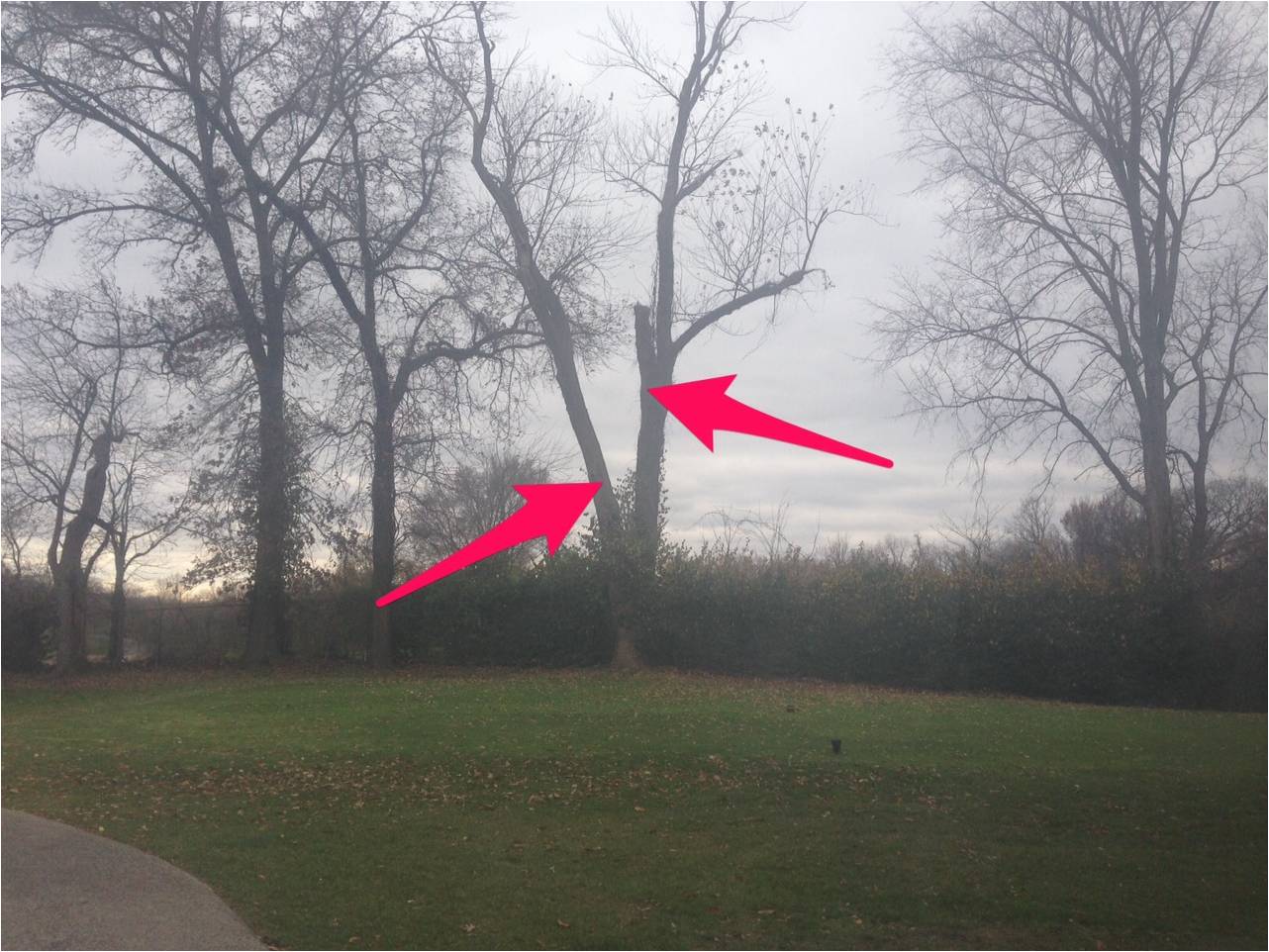
Also, the dual sassafras between #1 green and #2 tee has become severely compromised. We will be removing the left tree as well in the next few days. We were going to prune off the dead wood but after looking at the tree closely, there is not much to salvage and the safety of our staff is of utmost importance when we look at partial or full removals.

There are a number of other tree removals that will be taking place over the next few months. There are some standing dead right now and others that are compromised and will need further evaluation. We intend to do this with the assistance of the green committee and an arborist to help us evaluate their health. As an organization, we do not have the resources to plan a major tree removal program but we do have an aged group of Pin Oaks that are being compromised from a number of different things. I've had discussions in the past with our arborist and I will invite him on site in the next couple of weeks to help us evaluate some potential remedies to slow this process down.

We also intend to move a tree from the nursery into the area on the left side of #1 where we have lost a couple of trees over the late summer.

A good Tree Management Plan includes planning/paying for ongoing maintenance of the existing trees, removal of the dead/damaged/out of place trees, and preparing for replacement trees.

Below is a link to an article which has some excellent information in it regarding a Tree Management Plan.

https://asgca.org/design/existing-courses/course-renovation-articles/thoughtful-tree-planning/

Sunday, February 12, 2017

Maple Sap to Maple Syrup

We don't have a large supply of Maple Syrup this year to provide any for breakfast but we do have enough for Chef Brian to do some magic with in the kitchen.

The lack of consistent above 32 degree day temps and below 32 degree night temps reduces the proper sap flow required to provide us with large enough quantities of sap to give us a large supply of total syrup that can be used. 43 gallons of sap to make one gal of syrup. We will have about 60 gallons of sap which will make us a little over a gallon of syrup.  As temperatures warm and bud break begins to occur, the saps flavor changes and is not suitable for consumption.

A couple videos I've made over the last couple of days.  One for fun, the other to entice you with the smell of this beautiful naturally occurring product produced right here on the grounds at Glen Echo. Close your eyes and imagine the wafts of this light, natural tasting maple syrup drizzled across some Pork or in a dessert, Yummy!

https://youtu.be/aPmeCtrZ77I


https://youtu.be/iAC3H3YCSU8

Thursday, May 12, 2016

Storm Damage 5/11 Tree Management Plan

Limbs and leaves down everywhere. Spent a significant amount of our day on fallen Red Oak near 4 tee into the cemetery. Details below. Will be working throughout the day on Friday trying to clean up more material. Its pretty wet  so it is going to be difficult for us to clean up leaves and things on Fairways without doing damage so they will stay where they are for now.

https://youtu.be/0AoVxWBwe4U


https://youtu.be/s-jdxSGHkDQ


Cleaning it up


Threw in the total group except Hort and Mechanic

Getting near the end


Hope there is no damage


Monday, February 22, 2016

Stump Grinding Completed Today

Tim Crews from Crews Grinding Services from Springfield, MO came in today and ground the stumps from the trees we have removed so far this winter. We still have a few more trees in play areas to remove and a few along 3 fenceline that we will be saving to last. It took Tim a little over 3 hours to grind about 12 smaller stumps and 12 others that were pretty large(3' up to 8' in diameter). We will use some of the dirt material to throw back into the holes and will remove the parts that are mostly chips to reduce the amount of settling within the hole. Over the next few weeks we will cover them with topsoil and then sod so they will be healed in by the time the summer heat arrives.

We removed a couple of the smaller ground stumps this afternoon. The crew will work full speed ahead tomorrow trying to get the remaining material picked up before the rain and snow comes in overnight Tuesday into Wednesday. Wet and packed soil is much harder to deal with than the loose material we have right now.

Interesting note, Tim was going to a couple of other clubs after Glen Echo where he was going to be grinding over 100 stumps between the two clubs by the end of the day tomorrow.

Did a little slow motion action on the grinder at the 8' diameter tree along #4. Kind of a cool look at the chips flying.

https://www.youtube.com/watch?v=qmtgAqPSts4

Thursday, February 4, 2016

Tree Management Follow Up #2 Two Leader Pin Oak

The fellas dropped the two leader tree Pin Oak along #2 this afternoon. One leader if it fell or split apart would have gone directly perpendicular across the cart path/into the fairway and the other into the rough. When the men dropped the remaining 12' of the tree, it popped open like a watermelon. The cracked area was at least 6' long. This tree looked healthy on the top but both myself and one of our areas top arborists said it should come down. You brought me here to make the tough and correct decisions. I am relieved this evening that this tree is on the ground.

https://www.youtube.com/watch?v=BD481t4ATD0

Tree Management Program

Additional tree management work is taking place this week and over the next few weeks as we move through our list of approved removals. We will also be involved in pruning lower limbs on trees to raise canopies as time allows throughout the late winter and spring.

Our work this week concentrated along #2 fairway and #3 tee. We have two severely compromised Silver Maples and a Pin Oak dual leader tree that has cracked and is being removed. We will be spending $ 1,000 in April on cabling two other Oaks to slow their potential development of a large crack which will require their premature removal for safety purposes.

We will be placing a tree along #4 near the large Pin Oak that we finally removed once the stump is ground in the next few weeks. What I mean by finally is that I've had major pruning completed on this tree since I arrived 8 years ago in an effort to not remove it or an attempt to delay the inevitable. With my contractor/arborist out evaluating trees with me a few weeks ago, he said that tree was the worst he saw on property in a high traffic area and we should not wait any longer. 

I understand the concerns of folks who think trees are more important that about anything else but when it comes to hazard trees, we are left with no other option but removal. My efforts are to eliminate the potential for tragedy as well as completing the work in the proper time of year. The proper time of year saves us time and money for our operation. Large removals during the growing season increases the cost of removal by at least 25%-50% which includes increased contractor fees and lost time of my staff who should be managing turf. In the end, the biggest inconvenience is to our membership and guests.

Additional removals are planned with a couple of Ash trees and three planned for removal on 18 in which two are hazardous Silver Maples and a Sweet Gum nearby. Once these 3 are removed, a new hardwood tree will be planted in their place. We will also be adding trees in our planned nursery behind 17 green as we move closer to spring.

Stump grinding will be completed in the next few weeks once we get further along in our removals. Grinding stumps a few at a time would increase our costs by two to three times since we don't own our own grinder. I did just speak to our contractor and told him I wanted this work completed much earlier this year than in the past so we hopefully will have everything ground before the end of February.


The dual leader Pin Oak near the red tee on #2


Same tree with limbs removed. Stub will be removed later today. Tree is 300 yards from green.
Crack that was 3' long in the dual leader.


Silver Maple about 50 yards past the Pin Oak.

Yes, tree was hollow.


Trunk of tree
This was a very large upper limb that was nearly eaten through by carpenter ants.
All the upper limbs were hollow.


Staff working on cutting up the remnants that were dropped by our contractor.


#3 tee Silver Maple. Back side limb hanging over fence died last season.

Topping of tree by contractor. we will pull it over to prevent it from falling on the fence.

Additional trees along 3 tee that will be removed during the winter. This is an example. Removal will prevent personal injury as well as destroying fence if it fell onto it.


Thursday, January 7, 2016

New Year,Excellent Videos on Trees and the Golf Course

A nice balanced video from the USGA regarding trees on the golf course. Also a second video which I've posted before on the blog. It discusses the need for light and air movement on our main play surfaces(greens) and the negative impacts that can be placed on this most important surface from trees planted in the wrong location.

Beginning next week we have contracted removal of a few trees that are hazardous and too large for us to drop without first having the limbs trimmed off. This will then allow our staff to remove the totem poled main trunk safely. We drop the logs and haul them to our maintenance area for splitting or placed in our dump for grinding in the future. This work will begin on Monday and Tuesday(for the contractor) and will probably take most of next week for our staff to get the logs removed, area raked and material hauled away. The staff have been involved in splitting and stacking tree parts that were removed during the season to make room for the trees that have been approved for removal by the Green Committee and Board.


Wednesday, December 23, 2015

Trees and the Design of #3

In the last couple of years, there have been discussions regarding Hole # 3. Most of it has centered around the use of trees in the right rough between the fairway and the cart path. Their has also been discussion with Kye Goalby the designer and architect who did our bunker renovation so deftly about some minor routing changes of the hole. Allow me a moment to give some back history.

A few years ago, a large Oak tree on the right of the cart path near the top of the hill lost most of its top and fell in a thunderstorm. When it fell, it damaged an Ash that is on the fairway side of the path in a narrow area between the fairway and cart path. I left the tree in place knowing that it would need to be removed a few years later. Well, that time has come because the tree has a split in it and must be removed. Earlier in the year, we removed a severely compromised Ash that was in the narrow area between the fairway and cart path at about 185 yards from the green. Pretty far from the green but in this same narrow rough area. Some think that if there are trees in a spot, no matter how inappropriate the location in regards to design and play-ability of the hole, another tree should be placed back in the same spot.

Part of my discussions with Kye have evolved from the design of the hole and how an architect helps to route a hole to give players the proper direction the ball should travel and the best location for it to rest if struck properly.

As you can see from the picture below, once the fairway goes up the hill it falls to the left. The red arrows show the fall line from the center of the fairway to the left. The current fairway boundary on the right side moves in that direction as well. One of the things that was done years ago which Kye and myself agree was that trees were inappropriately planted along the right side between the fairway and cart path. If your ball lands in the narrow area between the fairway and cart path, you were forced to either go over or around this tree. If you were too close to the tree, it forced a play to the left which is not the direction the hole should be played because the ball will roll off the left side of the fairway due to the slope. If the hole was being designed today, the fairway shape would be more to the right. A properly routed hole leaves areas open so that if a ball is properly struck will be in decent shape for its next shot or will be on the green. All the great architects in history speak strongly against the placement of trees too close to the line of play not allowing a ball to be advanced forward. Of course, how close is too close to the line of play is in the eyes of the beholder.

The picture below shows this hole. You can already see how narrow the rough area is anyway. The green lines my interpretation of the potential changes that Kye and I have spoken about regarding changing in the fairway/intermediate. The right side of the hole toward the top is flatter and much better for a ball to land than the left side which falls off drastically into the rough and left tree line.

This gives you a little idea of the thought process that goes into tree removal and the potential to not replace what I would consider a mistake made from our past. I think not learning from our past and now trying to move past these type of issues is a mistake. It makes the course play truly unfair, reduces the opportunity to advance a ball forward, disrupts maintenance such as mowing around objects that should not be there and take time and creates problems for future. Some would say you've made it easier, it can be easier for someone who strikes the perfect stroke to a uphill green where you can only see a flag and hope that your shot does not go off line more than a few degrees or you will be in a bunker. It plays at least an extra club or maybe two depending upon your length.

A little winter season discussion regarding tree or not to tree, that's a pretty big question??


Thursday, December 10, 2015

Tree Management Plan

(This was emailed to all members but does not hurt to communicate through this route as well)

Each season during the last eight years here at Glen Echo, I have asked permission to remove trees. If its during the season and a tree has died or becomes compromised and I do not want to wait for winter, I see my chairman and or committee members and tell them of a tree that needs to be removed. They give me their blessing and its removed. I do not remove trees without a consensus on my committee.

I take my actions very seriously in regards to this work. I understand that tree removal for some is difficult. I also understand that there are people on the other side that prefer great grass to trees and expect me to do whatever I can within reason to achieve that goal. So, as a manager responsible to all members on all sides of all issues, who do I follow? Well I follow what I believe is best with my 25 years of experience in this business. I spend hours upon hours taking pictures and evaluating this work. I confer with Aborists, USGA officials, course architects and in the end I present my findings to our member committee to make the final decision and I live with their decision.  

I evaluate the removal of trees based on if its dead(duh)! Is it unsafe or hazardous. Could turf conditions be improved if there were only 5 trees in a specific area than 10 and does the tree add architectural value to the course. ie, separation of holes, protection of doglegs etc. I also evaluate trees if they create extensive clean up efforts from the mess they leave on the property. If you have Sweet gum trees in your yard and you clean them up or have someone clean them up, you understand the issues. Now put this tree on a property where people spend thousands of dollars a year to come to your property and want great conditions, this creates an issue for me. Instead of doing work to improve play down the middle from tees, to fairways to greens, I'm forced to deal with other issues. If they are near greens like 2 or 3 are, they place trash on the greens from fall through mid-spring. Walnut trees should not be on a golf course but we have four or five on our course. Trees create massive amounts of work for me and my staff and compromise turf grass in many ways. But they are necessary here because of the lack of fairway bunkers, and no doubt the right species, planted the proper distance from one another in the correct location are awesome! Yes that's right I said trees can be AWESOME!!

Normally our committee meets in October and we discuss the trees that I want them to consider for removal with a tour of the course. This year, that did not occur during the usual period. With the end of the year rapidly approaching, I told the committee that I would ribbon trees that I thought should be considered for removal over the last few days and asked that they evaluate them before our meeting. Some were quite obviously in need of removal and red x's were put on the trees by me but a number of others I thought needed the evaluation and approval of the committee. I have begun to target Sweet gums from the reasons listed in the paragraph above as well as weakened and or damaged Ash which are going to be under attack from the Emerald Ash Borer. I've also discussed with the committee an attempt to save some Ash through the use of insecticides. This would include trees in strategic play areas where the loss of the tree would leave major voids. This work will cost us a few thousand dollars each season. In the meantime, we have also planted a couple of trees in some of these areas to offset some of the older species that will probably die from natural causes.

If you do not follow my blog, you should because you would have known that we are in the process of starting a 4-6 tree nursery behind 17 green. We will grow these trees for 5-10 years and then will hire the Big Tree Spade company who could move these larger trees into an area that needed more than just a 2" tree bought at a local nursery to be placed in that spot. Once a tree is removed, another will be put back in the nursery.

So, in the end what happened. We are still evaluating trees on the list. We will be placing red x's on trees that will be removed. There are a couple of trees that I was evaluating for removal but our Arborist stated that they could cable them and delay the splitting process that concerned me. Tree removal will began when all approvals have been finalized and we have time to begin the work which for the most part will not begin until after the 1st of the year.

In the end, I can't help the folks that do not want any tree removal and or those who want all the trees removed. I will work in the middle attempting to first make sure all of us are safe. I then will use all the other tools and expertise that I have at my disposal to evaluate and balance and the desires of all
members on both sides of the issue and to move your great old golf course forward.

Thanks for your time,

Sincerely,
Joe Wachter
Certified Golf Course Superintendent
Glen Echo CC


Monday, November 9, 2015

USGA Article In Regards To Tree Management Plans

A great article from the USGA regarding trees on a golf course. Please take the 10-15 minutes it takes to read this outstanding article giving a historical record on how trees evolved on golf courses. This perfectly explains the situation we are now experiencing at Glen Echo. This does not speak of the elimination of trees but the thoughtful and considerate placement of trees as well as removal to improve overall playability, turf quality and the true cost of an overabundance of trees on a course.


http://gsrpdf.lib.msu.edu/ticpdf.py?file=/article/oatis-right-11-6-15.pdf

Wednesday, November 4, 2015

Late Fall, Winter Play

As the weather is changing, time for discussion regarding late fall and winter play rules.

This season we will allow carts off the paths as long as conditions are dry enough to do so. It does not take a lot of rain and or snow to place carts back on paths so when dry conditions and temperatures are comfortable, you should take advantage of this situation. A little golf, a couple cocktails and a lunch or dinner makes for a great day and helps the bottom line of the club. As freezing and freezing/thawing cycles begin to occur more frequently later in the season, cart path restrictions might become more frequent.

Also a part of our winter rules is for the practice ranges to be on mats only. I understand the desire to hit off of the ground but if we allowed play all winter on the zoysia, that area would be destroyed because of its inability to heal. We appreciate your cooperation in this matter.

I would expect frost to be on the increase as we move later into November. As a reminder, we will not allow play onto the course until the frost has lifted. One of the things we will face later into winter is frozen ground/frozen turf blade conditions from harder freezes. I don't worry as much about the ground being frozen as long as the grass blades are soft and pliable. One of the things I'm most concerned about later in the season is when the ground is frozen beneath but the surface begins to thaw. It might be a warm day above ground but this type of condition can create serious root shearing issues for us and damage our greens with every step. This type of condition will force us to remain closed until the freeze has lifted our of the green and allowed the surface moisture to drain away. I will discuss this problem in greater detail when our winter thaw occurs.

In the meantime, the staff has been busy blowing leaves everyday. From green's surfaces, tees, fairways, rough and bunkers. We also use our mowers to help grind them up once they are placed in winrows on the course. We will be breaking out our vacuum as well during the heaviest period over the next few weeks. We haul this material to the dump in the back of the driving range.

We are down to 5 hourly(Nick, Russ, Tom, Jason and Randy) Hort Becky, mechanic Dave and Skip/myself. We lose Randy after this week and Becky and Nick at the end of November. Still a lot of leaves to come off the trees. We appear to be 10-12 days behind in leaf drop so we will be deep into fall before most are down.

Come out and take advantage of this great weather over the next couple of days. It should be fun!!

Friday, October 9, 2015

Tracking in Fairways

Green committee meeting last night and a question was posed regarding tracking lines or vehicle lines in fairways. Normal for this time of year with us blowing leaves off fairways on a daily basis. The fairways have not been mowed in over 10 days. Mowing will clear up traffic lines as well as the darker green color of the grass but no growth equals no mowing. Went out this morning to see if we would get any grass mowed but not tall enough to cut anything off. Depending if you are on the tee or the green and looking out toward fairway, the off colored grass is laying over and more pronounced in its look because of its lack of dark green color and its length.

No more traffic than normal. That is one of the issues we face with tree lined fairways and 3-4 rows deep in trees. Now if you remove more ..........., less leaves to blow, less traffic on fairways. Have a great day! 

Saturday, October 3, 2015

White Pines Losing 2nd Year Needles

If you look out in your backyard or have been out on the course, you are beginning to notice the annual dropping of 2nd year needles of the white pines. This is a natural occurrence and nothing to be alarmed about. But if you see the tips of your branches or all needles turning brown, your tree is experiencing some other more serious issue. Contacting an arborist in this case would be recommended. 

As the turf mowing has been slowing, we have been in the process of removing some very weak smaller ash trees and other damaged trees I've identified to The Green Committee. My seasonal staff only have until the end of October until they are finished for the season. We are utilizing them to help with this removal while our year round staff are involved in turf renovation work. 
White pine beat 12 tee. You can see the inner needles turning brown.
2nd year needles at the red arrow. New growth at the tip on the right.

Thursday, September 24, 2015

Red Oak Trees With Issues

Contacted Tim Gamma today regarding Oak trees on property that are showing some significant stress. Some of this occurs from drier conditions that we have faced over the last few weeks. Send him a picture of a large Pin Oak between 8 and 10. He stated its a classic look of Bacterial Leaf Scorch that is effecting Oaks all over the city. The link from Missouri Botanical Garden discusses bacteria and how it effects the tree. Tim said for the most part trees will survive the issue unless it has other significant health issues.

Bacteria moves throughout the tree through the Xylem, Phloem, that is why you see whole limbs being infected from where it attaches to the trunk to the top.

Thursday, July 2, 2015

What Is The Landscape Fund?

New multiple bed planting near pro shop
Years ago a fee was approved to charge members $25 once per year which was placed in the Tree Fund. As the years have progressed, our landscape has become dominated by trees and the need for trees has been reduced. The fund is now called the Landscape Fund and is being used to rejuvenate existing ornamental plantings on the property, planting trees as the need arises, and establishing new beds.

Over the past couple of years, we have built new beds at 13 tee, the pro shop, planted 10 trees on property, established a new screen planting at 6 green and expanded/replaced two of the plantings at the back patio. Since the start of 2015, we have spent $5,000 to construct the planter boxes on the veranda,  the new construction/planting at the pro shop and purchased the limestone planter for the Pearson Plaza. This fall or next spring we intend to improve the Sun-room planting bed.(we call it the bubble). Becky, our horticulturist and I agree that the Principals of Landscape Design should be emphasized and our focus should be on year round interest in our beds emphasizing form, variety, and sequencing. We hope this will provide greater enjoyment for you and the many guests who attend events at the club throughout the year.

Upon my arrival in 2008 at the club, the landscape around 9 lake with the Woodland Garden on the dam side of the lake and the ornamental planting of the tee side were overgrown with weeds. Since that time we have made efforts to improve this area which is the largest total continuous planting at the club. Becky has moved plants from other beds as we've replaced plants and has worked hard at weed control. In an effort to reduce costs, we utilize chipped tree limbs that have been ground up from our property. Since this area has highly visible by both our members and guests, it is important that this area look its best.

This fall/winter, we intend to start a tree nursery behind the 17th green. My thoughts are that we would establish 6-8 trees in this area which will be used to grow trees for 5-10 years and then contract with a company with a large spade to move these trees to areas where trees trees are significantly aged or compromised. A golf course architect, superintendent and green committee will be involved in the placement of these trees and a majority of trees planted in the future at this club. Our goal is to keep green and tee complexes in as much full sun as possible and to improve sunlight to fairways whenever possible. Some of this work can be completed by not fence lining trees but staggering trees so light can enter these areas for longer periods of time.  Also understanding the path of the sun in all seasons and the shape and size of grown trees is important so that turf grass and trees can co-habituate peacefully without a caretaker like myself wanting to remove the offending party!
Placing 80' trees on the east and western exposure of a fairway will lead to a shaded and weakened fairway. You will wonder why there is very weak zoysia and I will be praying for lightning to help me remove the tree.


New planter box on the veranda


Wednesday, February 18, 2015

Tree Management Plan

Our contractor is out today topping 3 large trees along #9 club lawn that are severely compromised and have been on our removal list.  The contractor is removing the larger limbs which will make it safer for our staff to then drop the tree.  2 have large wounds/hollows and the 3rd has a large dead leader. Removing this leader places the tree in serious balance issues. It is listing toward the lake with all of its weight which creates a hazardous condition for everyone.  It is also in the way of a drainage project MSD will be performing in the future.
L-R Sweetgum hollow, Sycamore hollow and Sycamore with damage leader and in the way of future construction.
Sycamore near the trash dumpsters.
The tall Sycamore near the lake being removed.
End of a long, cold day for our contractor.  We will be dropping the 3 tree trunks and clean up the remnants over the next few days..

Friday, June 27, 2014

Details of Long Range Tee Turf Replacement

I sent out an email blast to the membership earlier in the afternoon giving  notice of our plans regarding the turf replacement for the long range tee.  The following information is some additional detail regarding changing this playing surface from Bermuda back to Zoysia which is the main fwy/tee surface.

There might be a couple of questions you might have regarding this project.  Why start this now?  A couple of reasons.  The Bermuda was damaged coming out of winter and is slow in responding.  Also, we need enough time to kill a majority of the Bermud and give the Zoysia a chance to root and grow before dormancy sets in.

Why not change ends of the range to the top.  A number of reasons I explained to my committee.  Cost would be much higher.  A dozer would be needed to move dirt and build targets.  Hitting balls down hill will increasing ball flight leading to more cost for balls and endangering my staff in our maintenance area.  I'm sure we would be required to put up a very large fence to protect the metro link trains from being hit.  Logistics of cart travel and walkers would be much more difficult and almost impossible.  Shall I list more?

As mentioned in the earlier email, our operating budget does not have the money to fund this project.  I had also stated the project would not be worth our time if we did not remove trees to improve turf conditions. 
My apologies in forgetting the estimated cost of $ 15,000 in the email.  Our staff will do all the work except laser-leveling the tee and some of the larger scale tree work will require some assistance.  No additional labor cost will be required. Like anything else we do extra on the course, we will schedule our regular work and plan our extra work accordingly.

The long range mats will be open as much as possible during the process.  The short range grass tee will remain open until dormancy so you have a place to warm up.

During the construction, I encourage everyone to stay off of the treated turf.  You could track chemicals back onto good turf surfaces such as the practice green from remnants of chemicals used to kill the Bermuda. We have 9 trees to remove on the east side of the tee.  One will die from a lightning strike that occurred a month ago and the other is a hazard tree we will be removing.  The trees shade parts of the teeing ground as late at 10 a.m. each morning.  We plan to keep the shorter scrub material along the creek to provide some separation between the first hole and the range tee but as trees continue to grow, they will be removed as they begin to create shade on the tee.  We will remove some trees along the creek bank on the west side of the tee as well.  These trees shade the tee from 3 p.m. on and reduces the total amount of sunlight to the turf.  We need a minimum of 8 hours of sun or more to have turf that can repair itself quickly enough as we rotate stations through the tee.  Additional sun equals a turf that dries quicker and can become playable that much sooner than the past wet, soggy turf that we have experienced on this tee. A drier tee surface also reduces damage from divots during practice time.   The work on the tee should get us almost two additional hitting stalls and we should have at least one more days's rotation from the very front of the tee.

The following is a general work plan for the project.
  •    Spray the tee with non-selective and selective herbicides. GECC staff
  •    Scalp and strip the remnants. GECC staff
  •    Cover the tee and attempt to grow the Bermuda again. GECC staff
  •    Spray herbicide application again.  This total process should take approximately 6-8 weeks.  Using     soil fumigant could shorten window but might require total shutdown of all weather tees on the long     range required by product label. GECC staff
  •    Install drainage in tee to improve the health of the zoysia and allow it to opened sooner after rain        events. GECC staff
  •    Adjust irrigation heads as necessary. GECC staff
  •   Till and Laser-level tee. Contractor.
  •   Install big roll zoysia.  GECC staff.
  •   Tree removal would be occur as needed.  Couple potential removals could be during winter season  but would need to evaluate.  Staff and contractor

·        The tee will not be ready for play until mid-May to the 1st of June 2015 depending upon completion date and grow in weather.

      As always, I will keep you informed of the activities as they happen.


Wednesday, May 28, 2014

Tree root pruner in action

Just started to use our tree root pruner today.  Purchased from Commercial Turf in Chillicothe.  This unit will be invaluable in our tree management efforts to improve the overall conditions of our turf grass in our main play areas near greens, tees, fairways and rough.   This unit will help to conserve water of our tree lined rough and fairways, will improve fertilizer availability for grass and will enhance the rough allowing it to be more consistent  throughout the property and overall a much more healthy plant.  It will also enhance other other turf surfaces such as fairways, tees and greens.

Check out video below.