Showing posts with label weather. Show all posts

Tuesday, August 31, 2021

Part Deux, Puffy, and Overlayed


 As meteorological summer began in June, we thought we were in for a hot and dry summer. The end of June and into July brought copious amounts of rain.(As wise men once said it never rains in July). Along with the rain storms came tremendous damage to THEM things which created some issues for our staff but they stepped up and handled the situation as best could be expected.(As seen on Social Media I will not use the word Trees as I now refer to them as THEM. Its a coping mechanism so work with me here)

Well, Part Deux happened again last week but luckily to a smaller extent.We struggled a bit through some horrific weather last week but have made it through to the other end. We hope to have the rest of our mess cleaned up for the holiday weekend including getting some support posts put back up on the tennis courts to stop any further damage. The new wind screens are being removed for the season to reduce any further damage to the existing structure until we get it shored up and strengthened for next year.

 1 green after tree fell on irrigation system causing 2 heads to come on. I came back to turn off irrigation not knowing this had occurred. Happy I came back.

 Over the last few weeks, our greens have struggled from soft and puffy conditions. Temperatures have averaged more than 3 degrees above normal including that all important night lows which has not allowed recovery time of our turf. Consistent and regular rainfall on our greens which do not have drainage has led to soft surfaces and fat/lazy grass plants who do not like to give up additional ball roll out. We have been forced to not mow greens on a number of days because of the rain or damage which has occurred on the course. We have also had issues with scalping out in the middle of greens and over the top of our hole locations. We use a plate that we stand on which reduces the heaving of the greens as we pull out the 8" plug from the green but we continue to have issues. Also, with an inch or two of soil at the bottom of our hole this creates great suction when the greens are wet. We attempt to reduce this suction using various techniques but sometimes to no avail.

                              This has been experienced many times this summer at Glen Echo
 

 Heat and moisture leads to high microbial activity in our sub surface's and the release of additional nutrients for plants. We attempt to control this growth by the use of regulators but that has been very difficult for us to accomplish over the last few weeks. High heat shortens the window of the chemical's useful life and then chaos hits the course either in 1-2" rainfall and or high wind conditions and we've missed some of our windows for spraying. One of the chemicals is a product which has to dry on the greens and the other must be watered in which also creates its own set of issues. When you are already wet do you add more moisture and possibly make your greens sick just to control growth. Sometimes you just have to do nothing until the environmental conditions change. We anticipate with cooler weather the next 7 days to get back on track with sand topdressing, brushing mowing and rolling. 

We are looking forward to more of this!

  We had hoped to have some cart paths back filled with soil and sod added in the worst areas between 1 tee and 4 but have not been able to accomplish this to date. We hope to begin this process as time allows. To a man and women, we are much appreciate of the effort to clean up our cart paths. You can do all you can to have great turf but having your equipment banged around with heights of cut set at thousandths of an inch can lead to issues on our best surfaces. I see staff members driving down the middle of a fairway to avoid the rough nature of our paths. Some have mentioned, why not concrete? Well, if we had a choice of course we would go with concrete but the cost is astronomical in comparison. Our local superintendent has a text thread where we throw out questions or look for guidance. Been told by a reliable source that has been doing concrete over the years that replacement of asphalt and going to concrete would be easily into 7 figures. I would like to have the most modern bent grass on our greens and complete drainage in each green but it can't happen right now. 

                                                                 The old and the updated!

From November through March, we have a tendency to have some large equipment on our paths.Our dump truck is 7'10" wide. An 8' cart path leaves you no room for error. An 8'4" cart path basically the same but does give you just a little wiggle room. Our backhoe is over 7' wide and our lift is nearly 8' wide and heavy. We work in the winter during freeze and thaw conditions which is the norm around St. Louis since we don't stay nearly as cold. As we are driving on our existing roadways you literally see them flex up and down.creating more path repair work the next season. Kind of makes you sick to your stomach knowing to accomplish your work you have to tear up something and create more work. Over laying these paths will help to strengthen our existing surfaces and allow us the time to continue to improve our facilities to the best we can make them.


We of course focus our efforts on our daily work but our biggest event of the season if coming up rather quickly. The Invitational 2021 opening round is about 403 hours away. I anticipate you will see some ever changing conditions over the next 16 odd days. I hope you have pleasant day.


Thursday, May 13, 2021

Yep its Weather, Getting Dirty/TIlling Deep, Zoning Out, and Early Range Shutdowns


 Its been a while since I've made a blog post. If you follow me on other forms of social media you've seen a regular plate full of details regarding the work our hard working staff are accomplishing on a daily basis.

Weather

First and foremost, lets talk about the weather, especially the colder than normal temperatures we have experienced in late April and May. The average temperatures in April were a couple degrees above last season. Now, May 2021 is a different story. We are currently 8 degrees behind average in both daylight highs and night lows. Last May we were actually a degree above normal. More importantly, our soil temperatures have dropped since the first of May to 63 degrees.

Soil temperatures at this level are excellent for our rough grass(cool season) and greens. Our bent grass likes temperatures to be slightly warmer, especially at night but they are in full production of energy which contributes to root growth and adds to storage within the plants. 

It is most difficult for our dominant short grass zoysia, especially our tees and areas of fairways with heavier cart traffic and additional shade. We've cleaned up our zoysia mowing only weekly at this time due to the lack of growth. Some of our weaker areas we will keep the mowers away completely. It appears we might begin to see some increases in heat over the weekend and into next week. We can't force the plants to grow. The systems within the plant currently are slowed because there is not enough energy to produce growth.

It is very important during this time that membership operating carts reduce traffic in fairways as much as possible. Using a 90 degree angle from the cart path to your ball in the fairway reduces traffic in the fairway. Once the ball is struck, move the cart back to the rough and cart path when possible and proceed to where you ball is located. We are still seeing a tremendous amount of traffic going from the teeing ground area directly through the rough off of the tee and into the fairways and then driving another 50 to 100 yards down the fairway. Your assistance is greatly appreciated to reduce this type of activity.

Soil and Sod 

Stumps from a few trees removed were ground a few weeks ago, remnants cleaned out and this past week they will filled with soil. Yesterday and today, our staff edged the existing filled areas and laid sod to cover the spots. Six in total were cleaned up. Our contractor will be out in the next couple of weeks to grind the remaining stumps that we have on property so we can get them cleaned and covered for the summer.

Sycamore and Sweegum that were in the club lawn to the right of 9 cart path were covered with sod. Also, 9 tee, a pine tree in the club lawn and in the triangle between 5/7/main drive. 

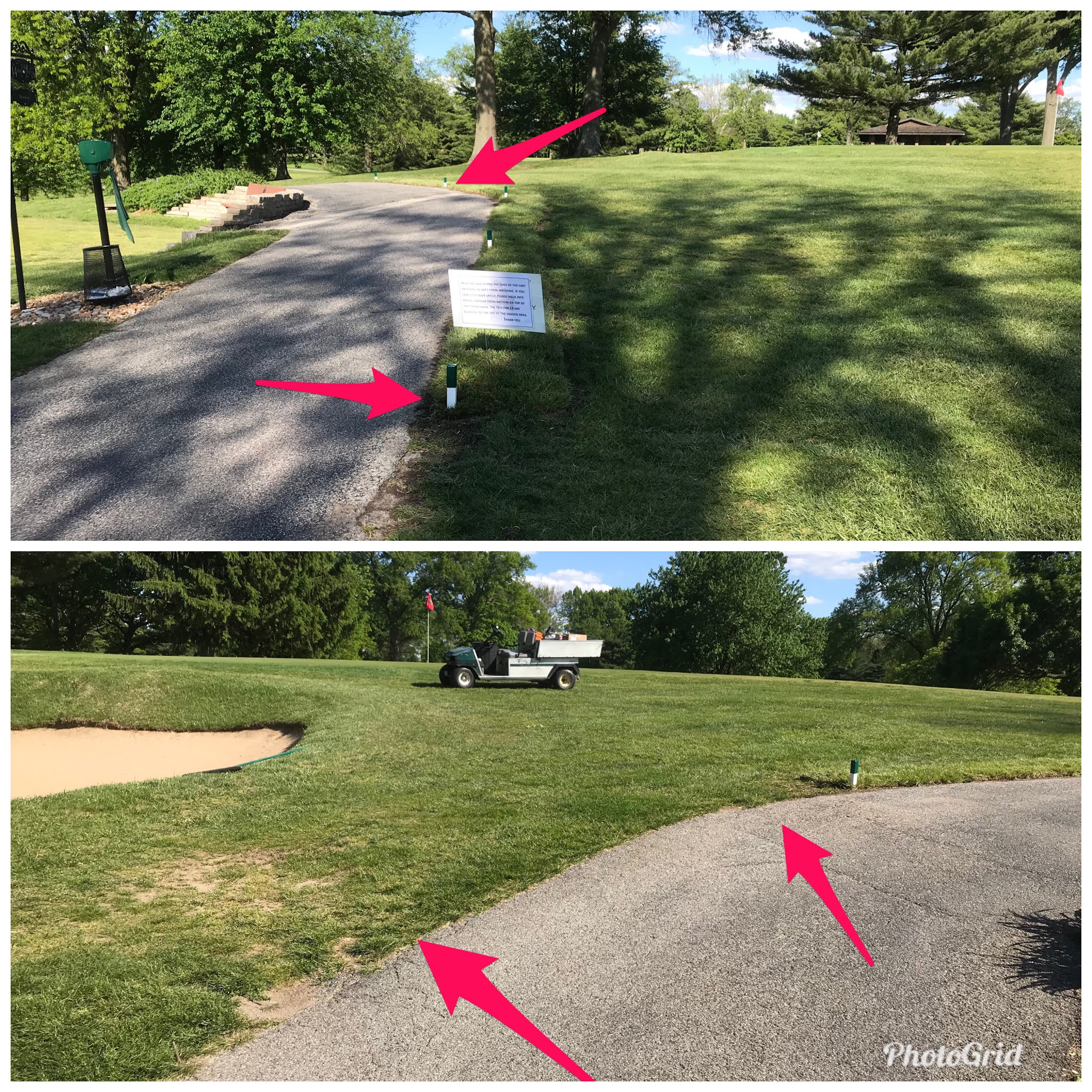
Some additional soil work was completed along some seriously compacted cart path edges behind 11, green, at 13 green and at the curve just short of 15 green by the 16th tee. We used a heavy duty tiller going as deep as 6-8". We added some black gold compost from St.Louis composting and covered with fescue sod. These areas will be kept very moist over the next week or two so it is important that we do not step into the 20" width of sod that are next to the path. Access to the green areas are still available at the top end of these renovated areas.

https://www.youtube.com/watch?v=No8JNhqkE78


From the 11th cart path going up the hill to 12 tee. We have this section roped off and are asking cart to proceed to the top of the hill at the circle turn for the 12th tee to enter the 11th green complex. This area has been very problematic because of the severe slope and the large Pin Oak that keeps this area  depleted from moisture and into heavy shade. Hopefully this extra work will finally keep this area in better shape.

This area leads up to 13 green. We tilled from just above the left tee up to the top of the hill in the bottom picture. You can access the green from below or above the section. Some can step across the sod without issue but please be reminded this area will be kept wet for a week or two to help it root properly. We will also keep the tees up on the upper tee of 14 for a week or more so more the reason to pull up to the top of the sodded area.


No pictures of 15 but this area will be roped off and will be obvious for our golfers. Carts can stop short of this area and or proceed to the circle for 15 green/16 tee.

Drop Zones

We have one established drop zone at the club which is the red teeing area of hole 9. As play has increased, so has the wear and tear to this teeing ground. It is also a fairly small tee with an extension that was added a few years ago that frankly speaking needs to be renovated. Teeing grounds are not the best locations for these drop zones so a couple of changes will be occurring over the next couple of months. 

On hole 9, we have rough graded in a new drop area beside the 9th red tee. We will be covering this with zoysia over the next week. Later this summer,(after July 4th, we intend to close the red tee and blue tee on #9. We will strip the sod from the tees, enlarge the red tee forward, to the right and a little off the back. We also will strip the blue tee and will extend its teeing ground to the right. We anticipate these tees will be ready for play by August 1st with the heat of the summer pushing a quick grow-in. In the meantime, we will utilize the new drop zone for the red tee/drop zone and the white tee will have the blue tee added.

New drop area to the right of 9 red tee. We still have some work to complete on the slopes and some leveling but its roughed in. We anticipate the red tee to split the different between the existing tee and the new drop zone.


The golf committee and green committee has been in discussion regarding a potential drop area to be established for the 15th hole. We will be placing a drop zone about 35' from the cart path about 10' from the Egan's Lake. It will be mowed at a reduced height of cut and a circle designating the area will be put in place. 

Driving Ranges

There are signs at each driving range that mention the range will be closed early on Thursdays. This must occur so that all balls can be removed by the pro shop staff and readied for our staff to mow before the first golfers whom arrive on Friday morning at 7 am. This program is usually implemented in late April and runs into June and or until the grass begins to slow its growth. Its important that the grass be cut twice a week so staff can see the balls and remove them so they are not chopped up by the mowers. 

On event day Mondays, our staff usually picks the ranges clean and mows after the groups begin play. The pro shop staff assists us with as much removal before dark on Sunday evenings. We do not close the ranges early on Sundays so our membership are not inconvenienced by our necessary operations. We appreciate your understanding during this time.


I hope you get a chance to get out and see your golf course over the next couple of weeks. Ball roll out has been pretty good I hear and hopefully the rain starts falling at night and leaves our weekends free to play golf.


Tuesday, February 23, 2021

Winter Greens Thaw/Course Opening

Well, we've made it on the other side of the worst weather of the season. Hopefully, our turf has survived any issues. The snow cover should have given the surfaces some insulation. I would not mind some bermuda grass damage but we will see. Bermuda rarely dies, it just gets pushed into the ground where it starts its growth instead of from runners attached to the surface of the ground. 

The course should have thawed and drained enough to open this Thursday, February 25th for play. We would anticipate the range to remain closed at least through the weekend due to very soft conditions from the thaw and balls plugging. Rainfall over the weekend should help reduce some of the soft conditions but the golf professional staff will have to determine when it can be opened.

I've posted a couple videos on social media since Saturday regarding the thawing of the greens at Glen Echo and how we determine when the course will be opened. I made a post in a previous blog regarding the freezing and thawing of greens on February 9th. Below is the link.

Thawing of Frozen Greens and When They Are Safe to Play

The first video shows the spot I cleared away from the practice green on Saturday to show the difference in time it takes from a cleared green to a insulated/snow covered green.

The second video is from  this morning showing the depth the greens have thawed since Saturday and an explanation of our decision making whether to open the course or keep it closed.

https://www.youtube.com/watch?v=aT_2DL1KsnM


https://www.youtube.com/watch?v=BQG3frUc2Ac


The pictures below are depth measurements of the freeze in our greens. Our greens have about 6" of sand on them and then soil. I would think the freeze moved down into the soil layer. The sand layer freezes quicker than soil but the soil layer underneather thaws slower than the sand. It is important that our greens thaw enough to allow water to evacuate through the profile of the sand allowing the green surface to become less saturated. The surface area of the green acts like a soaked sponge but in a greens case, the inprint in the surface can days for days and create a very disrupted surface. We will also want to mow our greens soon to remove its winter growth and the disruption in the surface from foot printing could cause scalping which would delay spring growth.
PG depth of freeze where snow was removed on Saturday

Practice green near the above picture but snow was allowed to melt naturally

15 green middle right

15 green back right

11 green still a little covered in snow

11 green off the left side middle. Still pretty frozen


Tuesday, February 9, 2021

Frigid Grass, Pipeline, Sap Lotta Sap and Tree Management

Like a shutdown corner on the football field, mother nature is doing her thing for the next week or two here at Glen Echo.  Below freezing temperatures and a few days of precipitation has moved us indoors to complete our course supplies refurbishing and other important duties before we get back out on the course. 

Green Root Shearing

Once temperatures have moderated and all the snow and ice is gone from the course, the course will not reopen until the freeze has come completely out of the greens. I've attached a 1 minute video from the USGA regarding root shear and its effect on golf greens.

Shearing occurs when walking on thawed green surfaces and the root zone is frozen. Foot traffic on softening bentgrass greens causes the surface layer to shift with our weight and can tear roots at the junction of the thawed and frozen part of the green. The shearing off or tearing of roots that were 4-6" long to barely an inch or less causes the plant to use a tremendous amount of energy to regenerate the roots back to their mature length. Now remember that there are an average of 

Keep in mind, all roots are continueing to grow and evolve during the spring season and into early summer. They are gaining root mass and extend top growth based on the supply of energy we provide. Once they've used all their energy for growth, there is usually excess energy that has no where to go so it is placed in storage to be used by the plant when production of energy does not keep up with demand. This generally occurs when soil temperatures reach around +85 and air temperature near +90 degrees during late June through early September.. 


Turf and Below Zero Temperatures

So will below zero weather have a negative effect on our turf? I'm glad you asked that question. Generally speaking our turf should be able to withstand these temperatures. Snow cover does provide some insulation but we only have about 1" or so covering our fairways and grens. 

 The turf most effected by below zero nights could be the bermuda grasss which we have invading almost all of our surfaces. It won't kill it completely but could potentially cause it to grow out from below ground. Normally bermuda begins to green up in its runners or stolons above ground. The freeze could force it to grow from rhizomes under ground because the runners on the surface on the ground could die back to below the surface. In most cases it will kill the plant completely but could delay its growth by weeks or more. 

Our golf greens, cool season turf have a higher cold tolerance to severe cold. We did discontinue mowing to allow our greens to get a little fluffy. I was contemplating a mow in January but saw the long term outlook and decided to hold on until February. I'm glad I waited. Mowing in winter, especially if it is milder can signal the plants to grow which could lead to some cold temperature injury. Poa annua can be negatively effected by cold but I've never seen much winter kill in my 31 years in the business here in St. Louis.  

Our zoysia grass tees, fairways have cold tolerance to about -5 to -10 degrees under normal circumstances. Without snow cover, north facing, shaded, and heavy traffiked areas could be subject to winter damage when temperatures fall into these ranges. This damage could result in slow green up and or death and in need for replacement.

Are there cultural practices which could reduce winter injury? Thank you for asking again and yes there are Best Practices that can assist in winter turf survival of zoysia grass. At Glen Echo, we do the following to improve our turf's chance for emerging unscathed in the spring.

  • Aeration and or slicing fairways/tees in the summer
  • Traffic control of carts and moving teeing grounds to reduce wear and tear. This is why we ask you to not drive directly from the teeing area to fairways because of wear and tear.
  • Light, the more light the better which means the removal of limbs and or trees as necessary to improve and increase light. A minimum of 5-6 hours is the best. This would also include root pruning of trees using our tractor driven root pruner
  • Ensure nitrogen fertilizer applications do not extend the growth of zoysia to far into the late summer/early fall which does not allow the zoysia to move into dormancy at the proper timing. Also provide adequate potassium to the zoysia through a late summer/fall which assists in winter hardiness
  • Reduce drought stress going into dormancy
  • Raise height of cut before season ends
  • Reduce traffic during non-growth dormancy months
Tree Management Plan

Our tree management plan is ongoing during the year. We did some significant pruning in the late summer/early fall to clean off suckers on trees and to remove lower and or dead branches that will allow more sunlight to get to our turf canopy. Our contractor is out this week removing a few trees that are on our green committee approved list that are too large for our staff to handle without being topped out. The committe has also given the green light to remove most Sweetgum trees from the property because of the immense clean up that are caused by these trees. The time and energy that will be saved from cleaning up gumballs as they drop can be moved to managing and improving other turf areas. We also have a few damaged and or weakened trees that will get our attention over the next month or so as well that we can drop on our own. Stump grinding will be completed and soil, sod and or seeding will take place depending upon where they are located. 

We have one tree left in our tree nursery which will be moved this winter. We will add another 3-4 back into the nursery before spring to allow them to grow and mature for future use.

Large Pin Oak being topped today near 4-5 cart path and main road. Tree has significant wounding in lower 1/3 of main trunk and top has continued to die back. 

Maple Syrup

We began the process of tapping our maple trees for their sap this past week. We had good flow the first day but the cold weather moved in and has shutdown the flow of sap. Looking at the forecast it appears the severe cold will break next week sometime and we will get temperatues above 32 which will allow for addtional flow. Attached is a video of a tree being tapped. We have about 15 trees tapped which should give us a great supply as long as temperatures moderate slowly over the next few weeks.


     Sometimes you get a bit greedy. 4 buckets of excellent
 flowing trees at the bottom of #3.
                                            
6 to 8 Drainage Project

The pipe between 6 to 8 cart path has been installed and the rock and dirt backfill is in place.
We still have a great deal of work to complete as the weather cooperates over the next month.
  • Additional soil to add as we pack it along and over the pipe
  • Grading and shaping of the soil
  • 4" drainage to be installed in front of 7 tee
  • Sodding all areas disturbed
Our hope is to complete this as quickly as weather allows so we can get the 8th hole open for play.


December/January Weather Stats

Daytime highs in Decembr were nearly 5 degrees warmer with night temps slightly warmer. Inversely, nighttime temps in January were over 5 degrees higher than normal with daytime being slightly over. Overall, averages were about 3 degrees above for the two months. 


December
TEMPERATURE (F) Observed Value   Normal   Depart Normal  Last Year
AVG. MAXIMUM    47.4               42.5       4.9           49.5
AVG. MINIMUM    28.8               26.9       1.9           30.0
MEAN 38.1 34.7 3.4 39.7
PRECIPITATION (INCHES)
TOTALS 1.60 2.84 -1.24 1.86
January
TEMPERATURE (F) Observed Value Normal Depart Normal Last Year


AVG. MAXIMUM 40.9 39.9 1.0 42.5
AVG. MINIMUM 29.0 23.7 5.3 28.8
MEAN 34.9 31.8 3.1 35.7 PRECIPITATION (INCHES)
TOTALS 3.82 2.40 1.42 6.49


Monday, October 26, 2020

Tumbleweeds, Timing, and Hole Poking

 Elvis Presley says listen up everyone as my dad gives you some information of what has been going on and will be going on at Glen Echo. 


As we rolled into September and then October, I thought we might see a few tumbleweeds dance across the golf course as it dried for an extended period of time for the first time this season. Of course we have come to expect it in the late summer and early fall but this year was pretty extreme. It wasn't desert hot but humidity levels of under 20% and daily winds of 10-20 mph saw our largest use of water on the course for a 40 day period. Of course we wanted the course firm and fast for The Invitational and we were able to deliver some pretty good conditions. First time I took rolling out of the equation over the 3 day event since I've been here. Didn't want ball roll out to get out of control, especially since our guests don't get to play the course as regularly as our membership.


So the timing of rainfall was helpful to replenish the soil but is now going a bit overboard since we are planning aeration of our greens this week. We plan to deeptine 8" deep with an 1/2" solid tine, fill the holes with sand, smooth them out, fertilize and let them breath. Of course, rain is dampening our parade. We will have to work with the rainfall over the next few days and see if we can get a few completed a day.


We were also planning to begin the installing the new drainage across the 6th approach during the first week of November.(Pending aeration completion and weather)  During the work in front of #6, we will be forced to close the 6th hole during this time. We hope it will take only about 5-7 working days to get the old pipe out and new pipe in and covered. This of course is all weather dependent and the pattern is looking more like some stopping and starting over the next couple of weeks. 
3' drain pipe in the waiting room along the main road. 


Tree removals along 7 pipe line that we will try to remove soon. 


The arrows designate the beginning of the project in front of 6 green. 


With the other work taking place, we will still be chasing leaves into December which will keep everyone busy.   


Thursday, February 6, 2020

Weather Stats for December/January

Temperatures were above normal for December and January. Day temperatures were way above in December
and night temperatures were way above for January. Below in rainfall and average in snowfall
for December with January having higher than normal rainfall and snowfall about normal.                                          

TEMPERATURE (F)
                                  Normal          Depart           Last 
            OBSERVED VALUE        Value            From            Year
                                                  Normal 
              DEC    JAN        DEC   JAN       DEC    JAN       DEC   JAN              
AVG. MAXIMUM 49.5    42.5      42.5   39.9      7.0    2.6      47.4  38.5
AVG. MINIMUM 30.0    28.8      26.9   23.7      3.1    5.1      30.5  22.9
MEAN         39.7    35.7      34.7   31.8      5.0    3.9      39.0  30.7

PRECIPITATION (INCHES)
             1.86    6.49      2.84  2.40      -0.98  4.09      3.98  2.93

SNOWFALL (INCHES)
TOTALS        5.1    4.9       4.4    5.6        0.0  -0.7       1.7   12.5
SINCE 7/1     6.6    11.5      5.1    10.7       1.5   0.8       6.9   19.4


...DECEMBER MONTHLY Records

TIED 10TH MOST OCCURRENCES WITH A HIGH TEMPERATURE GREATER THAN OR
EQUAL TO 60 DEGREES (7 DAYS).

...DAILY...

RECORD SNOWFALL OF 2.4 INCHES SET ON 12/16. PREVIOUS 1.8 SET IN 2000.


...JANUARY MONTHLY RECORDS...

6TH WETTEST JANUARY ON RECORD (6.49 INCHES).

TIED 2ND MOST OCCURRENCES WITH AT LEAST ONE HALF INCH OF PRECIPITATION
(5 DAYS).


...DAILY...

RECORD PRECIPITATION VALUE OF 2.16 INCHES SET ON 01/10. PREVIOUS 2.09 IN 1975.

Saturday, June 22, 2019

Blues, Stimulation, and Getting Tight


What a whirlwind the last two months have been if you are a sports fan in our fair city. Great run for our St. Louis Blues as Pierre Laclede can attest outside city hall last weekend!!! #LGB

Speaking of stimulation which our Blues did plenty, we have finally been turning to the good side of weather over the last few weeks even though Friday and Saturday have been wash outs for the most part.

Glen Echo is a warm season golf course. Our largest area of fine mowed turf are our fairways and tees which account for almost 30 acres of warm season grass, mostly zoysia. The bermuda grass which I have a love/hate relationship with is required to help round out our course and fill in where we have voids in cool season fescue, poa annua and bent grass which invades our rough. The long cold winter has slowed its emergence in higher traffic areas but warmer temperatures are beginning to help it fill in where we need it.

There were enough gaps in the rain during Stanley Cup winning week so we could apply fertilizer on the fairways/approaches which will improve green up and also begin to help the turf fill in as needed. Most areas where we have needed to replace turf in fairways occurred from some of our bermuda eradication work last fall and some winter kill of both bermuda and a little zoysia. Also we experienced a few thin areas in north to east facing slopes 10 and 12 approach and also from excessive shaded conditions.We still have a few more places to do some sod patching on fairways, intermediate, and a few green approaches and surrounds. As temperatures increase which increases soil temperatures, this will also speed up growth of our warm season grasses. We did modest fertilizer application around the greens to improve fill in of the bermuda and give the cool season turf just a bit of energy to fight through the rest of the summer. We will do some additional spray-able and granular apps along weaker fairways and around all fairways in the first pass of the rough.  This will improve color and thicken the rough for the summer. Oh joy he's going make the rough rougher, yes, yes I am.

I think overall our rough is about in the best shape I can remember since arriving in August of 2008. Still fighting some weeds in various parts but are getting some good kill throughout the property. applications.


We had hoped to begin aerating fairways on Monday but it appears we will be too wet. We will try next Monday on our closed day which allows us to get a full day in. We will also do some individual fairways this upcoming week if we begin to dry down.The fairway aeration program should improve the turf in a number of ways:
  1. Reduce thatch through increased microbial soil activity
  2. Increase water penetration and drying down in wetter areas
  3. Assist with disease management including fairy ring
  4. Stimulate turf growth
  5. Reduce compaction in our fairways soil
  6. Breaking of the cores will help to fill in small imperfections in  surface areas.
Russ mowing 2 fairway.
From behind #2 green

The course continues to tighten and improve as we work our way into the first week of summer. Tree trimming, tree removal, sodding, aeration, and just general clean up of all areas are ongoing 

 I've included a Countdown Timer on the main page of the blog for the upcoming Invitational Member/Guest coming up in July. Amazing to think we are less than 30 days away from this great event.

Tuesday, June 4, 2019

Course Report


The following statements were made by Dr. Lee Miller, University of Missouri Extension turf grass Pathologist. They were opening remarks to his last four messages over the past two months. 

He supplies biweekly reports regarding turf grass issues that are being seen throughout our region. He talks about what he is seeing and then discusses potential cultural practices that have proven effective to improve turf conditions. Of course, when most of the issues are environmental and or weather related, one has to wait and be patient before real and effective improvement is seen. 

4/5/19


March madness may be over, but the consistent wet and cool weather pattern seems to be sticking around in MO. Temperatures are slated to rise slightly over the next few days, and infection of zoysia grass by the large patch pathogen will presumably be occurring. The over abundance of rainfall may not only flood the Missouri River, but also result in a flood of large patch in the region.


"This wet weather pattern is shaping a severe season for this disease, and this weekend's warm-up will likely get large patch pressure cooking. With the amount of rain the region has experienced, I expect fall fungicide applications may not be entirely sufficient for control and spring applications may be necessary.


4/23/19


The wet winter and spring is causing some head or belly aches for some zoysia managers in STL and mid MO. The wettest winter since 1984-85 and subsequent cool and rainy spring pattern has resulted in slow, and perhaps no, green-up thus far. Widespread winter kill of well maintained ‘Meyer’ zoysia would be a first since I arrived in 2010.

"Several reports in the last week have expressed extreme concern over the lack of zoysia green-up, and the potential for large amounts of winter kill on some golf courses and home lawns. As mentioned previously, the 2019 winter was the wettest since 1984-85, and the 5th wettest on record.

5/14/19


Spring is running about 50-70 base 50 growing degree days slower than last year, but most plants and spring turf grass diseases are in full bloom. This week’s warm up will hopefully spark warm-season grasses out of their slumber, and let worried turf grass managers and homeowners know if the wet winter won the battle.


6/4/19

A ton going on in the past week, and unfortunately a lot of it falling from the sky. Preliminary reports are that May probably will be the wettest on record in Missouri and those in Kansas City broke the record for sure with an astounding 12.82” in the month. Winter kill reports on warm-season grasses are also widespread across the state. In the good news category, cool-season grasses are faring well in this mild weather.


Even though it seems that rain has never let up, we have been able to make progress on the golf course. The wet conditions have still made it difficult to mow regularly but when we have been given a little open window, we have been able to improve overall conditions throughout the course over the last couple of weeks.

We just fertilized our warm season tees about 10 days ago. We hope to get our fairways fertilized soon but conditions have been so wet and or storms being predicted that we did not want to lose the benefits of the fertilizer so we have delayed this application. We use about 5-6,000 pounds so its important to make sure most of it stays on our property at Glen Echo.

We are starting to see some growth in the fairways even without the fairway fertilizer. We mowed last Friday and Monday and there were some clippings beginning to accumulate from the mowers so we are getting growth.

The slowest that I've had greens to heal after aeration over the last 10 years at Glen Echo. When we completed the aeration in March, our average temperature model was about two weeks behind last year. As we moved closer to May 1st things began to tighten up. We had a number of night time lows below freezing which stunted the healing process in March and April. We also provide significant growth regulation in the early spring to our greens to reduce the impact of seed heads in the stand of poa annua we have throughout our putting surfaces. 

Our control this season was exceptional for the most part but it did significantly effect the healing process. Once we were a month into seeing  the holes were not closing, we allowed our regulators to run out. From around May 1st on the greens have not been regulated but have been very slow to grow. This is mostly due to wet soil conditions and reduction of overall sunlight. We've been able to mow one day and roll the next because of the slow growth. As we have begun to warm, we have been increasing to almost daily mowing to improve ball roll. We have also started rolling on days that we mow to increase roll out. 

We've had pretty good success in combating large zoysia patch on fairways with just a spring application of fungicide but this season was not very good. Probably the worst I've seen in the 29 years I've been in the business. It does thin the turf but once we apply a curative application, the disease usually begins to go into check and the grass begins to fill in. We will probably do a fall application on the most severely impacted fairways this season to discourage a repeat performance in the spring of 2020. There are still some areas of activity but they are smaller in scope and should begin to fade as temperatures increase and the rain hopefully subsides. 

We've also treated fairy rings that have popped up as well. Most are in check but some appear to have loss of turf. We will replace these over the next couple of weeks.

Over the last 10 years, we have worked diligently on attempting to corral the berrmuda grass in our fairways and intermediate through mostly chemical treatments but also with sodding. We have some areas that need repair and we will work on those over the next couple of weeks. 

We will be spraying our healthiest fairways where the bermuda is beginning to pop up in small spots to allow the zoysia grass to spread and improve. We will also begin to aerate fairways and tees as conditions begin to dry. We will probably not do a large scale aeration operation but will be foreced to do individual fairways at a time during the month of June.  Our goal is eliminate the disruption of the fairways before the end of June to allow our zoysia to heal and be in great shape from July 4th through the end of October.  We have spent tens of thousands of dollars on chemicals, sod and man-hours improving these surfaces and will continue this work. We do not want to take steps backwards.

We have been pretty lucky here at Glen Echo this season on the amount of total turf loss we've experienced in our zoysia. Some clubs have had to replace complete fairways. We have a few isolated areas. Our thin areas will begin to improve as we dry, warm up and apply nutrients.

The staff have worked very hard at keeping damage to a minimum while operating equipment which has caused some difficult conditions for you and the game you love to play. Last week, we were able to string trim around all trees through Hole 15. We've been able to do a little less push mowing of certain areas. I still warn you if you are in the lowest area of a hole, it is probably the wettest spot and could lead to damage or a cart being stuck so be careful out there. 

We've been for the most part hand raking bunkers this spring to allow the sand that we added in late winter to firm. Two tee looks great but was very slow to set roots but we finally opened it last weekend. We added about a foot of dirt to the surface which had to firm causing additional delays in our sod being laid. Much different than the fifth tee last season which was basically leveled on the existing surface. A few limbs and or small trees will be removed to increase sunlight which will be necessary for the zoysia to flourish on this new teeing ground. 

One of the things that my experience has taught me is to remain patient. I've come to understand that most of the difficulties we face as turf managers comes from within and being impatient and trying to force mother nature and do too much. Mother nature always wins these battles so I remain patient and attempt to not freak out like the guy below. Hope to see you on the golf course soon!


Wednesday, May 8, 2019

Course Discussion, Bermuda Eradication and More

We've been able to mow more and more turf over the last week but conditions are very wet in various areas. It appears there will be a change in the pattern beginning over the weekend. We can't wait!!!!!!!

Randy and Rollo push mowing the area between 7 tee and 8 approach fairway which is too saturated for a big mower. You can still see the smaller tracking from the 22" mowers.

Bermuda eradication work on the course is ongoing. We attempt to suppress the bermuda in the late summer and early spring. You can see some of the areas that have worked pretty well in the intermediates on various holes. Our goal is the reduce the competitive advantage of the bermuda through early summer. We then do everything we can to repair the damaged bermuda areas and allow the zoysia to take over other areas by mid-June as we prepare for the rest of summer play and of course 'The Invitational' in July. We've made great strides with this work over the years but must continue with maintenance applications to keep the bermuda in reasonable check. Notice I said check and not eliminated. I posted a video below which is a bit longer than normal but goes through the thinking of our program and what we are attempting to accomplish.

https://www.youtube.com/watch?v=26nDb0Mb0Gc


Friday, March 8, 2019

Weather I'm Right or Whether I'm Wrong

Well, it appears the end might be in sight but I'm skeptical for this weekend. Course still has some snow cover and all greens are covered and frozen. I could not get a spike down past 1/2" in the surface on the greens. Predictions of 7/10" of rain and 60 degrees could give us the final push of snow going away as well as thawed greens.  We will alert you once the thaw has happened.

And by the way, Welcome Back Party in the clubhouse tonight so plenty of activity at the club even if it does not include knocking the little white ball around.


In the meantime, think ah yes

Tuesday, March 5, 2019

Weather Stats for February

Thought the weather of February was worse than it was but the first 
week of March has already made me forget about February. Just kind of
an average month of temperatures, a little below normal temperatures
and rain slightly above and snow slightly below. 18 degrees below
normal for the month of March so far. Heading up the scale to more normal 
in a few days, at least we hope. 


OBSERVED         ACTUAL            NORMAL  DEPART  LAST YRS 
                                   VALUE   FROM     VALUE
                                           NORMAL
.............................................................
TEMPERATURE (F)

AVG. MAXIMUM     43.4              45.0    -1.6     47.9
AVG. MINIMUM     26.1              27.6    -1.5     28.0
MEAN             34.8              36.3    -1.5     38.0


PRECIPITATION (INCHES)

TOTALS           3.56              2.24    1.32     5.25


SNOWFALL (INCHES)
RECORDS
 TOTAL           23.5   1914
 24 HR TOTAL     15.6   02/20/1912 TO 02/21/1912
TOTALS            2.4               4.3    -1.9      0.8
SINCE 7/1        21.8              15.0     6.8      5.5

RECORDS

...MONTHLY...

TIED 8TH MOST OCCURRENCES WITH AT LEAST A TENTH OF AN INCH OF
PRECIPITATION (8 DAYS).


...DAILY...

RECORD PRECIPITATION VALUE OF 1.18 INCHES SET ON 02/06. (PREVIOUS
1.11 IN 1951).

Friday, February 15, 2019

Weather Stats for January

The last few days of the month put us slightly below normal for the month 
temperature wise. We were running a few degrees above normal before the
last few days of the month.

15th snowiest January on record and we had 1 day January 30th 8 degrees 
which was the lowest high temperature for that date which broke the mark 
from 1965. February is trending a couple of degrees below normal temperature 
wise and above normal in moisture.

Temperatures
                 2019              Normal   Diff to Norm     Last Year

AVG. MAXIMUM     38.5              39.9        -1.4             39.6
AVG. MINIMUM     22.9              23.7        -0.8             19.6
MEAN             30.7              31.8        -1.1             29.6

Rainfall

                 2.93              2.40         0.53            1.23

Snowfall

                 12.5               5.6          6.9            1.2

Thursday, February 14, 2019

Verified Closed Thursday, February 14th

Happy Valentine's Day to all the Sweethearts out there. Did verify on a few greens the freeze that is still in the greens. PG, 18 and 2 are from 1" to 1.75" thawed. Checked 1 as well without a video and it is at 1.25".

We have some additional cold and moisture driven weather over the next 6-7 days and will then hopefully get the freeze out of the greens and will be ready to have some members and guests out on the course. On the email version I believe the video does not show up but you can hit the link for the green to see the video.


Monday, January 28, 2019

A Big Blast From the North and the Impending Thaw, How That Effects Golf Green Health

We've had above normal temperatures for the most part during the first 28 days of January with nights being well above normal and day temperatures a couple degrees above. This next blast of cold air the last four days of this month will bring our temperatures closer to average.

I'm sure everyone is anticipating the impending cold that will be followed by a warm up in the forecast below. I believe we have a 1 in 4 chance getting the course open this weekend.

Before we get too excited for a potential course opening this weekend, allow me a moment to discuss the yearly freeze/thaw issue that takes place with our greens.

We are getting to the time of year, probably a month or less before our first mowing of the winter/spring season. With cold temperatures like we will be experiencing over the next few days and no snow cover, the freeze is going to move pretty deep into our sand layer of our greens. The greens need to thaw at least 2-3" and the top of the green surface must be free of significant moisture.

Consequences of Greens Not Being Thawed Deep Enough
As the greens begin to thaw just an inch or two, the thawed part of the green can shift from golfers walking causing the area where the thaw and freeze meet to break or shear the roots off. Our roots this time of year are about 4" deep on average.  

Reducing the length of the roots forces the plant to regenerate new roots in the spring forcing it to catch up with non-damaged plants. Roots not damaged are growing deeper and branching more which  contributes to a healthier plant throughout the spring  and into the summer. The damaged plants see a total surface area of the roots reduced from this damage. The damaged plants must play catch up the rest of the spring and into the summer. If summer conditions arrive early like they did last year, there is less growth potential available for recovering plants and no storage of excess energy. 

The more total area of rooting the plant has, the more energy and moisture they can absorb throughout the spring and into the summer. Usually excess energy is produced and the plants can store some of this excess energy within the plant. The plants store this energy for use during the summer when growth slows and photosynthesis does not produce enough energy to maintain a healthy plant. The longer the plant has energy, the better it can ward off the severe stresses of our 
St. Louis summers. 

Consequences of Water Near the Surface
If the greens have not thawed deep enough to allow the moisture to move through the profile, the greens become spongy and very soft. During late winter play, if we allow play on greens that are very soft and spongy, foot traffic imprints into the surface of the green and may take a couple of weeks for it to come out. This condition can also contribute to large ball marks and damage from just walking on the green. There is also some potential for equipment potentially scalping the surface if this thaw occurs closer to the end of February. We always try to roll our greens in early spring in an effort to reduce the potential for scalping from puffiness and or foot imprinting.

The staff will be monitoring our surfaces and will alert the pro shop when play will be allowed on the golf course including the practice green. For those of you who like odds, I would place our chances of opening at 25%.

The staff has spent the last few days splitting wood, cleaning up tee markers, refurbishing some tables for Golf Pro Mike, cart maintenance, and checking out the internal workings of the ball washers. I've attached a few pictures of their work below.

Sanded and stained but not quite finished.


Shiny and new!

3 Tables in all were refurbished.

Sanding of old material from tee markers

Beginning the coating process.

The walk on area from the pro shop to the practice green was renovated
this past fall. We prepared a little taller stake to attach our nylon rope which will
 allow us to rotate the entrance and exit area from the practice green. Proper
 water, soil structure, aeration, rotating the wear pattern and removing the large sweet
gum should  help improve this area tremendously.
Guts pulled out of the ball washers and being cleaned. Washers were professionally
repainted 4 years ago and look like new  to this day.

Cleaning up the chairs next to the practice green.