Showing posts with label Green surround renovation. Show all posts

Monday, October 25, 2021

Aeration, Germination, Hibernation, Foundation

Its been a while since I've made a blog post. I'm making daily posts regarding course opening, carts and practice range restrictions or lack thereof on social media. Allow me a few moments to expand upon the work we have completed this fall so far and what there is to come.

We attempted to delay any aeration of main playing sources until we've gotten through most of our calendar of events in September and October. We began the aeration work around our greens using a 1/2" coring tine after slit seeding fescue around the greens to improve our coverage of turf grass. Our process included slit seeding, then aerating, spreading seed with a rotary spreader and then dragging in the material to make good soil contact and mowing. We should get seed germinating in the areas over the next couple of weeks and will then mature in the spring. We plan on using our rough aerator that makes a little bit larger hole a further out on the green surrounds over the next week or two which will improve its overall health as well.

We will begin to use our pull behind rough aerator in our rough soon as time and weather permits. Cores or plugs are pulled and we use a metal drag to break them up. This assists in reducing compaction and helps with stimulating new growth in our rough plants.

https://www.youtube.com/watch?v=a4cVFB2DlRQ


Greens aeration will begin on Monday, November 1st. Depending upon conditions for the first day, it might take us a 2nd day or so to finish up the last few greens. We will use our deep tine verti-drain aerator and go about 7-8" deep. The holes will be filled with sand and surfaces brushed to smooth them
out.
 https://www.youtube.com/watch?v=kQ0xEew0b9I


Our warm season turf grass zoysia was fertilized with potassium in September to assist it with winter hardiness. It thickens the cell walls and improves water and energy uptake. As zoysia goes into dormancy, it is storing energy which assists it in fighting off excessive cold temperatures.

We applied fertilizer to our cool season rough grass in the past couple weeks which will assist in providing new energy for our turf. As temperatures begin to fall, it utilizes less energy and begins to store energy for the next season. Once cold temperatures arrive in late November and early December it goes into a form of dormancy even though it is fairly green. The stored energy then allows the plant to green up a little earlier than non-fertilized turf.

A couple of weeks ago, I asked our contracted tree expert Tim Gamma to come out on property and assist me in evaluating trees that have been damaged by the gall over the past year or two that should be removed. There are 35-40 trees that were identified for removal in which 21 are Pin Oaks. There are a few Ash, Siberian Elms and Maples in which some were damaged by this summer storms and or have been scheduled for removal over the past year which make up the total number of trees. Some of these trees will be removed completely by our staff but others will require assistance from our contractor. They will top them leaving a stub and we remove the large limbs that can't be chipped and the log. Our budget does not have the funds in it to remove all the trees. GM Tim Grossman and the Board are working through the finances to determine the number of trees we can remove with the available finances. 

We made our last mowing early last week on our zoysia tees, approaches and fairways. They might grow slightly over the next week or two and will then go into dormancy as our temperatures get cold enough for frost. We have also made our large patch zoysia fungicide application over the past few weeks to reduce the effects of the disease. The fall application of the fungicide assists in reducing the severity of the disease in the spring but we also must make another application in the spring to keep the disease under complete control.


Thanks again to the Foundation for the recognition of the work accomplished over the years here at Glen Echo by our staff.     


Saturday, April 13, 2019

Sodding Zombies

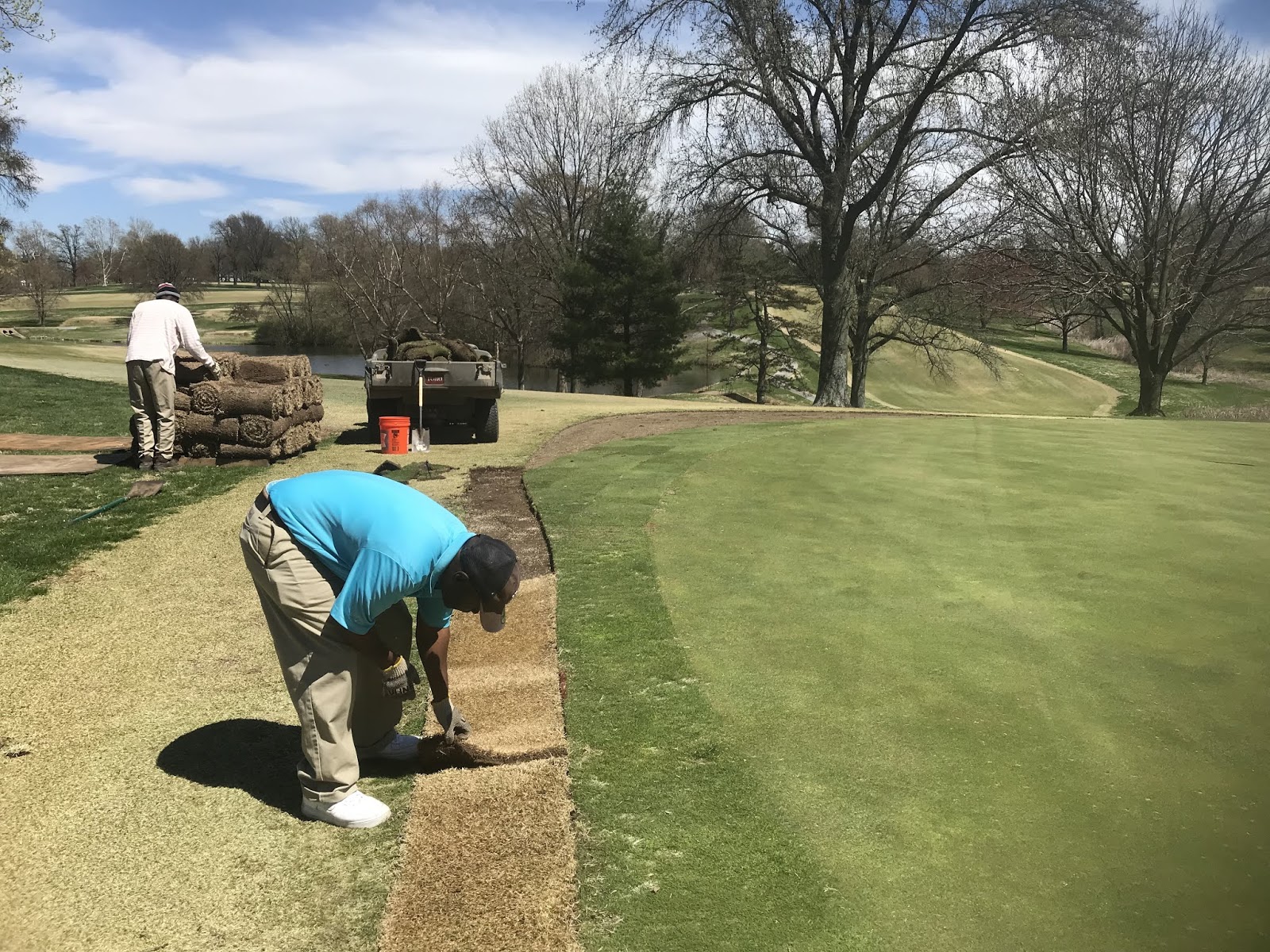
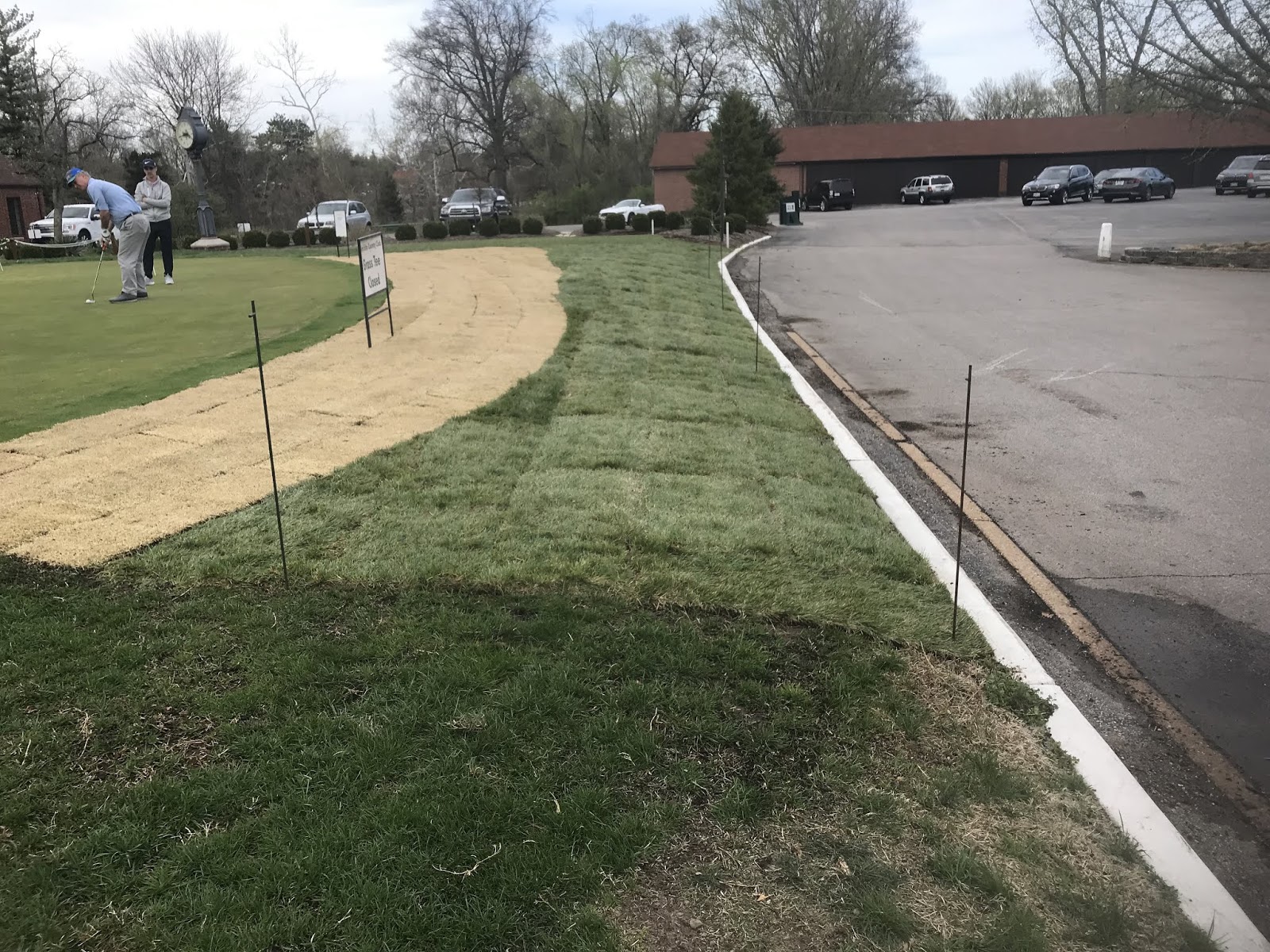
Not much of a zombie guy but the staff has been getting that sod zombie strut going pretty good the last couple of weeks. They laid another 500 yards on holes 5 left rough to finish the bunker surround area. 7 back right bunker entrance, 2, 11, and 15 approach's and the east side of the practice green area were all sodded. Also a couple of stump holes were covered up and some repair on 4 approach. Pulled up some good bent grass on the approaches and laid it on damaged collars. Normally when we have cut off larger areas for repair, we've used a tractor with a blade and the backhoe as well as a dump truck but its been too soft and the areas are pretty sensitive for large equipment. All these areas were hand picked up. We were able to place the sod nearby this week after our backhoe repaired which kept them from having to load into carts and then unload onto the ground. Staff did a killer job on all of this work!


Left collar on #11 repaired.

Right collar repair 11.

15 stripped and waiting on sod.

Right side of 15 laying sod.

15 complete


We had completed part of the practice green area near the pro shop and looked at the Pearson Lane side and had to clean it  up as well. Aerified it heavily and then put a couple yards of compost in place to help soil structure a little.


Guys laying the sod on practice area.

Its been mentioned could we place some zoysia around so you can practice approach bump and runs so we did a decent sized strip on the east side of the practice green. Not really a place to be chunking out areas of sod but should be able to practice and few bump and runs. We might have to close sections of this during the season when play has worn it down a bit.
We also put some entrance and exit areas on the  pro shop side to try to spread the walk on and off area. We hope the soil modification, irrigation and aerating we will be doing will help keep this area looking good as well.

From the pro shop walk way. Did a larger cut out of zoysia neared Doc Ott's clock area.

Finished the area between the bunkers. Still have to repair the sod trench line from new irrigation.
Another look on 5.

2 approach repair and clean up.

2 approach

The mowing of greens are becoming more regular along with rolling. The first mowing of rough, tees, tee surrounds, fairways occurred this week and bunkers were trimmed up. Finishing up on our pre-emergent applications and we do have a great deal of broad leaf weed control that will take place over the next couple of weeks. Dandelions, clover and some cool season weed control.

We did some finish grading around the new 2 tee complex. Trying to get our laser leveling contractor in over the next week. We are going to have to dig out part of the back tee. The soil is soft and pumping so we will dig it out this morning and put some good hard Glen Echo clay in its place. Little video below showing the smoothed out area.

https://www.youtube.com/watch?v=_KPSyWUcEn0


Update on the repair to the back of the tee. Dug out a 10' x 12' section of the back of the tee this morning and back filled with some Glen Echo clay. The soil that was originally used was excessively wet and plastic like not allow the surface to firm and ultimately would have settled. The new soil should improve the situation.

Skip dug out  about 2' of fill that ended up being too plastic/rubbery.

Back filled, packed and smoothed over.

Tuesday, July 26, 2011

Green conditions and other turf concerns

Our greens have faced some difficult conditions over the last couple of weeks with what appears to be more to come in regards to hot weather.  We have gone two weeks without rain which good good during high heat because we can control the amount of water to our greens.  However, our greens have become consistently inconsistent throughout the profile.  There is plenty of moisture in the surface area but we are seeing less than adequate levels in the 3-4" area of the profile which makes for difficult management of our putting surfaces.  As mentioned in last weeks post, we are using all tactics to help get us through this most stressful period.  


11th green is definitely struggling with wet and dry issues.  Normally one of our wettest greens, we have struggled to get its moisture where it needs to be.

7th green with some stress but holding its own.


Our collars have taking a beating over the last week.  The green surrounds are beginning to pull water from these areas and we have reduced inputs to the green so there is less availability from these areas.  We have pounded them with water from our hoses but to no avail in some cases.  Hopefully, some of the turf has just gone dormant and is still alive in the crowns and will rejuvenate during some more normal weather.  Some areas that have taken the most beating have been the practice green, left side #16 and the front of #3.  All trouble spots from the past.

Our Zoysia/Bermuda tees are fantastic and some of our cool season tees are beginning their yearly struggle.  Drought stress or inadequate water distribution, disease and conditions just too hot for cool season tees(mixtures of poa, bent, rye and bluegrass) are just some of the issues we are facing.  Removal of a few trees, raising the teeing level and or modifying locations of these tees would be something that should take place in the near future.  Less water, no regular fungicide applications and great summer conditions are more the reason to remove these type of tees from the property.  We have enough space for the zoysia to survive the amount of play that we have on a yearly basis.  The first 20-30' of this tee is beautiful zoysia because it received enough sunlight to adequately grow a warm season grass.


Our cool season fescue green surrounds are holding their own right now.  They are stressed but doing okay.
The back of 10 green surround is a great example of how our fescue program is working.  You can see the line between the good fescue turf on the left side and the junk poa, bluegrass turf on the right.  This will be replaced in the future to improve the overall look and playability of this area.


Thursday, July 14, 2011

Back of #3 green surround

I had mentioned in an earlier green committee meeting in the spring that I intended to improve the back middle and right hand side of the green surround on #3.  The area is sun filled almost all day long and is incredibly hot in the middle of the afternoon. The intermediate cut is beautiful zoysia which is at 1.25" and is like carpet.  We decided to extend the zoysia back another 16' which places it to the bottom of the back right mound.  We then put another 16' of fescue which will be cut by the green surround mower at 2". Poa annua  overwhelms the area each fall and we decided to remove it for good and replace the area with the sod.  We had hoped to have this work completed sooner so it would be grown in completely for The Invitational but weather conditions would not cooperate this year allowing us to get everything accomplished .  The work was started early Wednesday morning and was completed and in place when the gully washing rain hit the club late that afternoon to no ill effects on the sod.  This area was one of the worst looking areas of the course from mid- summer until fall.  It will be much improved from both a playability and visual aspect.


Jason cut the sod off with our walking sod cutter.  Skip is using the box blade to push the material into the bucket and it is then placed in our single axle dump truck.

A better view of the area.  #3 green is in the back ground.  I am standing near the blue tee of #12.  

The staff finishing up the fescue being laid.  Jason is hand watering the zoysia that was put down in the morning.  The big roll sod provides for a much quicker application and I believe it  heals in much quicker than normal sod pieces.
I

Saturday, March 5, 2011

Dye around Greens

Anyone who came out and played over the last couple of days has seen some marker dye being used around our greens, fairways and tees.   I was completing the preemergent/roundup application in our warm season turf areas which controls in season goosegrass and crabgrass germination and will kill the poa annua that pops up in places.  The staff used a 4x8 sheet of wood to drag around the edge of the collars to protect our green/collar turf from any over spray as we drove around the collars.  We might have some small hand applications to spot treat over the next few days due to bunkers being too close to the green surface or the sprayer moved a little further out then planned.  We will be applying preemergent and weed killer to our cool season first cut rough toward the end of March/early April.

Green #16 complex and the marker dye which indicates to the operator where the plant protectant materials have been applied.  

Wednesday, October 21, 2009

New Fescue Sod around greens

We just replaced the intermediate zoysia/bermuda rough around greens #7, 11, 12 and 18.
The picture below is the big roll sod that we used to help speed up the process. There are less seams that need to heal and quicker laying and the material which allows staff to do other jobs. Jason is operating the tractor and Jose is pulling the plastic netting off of the sod as it is rolled out. We initially had to strip out the old sod and hand shoveled this material into the back of carts because of the soft conditions and narrow confines where we were working. A few weeks ago we were able remove the old sod using a tractor with box blade and the front loader and dump truck. A little more work this time.

The picture below is the left side of 12 green. We ran out of time to complete the right side. It will be completed in the next few days. The new work tied into the back of the green which was replaced this past spring.
The view below is from the back to the front along the left side of #11 green. We replaced four widths of sod along the green collar. This is next to the area of sod we replaced last spring. We also placed four strips of sod on the right side and back of the green as well. We do have some bermuda on the side hill and bank which we will begin to seed into and also do herbicide treatments to reduce the aggressiveness of the bermuda grass.
You will notice heads exposed with no sod on them next to a couple of the newly sodded areas. We will be digging these heads up in the next few days and raise the top of the head to the level of the new sod.
This is the walk off area of #7 green next to 8 tee box.
Standing in the same spot at the top of the walk off area on #7 but looking to the front of the green. We also replaced sod on the left side of the green as well to tie into the back of the green.
The right side of #18 green looking to the front. This work ties into the turf between #18 and PG sod which was placed last spring.


Thursday, May 21, 2009

New Fescue/bluegrass green surrounds

I thought I would give you the before and after pictures of the sod work we did at the practice green and 18 green, 12 green, and 17 green surround areas. After the pictures I have a description of how the work was completed with pictures.

I haven't had a shot of Lady lately as you can see her patiently waiting for me. This is a view next to the practice green looking toward the road and the club house


Looking the opposite direction from the pictures above to the area between the 18th green and the planting beds.


13th green looking down toward the tee box. The renovated view is looking back up the hill toward the green. We had to replace some of the intermediate first cut of rough which is on the right side of the picture. The bermuda grass had been severly damaged by our bermuda eradication program.


The 17th walk off area is depicted in the two shots below.


The back part of 12 green was replaced.


PROJECT DETAILS
This past Tuesday, the crew began stripping away the sod from four different green surrounds. In the case of the practice green, it was a complete removal of all zoysia/bermuda grass that surrounded the green. We also removed the area between the practice green and the 18 green, 13 about 20 yards from the left side of the green up to the back end of the left side bunker, the back of 12 green and the walk off area on 17.
Below, Tom Lewis is stripping away the turf with a sod cutter.


This is a view looking from the main drive behind 18 green where all the sod has been stripped.
It took the crew about 5 hours to cut, clean and finish grade in preparation for the new sod.


The sod was then pushed into piles. Assistant Skip is doing the honors in this scene.
Much quicker using a piece of equipment to pile it up instead of removing it by hand. In some cases, we did remove some of the material by hand depending upon the location of the sod which needed to be removed.


Russ is working in one of those tight corners.


Nick has been working along the sidewalk edge manually removing the sod from the very edge of the sidewalk.


The loader was used to load up the material and it was then dumped into our single-axle dump truck. We hauled the material away to our dump area. The operator can set his bucket on the ground and the material can be pushed into the loader.


You can see the dump truck in the background and a cleaned and finish graded surface. We utilized the box blade on our tractor to smooth the area. We also use the bunker rake which does a nice job of smooth finish grading.


We then spread a starter fertilizer on the ground and then begin the sod laying operation. Starter fertilizer has a high phosphorus number which helps the plant establish a good root system. We decided to use big roll sod in this application because it saves man hours in the installation and would be less affected by warmer conditions. There are less seams in the sod which helps to conserve moisture. It only has a seam down the middle and where you are forced to lay another piece of sod or if the sod has to be cut for some type of reason. The turf comes in 40 yard rolls which are about 40" wide by about 105' long. When the sod is harvested in the field, it is wrapped in a plastic mesh which helps to hold it together. This mesh is very fine and can be torn with your hands. It has a 1" square pattern The turf is also grown with a plastic mesh which lays on the field after seeding and the turf grows up through the mesh. It strengthens the turf and helps to keep it together when it is harvested.
We removed the plastic mesh that the sod cutter put on the sod to prevent the material from getting caught in your spikes and tripping you. If the sod would get thin in areas or by chance would die, the mesh would then be exposed which could cause the potential tripping situation. We are rolling the sod out forward here but we changed to rolling it backwards. The operator can watch the sod being laid and keep a better line going backwards. If he is moving forward, he has to keep his eyes forward and cannot necessarily see what is going on behind him. If everything goes properly, you can roll out a 40 yard section of sod and slide it against the other pieces in about 5 minutes.


We laid about 600 yards of sod on Tuesday and the remaining sod went down yesterday. Our total sod use for the 5 areas we repaired this week was 33 big rolls at 40 yards each and 3 pallets at 70 yards each.


Saturday, April 25, 2009

11 Green left surround turf/drainage improvement

With the removal of the Oak tree to the left of 11 green, additional work was needed to improve the playability of the left side surround and to help drainage issues. There was a mixture of dirt, poa, bermuda, rye grass, bluegrass and fescue for a person skilled enough to hit it that far which made for some interesting chipping across the green. There were also drainage issues caused by water above the green and in front of #4 tee running down onto the green. The water that came across the front half of the green would move off of the green because there is just enough slope to assist the water in moving off of the green. Water that would run onto the green toward the back half of the green would be trapped by a low spot that has developed in that section of the green. It would also go across the complete back half of the green and slowly move into the sub-surface of the green and slowly work its way out the front of the green. As most everyone knows from playing this green, it is flat for the most part as is the subsurface so moisture would be retained in the green for long periods of time.

Our Master Plan architect, Spencer Holt was in town in January to meet with me regarding a couple of planned projects. I mentioned to him that we had some pretty serious water issues with this green and that we needed to improve the area. We shot some grades with the transit and he worked up a diagram below with the removal of the tree on #11. I just wanted to show you an illustration of the type of support documents that we can do our work.


I'm missing a couple of pictures but will fill you in on what I missed. The soil/sod mix was stripped away with a walking sod cutter. The area is about 45' x 100'. The material was pushed into a pile by a tractor and blade and then loaded up into our dump truck and hauled to our dumping area.

Skip and Russ After sod stripped away and backhoe was used to make our drainage catch area in the back left corner. The staff have already laid some of the sod in the background toward the front of the surround. Excess dirt was hauled to various spots where we needed some soil. # 3 and #12 rough area where we had some ruts. The curbing at #6. The right front entrance where grass will not grow and we will be placing a small hosta border in place of bare ground and some was hauled back to our storage area for future use.


Different view of the same area. Digging out some smaller drains that were located in the back corner.


Skip is trenching and Russ is checking depth to insure that the pipe will drain. We had a transit set up in the background to the left of the tree which set the original depth.


Russ is using a saw to cut through the asphalt so the trencher can continue it's work. A dirty job but someone has to do it.


Old clay tile that we cut through in our trenching operation. We are assuming some of this material was from some type of greens drainage. In the catch basin area, we used perforated pipe(pipe with holes in it) and pea gravel to allow water that is underground to move into this area and be drained away. We laid a couple of inches of pea gravel on the floor of the trench so soil does not move into the pipe.


Old galvanized irrigation pipe that we had to work our way around as well. We actually hit this in two spots.


The 6" drain pipe lying in the trench. We placed a couple of screws on each side of the coupling and wrapped duct tape around it to insure it does not pull apart.


This is the catch basin area with the 12" drain. The pea gravel was placed within the top inch or two and we then placed some sand over this material to the top of the trench which will help our sod hold some moisture and will stay alive.


The finished product from the left front approach area.


From the right front corner. In working with out architect, we wanted to make sure the catch basin area was deep enough to catch the water coming into that area but soft enough to not change the overall view of the green area as you were playing the hole.
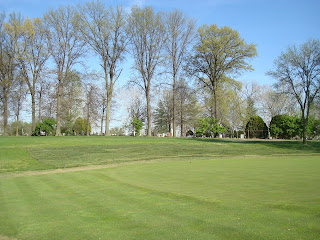


The back left corner of the complex looking out toward the front. You can see the catch basin in the foreground.


The view below is from #4 cart path looking toward #11 green. This is the direction that the water will flow from down into the #11 complex.


In playing in the Opening Day event today, the green at #11 had sun on the complete green at 9:45 a.m. this morning. Below is the view from last August when I did some timed photography to determine the amount of shade that was covering the greens during the day.