Showing posts with label bunkers. Show all posts

Friday, April 8, 2022

Edge, Vertical, Install, Removal, and Notch

We have not had the greatest weather over the last few weeks. A few dry days, then some cold and wet weather. Staff have been changing the pace more than Adam Wainwright to get things completed for the season at Glen Echo.

EDGING OF BUNKERS

The staff began the arduous task of edging bunkers and moving sand around in them this past week. They completed Holes 1, 3, 4, 7, and 5 with a little more work to be completed. I have a video below which will give you an update of the work and what it takes to get to the finished product which I will bullet point below;

  • Edge the lower side of the bunkers. Use a sharpened sod shovel to reform the edge removing the sod that has grown over the old edges. Shake the excess sand from the sod.
  • Locate the depth of the various areas inside the bunker to determine which areas need sand and which locations need some sand moved to the more shallow areas.
  • Shovel the sand or if there is room use the blade on the bunker rake and push into place.
  • Rake the bunker and move to the next. Took 4 staff members all day to work on about 11 bunkers.
https://www.youtube.com/watch?v=rLbqJOOWHfY

Completed


VERTICAL MOWING OF GREENS

This past Monday we took advantage of the golf course being closed and vertically mowed our greens. We have a set of reels that goes on our normal greens mower that mows up and down instead of a lateral mowing that we do on a regular basis. There are 37 blades on each mower that cut straight down into the canopy of the turf. These blades are about 3/4" apart and cut through the top of the surface of the green cutting longer turf blades and pulling up small amount of thatch in the process. We only set our cutters to about a depth of 3/8" so the healing process is pretty quick. The purpose of this practice is to help stand up the blades of grass and cut off the longer leaves of bent grass. Bent grass from its name lays over and can become longer relatively speaking. The longer the blade, the more friction placed on the golf ball which slows the balls roll out.

Once we've vertically mowed, we then use a drag brush to stand the turf up and spread the sand and thatch around on the green. The regular mower than mows the green picking up a majority of the excess leaves and thatch material. First video is of the vertical mowing and 2nd is the regular mowing to clean up the material off of the green. 

https://www.youtube.com/watch?v=SGZBxOAWgPM

Vertical mower, as you can see the blades are in the vertical position.


 https://www.youtube.com/watch?v=dJZCu9mnPn0


FENCE INSTALL

The fencing along St. Mary's Lane was made up of a lightweight aluminum fencing which is difficult to stand up against a large area mower. Of course its important that our mowers stay away from the fence as well but at times it would bump up against it and stretch it out of shape. We will be installing an 8 gauge galvanized fence from the Wallingford gate down to the entrance to the club. A majority of this work is complete. We need to bring in another roll of fence to complete the project.

Staff stretching the fence along St. Mary's.

Look from the installed side.

TREE MANAGEMENT PLAN

Over the last few weeks, we've removed another 5-6 standing dead Pin Oaks that succumbed to the Wasp Gall that have invaded our property. We still have 2 to remove on the right of 2 and a dead Sycamore along Lucas & Hunt as weather permits. We had hoped to have all ground out stumps filled with soil and covered with sod but have not been able to get this accomplished because of the lack of lengthy periods of dry weather.

NOTCH ON THE BELT

As most of you know, I've been on a journey over the last few months to improve my physical health and along with these efforts my mental health is improved with the release of hormones and other positive effects of the weight loss, proper eating and exercise helped to create.. My participation in the GO! St. Louis Marathon was an accumulation of efforts since December 10th that have led to weight loss of about 33 pounds and exercise in which majority of it included walking of over 300 miles. During the 12 week challenge with over 130 fellow superintendents, vendors and family members, we lost over 2,200 pounds and I lost 33 total but only 23 during the start of the event on January 1. As I continued to push myself to beat personal bests in waling distance and pace, I decided to do the 1/2 Marathon at the end of February. A couple weeks later after walking along with some jogging I went over 16 miles and the die was cast to try for 26.2 miles. 

My desire is for this to be a permanent change in eating and general exercise which. I still have a goal to get down to 170 pounds(11 more to go) and be at my college graduation weight. I appreciate the memberships support of me during the period. Its been a great experience to date.


I hope to see you out on the course soon.


Tuesday, June 4, 2019

Course Report


The following statements were made by Dr. Lee Miller, University of Missouri Extension turf grass Pathologist. They were opening remarks to his last four messages over the past two months. 

He supplies biweekly reports regarding turf grass issues that are being seen throughout our region. He talks about what he is seeing and then discusses potential cultural practices that have proven effective to improve turf conditions. Of course, when most of the issues are environmental and or weather related, one has to wait and be patient before real and effective improvement is seen. 

4/5/19


March madness may be over, but the consistent wet and cool weather pattern seems to be sticking around in MO. Temperatures are slated to rise slightly over the next few days, and infection of zoysia grass by the large patch pathogen will presumably be occurring. The over abundance of rainfall may not only flood the Missouri River, but also result in a flood of large patch in the region.


"This wet weather pattern is shaping a severe season for this disease, and this weekend's warm-up will likely get large patch pressure cooking. With the amount of rain the region has experienced, I expect fall fungicide applications may not be entirely sufficient for control and spring applications may be necessary.


4/23/19


The wet winter and spring is causing some head or belly aches for some zoysia managers in STL and mid MO. The wettest winter since 1984-85 and subsequent cool and rainy spring pattern has resulted in slow, and perhaps no, green-up thus far. Widespread winter kill of well maintained ‘Meyer’ zoysia would be a first since I arrived in 2010.

"Several reports in the last week have expressed extreme concern over the lack of zoysia green-up, and the potential for large amounts of winter kill on some golf courses and home lawns. As mentioned previously, the 2019 winter was the wettest since 1984-85, and the 5th wettest on record.

5/14/19


Spring is running about 50-70 base 50 growing degree days slower than last year, but most plants and spring turf grass diseases are in full bloom. This week’s warm up will hopefully spark warm-season grasses out of their slumber, and let worried turf grass managers and homeowners know if the wet winter won the battle.


6/4/19

A ton going on in the past week, and unfortunately a lot of it falling from the sky. Preliminary reports are that May probably will be the wettest on record in Missouri and those in Kansas City broke the record for sure with an astounding 12.82” in the month. Winter kill reports on warm-season grasses are also widespread across the state. In the good news category, cool-season grasses are faring well in this mild weather.


Even though it seems that rain has never let up, we have been able to make progress on the golf course. The wet conditions have still made it difficult to mow regularly but when we have been given a little open window, we have been able to improve overall conditions throughout the course over the last couple of weeks.

We just fertilized our warm season tees about 10 days ago. We hope to get our fairways fertilized soon but conditions have been so wet and or storms being predicted that we did not want to lose the benefits of the fertilizer so we have delayed this application. We use about 5-6,000 pounds so its important to make sure most of it stays on our property at Glen Echo.

We are starting to see some growth in the fairways even without the fairway fertilizer. We mowed last Friday and Monday and there were some clippings beginning to accumulate from the mowers so we are getting growth.

The slowest that I've had greens to heal after aeration over the last 10 years at Glen Echo. When we completed the aeration in March, our average temperature model was about two weeks behind last year. As we moved closer to May 1st things began to tighten up. We had a number of night time lows below freezing which stunted the healing process in March and April. We also provide significant growth regulation in the early spring to our greens to reduce the impact of seed heads in the stand of poa annua we have throughout our putting surfaces. 

Our control this season was exceptional for the most part but it did significantly effect the healing process. Once we were a month into seeing  the holes were not closing, we allowed our regulators to run out. From around May 1st on the greens have not been regulated but have been very slow to grow. This is mostly due to wet soil conditions and reduction of overall sunlight. We've been able to mow one day and roll the next because of the slow growth. As we have begun to warm, we have been increasing to almost daily mowing to improve ball roll. We have also started rolling on days that we mow to increase roll out. 

We've had pretty good success in combating large zoysia patch on fairways with just a spring application of fungicide but this season was not very good. Probably the worst I've seen in the 29 years I've been in the business. It does thin the turf but once we apply a curative application, the disease usually begins to go into check and the grass begins to fill in. We will probably do a fall application on the most severely impacted fairways this season to discourage a repeat performance in the spring of 2020. There are still some areas of activity but they are smaller in scope and should begin to fade as temperatures increase and the rain hopefully subsides. 

We've also treated fairy rings that have popped up as well. Most are in check but some appear to have loss of turf. We will replace these over the next couple of weeks.

Over the last 10 years, we have worked diligently on attempting to corral the berrmuda grass in our fairways and intermediate through mostly chemical treatments but also with sodding. We have some areas that need repair and we will work on those over the next couple of weeks. 

We will be spraying our healthiest fairways where the bermuda is beginning to pop up in small spots to allow the zoysia grass to spread and improve. We will also begin to aerate fairways and tees as conditions begin to dry. We will probably not do a large scale aeration operation but will be foreced to do individual fairways at a time during the month of June.  Our goal is eliminate the disruption of the fairways before the end of June to allow our zoysia to heal and be in great shape from July 4th through the end of October.  We have spent tens of thousands of dollars on chemicals, sod and man-hours improving these surfaces and will continue this work. We do not want to take steps backwards.

We have been pretty lucky here at Glen Echo this season on the amount of total turf loss we've experienced in our zoysia. Some clubs have had to replace complete fairways. We have a few isolated areas. Our thin areas will begin to improve as we dry, warm up and apply nutrients.

The staff have worked very hard at keeping damage to a minimum while operating equipment which has caused some difficult conditions for you and the game you love to play. Last week, we were able to string trim around all trees through Hole 15. We've been able to do a little less push mowing of certain areas. I still warn you if you are in the lowest area of a hole, it is probably the wettest spot and could lead to damage or a cart being stuck so be careful out there. 

We've been for the most part hand raking bunkers this spring to allow the sand that we added in late winter to firm. Two tee looks great but was very slow to set roots but we finally opened it last weekend. We added about a foot of dirt to the surface which had to firm causing additional delays in our sod being laid. Much different than the fifth tee last season which was basically leveled on the existing surface. A few limbs and or small trees will be removed to increase sunlight which will be necessary for the zoysia to flourish on this new teeing ground. 

One of the things that my experience has taught me is to remain patient. I've come to understand that most of the difficulties we face as turf managers comes from within and being impatient and trying to force mother nature and do too much. Mother nature always wins these battles so I remain patient and attempt to not freak out like the guy below. Hope to see you on the golf course soon!


Thursday, March 21, 2019

Collar/Approach Renovation and Bunker Work

The staff has had busy week. We removed the false front bent grass approach on #10 and used the bent for collar repairs on holes 3, 4, 5, 6, 18 and the practice green. Over the last few years we have been converting these approaches to zoysia grass.  There are a number of reasons that this is being done:

  • Less chemical applications since the approaches are now zoysia. This will reduce our overall chemical use which is good for the environment.
  • Zoysia requires less water which will make the approaches more firm and allows the ball to release forward onto the green instead of hitting the more heavily watered bent grass approach and stopping.
  • Our collars are mowed with a walk mower which takes more time to mow than the riding mower we can use on the approaches. We have converted them to a single pass mow which reduces labor which can used on other areas of the course. 
We still have larger approaches on 7, 13, and 15 that will be completed over the next couple of weeks. We reduced the size of 2 and 11 a few years ago but they are still larger than the single lap collars we have converted. We will attempt to remove these if time allows. If we run out of time, they will be worked on this fall.
Laying zoysia sod on 10 approach. This sod was taken off of 2 tee and used for this new approach. Saved operation a full pallet of sod which costs about $ 300 including delivery costs. It does take extra effort to do it this way with cutting the sod, lifting it and laying it but its great to use turf in another area.

Staff continue to lay more sod on 10.

This is a before with the old bent grass being stripped off by the sod cutter.Tom is cutting the bent grass sod into pieces so it could used again on damaged collars.

Staff in front of 3 green on the collar removing bermuda infested and thin turf.

New bent grass sod in its place. We saved nearly 400 linear feet of bent grass to use on our collars.

The guys are finishing up the left side of #6 green collar.


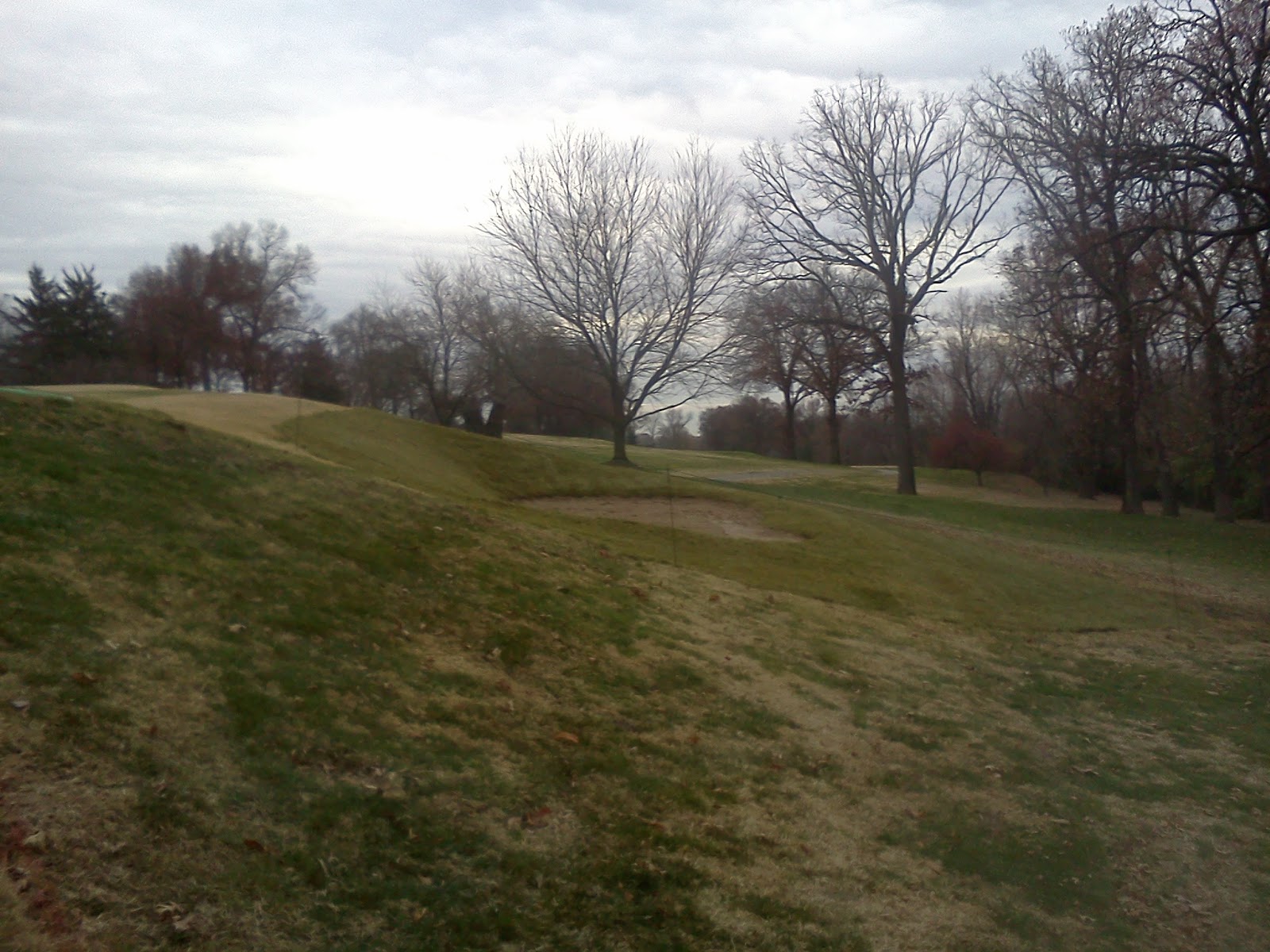
This morning the staff began working on our bunkers. Currently they have completed edging and redistributing sand in bunkers on holes 1-8 and the 2 large bunkers on 7. We will attempt to get the rest by early next week. The work has included adding additional sand to each bunker as needed from checking depths. As a player, you should expect that the sand will be a little fluffy in the bunkers that have been worked. It will take some time for us to get the existing sand to be mixed in with the new sand. We will be taking our packing machine out after heavy rains to help firm up the surfaces over the spring season.

No, not a Fox digging holes. These are check holes to see the depth of sand in the bunker to determine if we need to add any sand to the bunker or distribute deep areas of sand to more shallow areas.
Bermuda grass the was removed from normally the lower side of each bunker. Over time the bunkers shirk in size due to this fast growing plant.
Sand waiting to be added to the bunker on #1.

Newly added sand being shoveled and raked on #1.

Completed bunker on the left of #6


Tuesday, December 4, 2018

Bunker Repair and End of Season Greens Spray

Our bunkers have gone through their 6th season and are in need of some repair. Most of the entrances and exits have some wear and tear issues from both equipment and efforts to keep them clear of debris. We spent most of the day on Friday reparing the left front bunker of #5.

The first thing we had to do was remove the sod along the edge to locate the actual edges of the bunker. We had to remove the excess sand that has been either blown out or drug out by our bunker rake.

We took the sod off and scraped the sand down to the soil layer and dug down along the sand until we found the original bunker edge that was done in 2012.

Once this was completed, we then laid new fescue sod and then moved the sand up against the new sod to assist in stabilizing the bunker edge over the next few months. In some cases, we will need to remove sod from the green splash side of a bunker as well. We will attempt to complete a bunker a week until sod cannot be cut from our supplier and will then begin again in late winter/spring hopefully completing most of the problem areas before spring has fully arrived. We will of course be checking sand depths and adding sand as needed as well to insure we have proper depths for our members and guests to play.

Some of you might have noticed the greens were pretty bright in color over the weekend. No, not a lot of growth taking place. We sprayed a fungicide called Civitas 
which has some late season benefits as well as early season benefits for 2019. Click on the link if you want to read more about it.


Right front edge of the #5 first bunker on the left

Arrows designate the edge of the bunker. We stripped off the sod from the tip up the arrow back up the slope. Sand hand been pushed up over the actual bunker edge so we dug down into the sand bank to find the original edge of the bunker Kyle Goalby had originally shaped.

Sand/soil mix being removed from the dge

Repaired edge with new sod. 

Sprayed the greens late last week with a fungicide which delays fall/winter dormancy and should assist in spring green up. Yes think spring!

Thursday, July 6, 2017

Excellent Article On Bunkers

Excellent article from the USGA regarding bunkers and the reasons why they might play different from bunker to bunker.


http://www.usga.org/content/usga/home-page/course-care/regional-updates/west-region/2017/five-reasons-why-bunkers-are-not-consistent.html

Thursday, June 4, 2015

Video Regarding Tee Aeration, Juvenile Red-tailed Hawks and Other Information

Rain put a damper on our tee aeration plans today. We will probably finish the work next week. Video discusses that work as well as the fairway turf situation, greens bunker edging and a couple of other areas. Photos below also add to discussion later of these subjects later in the video.

Our Red-Tailed Hawks picked up stakes and moved to the Sycamore near 5 White/Blue tee this year. I had kind of lost track of them this season until Ms. Herrin mentioned where they were located. If my eyes don't deceive me I think we have 2 juveniles about ready to take off on their 1st flights soon!

https://youtu.be/0kS6uzl8yzU


Bunker edging. Sand was deep enough along edge I had to use a spade shovel to reform the edge. Back 9 are complete as is  Holes 8-9. Hope to finish the rest of the front next week.

From time to time you will notice some black algae appearing on greens. This usually occurs because of climatic conditions, warm and humid conditions and sometimes and the end or past time for a fungicide application. The past 6 weeks have seen a weekly application of some type of required spraying product either it be a growth regulator, summer root disease management product and wetting agents to keep profile consistent in its moisture content.

This is from the 2nd green and the ugly reddish colored turf is poa annua which does not like Paclobutrazol, a growth regulator product we have been spraying every 30 days or so to help reduce the impacts of poa on our greens. My last application last week was 1/2 the rate of the month before.  As we get into summer, we cannot over stress the poa annua or it becomes poa deadua.  Too much poa annua dying quickly could contribute to yours truly's untimely demise. This type of condition does help bentgrass grow into the area and improve our total amount of bentgrass coverage. Losing 20-50 poa annua is something I do not want to see in my lifetime unless I was spraying Round Up and trying to kill it. 

Thursday, April 10, 2014

Leaf Patrol, Bridge work and foot prints in bunkers

After mowing greens this morning, part of the staff spent the rest of the day clearing a large amount of leaves that accumulate over the winter along our fence lines.  They hand rake and use backpacks to blow the leaves in rows so that another staff member with a tractor and vacuum can then come by and pick them up and haul them to our dump area.  They were able to get a large portion of #4 completed and started on part of #3 because the winds changed direction.  This normally takes 3-4 days to complete the entire perimeter of the fence line of the property.  If the leaves are not picked up, they will kill grass along the fence rows, make it difficult to locate a stray golf ball and can also be blown back into play areas when  the wind blows in the right direction.
Jason picking up the rows of leaves along 3 that Jeff, Randy, and Sam blew away from the fence.

Skip, Russ and Tom worked on the 15 bridge/spillway project today.  A couple of portable mixer loads of concrete were placed underneath the 15 bridge spillway to shore it up and stop the scouring of gravel from underneath the structure.  The guys mortared some cracks in the upper part of the spillway to reduce leakage underneath the structure.  We plan to place a new concrete roadway on the bridge, preferably a Monday in the next couple of weeks. Still have to talk with Skip about the concrete flume work that I originally had discussed.
Skip, Russ and Tom pouring the concrete through the hole cut in the lower spillway. You can see the boards in the foreground and background that were used to prevent the concrete from coming out from underneath the structure.

I sprayed greens today with our seed head suppression product that I discussed a couple of weeks ago.  The requirements of the application are that you spray it no later than 21 days after the first application.  I was 1 day on the back 9 and 2 days early on the front 9 but early is better than late. I was concerned with a potential report of rain overnight and with Men's Opening Day on Saturday, did not want to be late with the application.  It appears our application is working but we still have not reached the peak flush for seed heads which should occur in the next few weeks and last for at least a couple of weeks depending upon the weather.

During the spraying today, 17 green was one of my last greens to spray. I took a picture below of a bunker that was not raked.  What was most surprising to me was that all three bunkers appeared to be not raked and all had foot prints in them.  Please be aware that bunkers are not raked every day and if you leave your foot prints in a bunker, players behind you are potentially left with a difficult shot if their ball would fall into a foot print.  Please be considerate and rake the bunkers after you use them.  Interesting, a majority of the other bunkers were raked properly.
The right bunker on #17 that was not raked after balls were hit from it by what it appears to be at least two different foot prints.

Friday, May 31, 2013

New bunker drainage

Quick video of the outflow from the 3 bunkers on #7.  Always great to see things working properly.

Friday, May 10, 2013

Playing from our new bunkers

The weather has not allowed us great access to the course this year but one area of the course that can now be played on a regular basis is our bunkers.  They are draining nicely and the sand is fairly consistent.  There are a number of items that I need to address regarding the bunkers and ultimately their play-ability.

There is no doubt that they play much different than what we had in the past.  New sand in general is always different than older sand.  It does not have any silt or dirt in it and does not compact as well.  It does drain well and for the most part is the same consistency.  All the bunkers have drainage but some are in the sun more or in the open where wind can dry the surface out.  Sand that has a small bit of contamination in it does not drain as well but it does play firmer than new fresh sand.  Can't change the physiological makeup of the materials.  It takes time for this material to settle and for us to get familiar with how to play out of it.

I polled the green committee last night.  Some are not having an issue and some are.  I went out this morning and hit 3 balls out of the 18 left bunker. One hoped one off the stick for a gimme, 2nd within 8' and the third flew off the green.  Tried a couple of other bunkers and could only flip one out of the bunker of 3 and flipped three out of the bottom one but only one made it to the green.  Very inconsistent at best by me which is what you might be going through.  No doubt, our golf professional Barrett Martens can help you with some techniques or equipment/club changes to help your bunker play.  He has already been working with individuals and groups in improving their bunker play.

Below I've listed a few things we have been doing and will do in the future to improve the play-ability of the bunkers as best as we can.


  1. We will continue to use our vibratory plate to help compact the bunkers.  This is a short term improvement and will continued every 4-6 weeks during the season. 
  2.  We will begin to evaluate sand depths to make sure we have what is considered proper depth of 5-6".  During the building there could have been some increases in depth.   
  3. As the rains subside, we will be apply some wetting product to the surfaces which will assist them in holding more moisture which will firm up the surface.  Also, as conditions begin to dry down, we will be using our surround irrigation which will keep the bunkers surface/subsurface a little more moist which helps with compaction.
  4. We will be working with our new mechanic to make adjustments in our raking machine to reduce disruption of the surface which increases drying which contributes to fried egg lies.  Brooming sand, reducing the tines on the rake will dry the sand at the surface.
  5. In time, some natural organic material will make its way into the bunkers and break down.  Grass clickings, tree debris, some small amounts of soil from time to time which.  We attempt to keep the bunkers clean but this is a natural process which occurs over the years the new sand is in place. 

Excuse my amateur attempt at video.  Used my cell phone this morning to talk about my effort at a bunker shot.   


Saturday, May 4, 2013

The staff and I are so happy!!!

The staff and I are so happy that after 2.4" rain yesterday, we were able to put the course's bunkers back into play in less than 3 1/2 hours.  We do have a few less bunkers than last year but we have bunkers that drain and have very little washing of the faces.  It took just a little over 1/2 hour more than normal to do our work this morning.  Not happy over the wet conditions but extremely happy with the work that we accomplished in a short period of time.  Have we said thanks enough yet?  We do not believe so!  Thank you again!!!!

Wednesday, February 20, 2013

#14 Sand replacement completed

The staff finished the sand replacement on the 14th hole today so all bunkers now have the same sand.

Tuesday, February 19, 2013

#14 Sand Replacement

The staff spent the last two days removing sand from the bunkers on #14 and putting the sand back in the bunkers that we used last fall on the project.  Skip and I worked on the front right bunker yesterday while the guys had President's Day off and everyone returned today to finish off the right side bunker and rear bunker.  We should have the front left bunker completed on Wednesday before the storm moves in on Thursday.

Skip placing the bucket down on the bunker floor so we could shovel the sand into the bucket and he could fill the carts to haul the sand back to the shop.

The staff this morning finishing the rear bunker on #14.  Cold morning outside, brrrrrrrrrrrrrrr!!

Wednesday, November 21, 2012

Day 39 Bunker Restoration, ALL BUNKERS ARE FINISHED, TERMINADO, TERMINEE, FINITO!!!

The staff finished the practice bunker on Tuesday which is the last bunker in our overall project.  We had 45 bunkers when we started last season and now have 37 bunkers to maintain.

The project has come in at or near our budget.  There were a few surprises along the way but most everything went as planned.  The staff faced some pretty difficult circumstances with the rain we experienced in the first half of the project but some dry weather over the last half allowed us to get the project completed fairly close to schedule.

Plans for the next couple weeks include:

  • Cleaning up out flow trenches and sodding as needed.
  • Sod the bentgrass collar back in place along #17 
  • Hand watering the new sod to push root growth before winter sets in.
  • Trimming sod edges along the bunker edge.  
  • Back filling settled trenches and seeding areas next to construction which were disrupted but did not      require new sod.
  • We will also be expanding the targets that Kye shaped before he left the project and will be seeding them with rye grass and covering them with straw.  We intend to sprig the targets with bermuda grass in mid-spring so that they can be mowed tightly giving them a green surface appearance.  
Staff edging the practice bunker.

Forming an edge which will allow the new sod to tie into the existing area.  

Removing the old sod along the new edge.

Sodding the new practice bunker.

The finished practice bunker!!

Monday, November 19, 2012

Day 38 Bunker Restoration, THE GOLF COURSE BUNKERS ARE FINISHED!!!

With great anticipation and excitement, our bunker project began on September 17th.

 At the end of the day today, I am relieved and very happy to announce that we have completed the bunkers on the golf course!!  

The remaining sod was placed around #17.  The soil was removed from the trenches of #1 and drainage was  installed.  Sand was hauled into the bunker and sod was placed around it.  We plan to complete the practice bunker on Tuesday.

At this time, the following bunkers have been opened for play.  Bunkers that are open for play have no ropes around them.  As the sod continues to mature, we will open additional bunkers to play.  

#3 left bunker                     #6 left bunker     #13 left bunker
#4 left bunker                     All of #7             All of #16
#5 left approach bunker      All of #9             All of #18.

The staff removing the soil from the trenches on #1.

Sand being added to the bunker.

Sod being laid around the bunker.

The bunker completed.

A view from along the fairway of #1.

Saturday, November 17, 2012

Day 37 Bunker Restoration

The staff was able to get the three bunkers on #17 nearly completed on Friday.  We still have the outflow trenches to back fill and packed and we have some sodding to do on the right bunker.  We also have some bentgrass collar that needs to be replaced.

We will be cleaning out #1 bunker on Monday, install drainage, sand and sod which will complete the golf course portion of the project.  We still have work to do on practice range and will take care of that as soon as possible.  We will be spending the next couple of weeks checking and cleaning up our work areas, back back fill settled trenches, trimming sod, watering, mowing and other work to get the bunkers and course ready for winter.

Randy moving sand in the left front bunker of #17.

Staff spreading sand in the left rear #17 bunker.

Finishing the sand in the left bunker of #17.

Placing drainage in the right side bunker of #17.

Sodding the right side bunker of #17.

More sod.


Right side bunker #17 nearly complete.  Some sod work around the green and the front edge of the bunker and outflow trench back fill.

The left bunkers on #17 complete except for some drain outflow work and collar sodding next to the green.

Nearly complete, #17.