Bermuda eradication work is going well with our first spray that took place around July 23rd. Short video which stopped before I could complete my explanation(maybe my camera is telling me something). Larger Bermuda patches are pretty obvious from the red color that the Bermuda gives off as the chemical is taking effect. I was not trying to scare everyone off when I made the post regarding take your pictures now. I just knew that areas of the course would not look quite as green as they did but they still look pretty good when you see the effects the chemicals are making on the Bermuda. It will take more applications to get a pretty solid kill. The overwintering spray has a tendency to be the most effective.
I will make another application in the next couple of weeks and will complete the third application toward the end of September which will help us considerably for next season. Some of the Bermuda areas that are intermingled in the Zoysia are not as easy to locate but their are plenty of areas like this that we need to continue to hammer with these products to help push them out completely.
We do have some pretty serious issues with contamination in our intermediates in which some areas have little or no Zoysia. The left side of 10, right side of 5 and a few other areas where the Bermuda has moved from the rough into the fairway. This is coincidentally the areas which are sometimes shaded as well which discourages Zoysia and encourages Bermuda. Some of these areas will be treated with RoundUp and killed off completely and then sodded. I might do a couple of these just before dormancy this fall and then replace them in the spring with new sod. Looks like it is dead anyway when it goes into dormancy and will help us next spring get an early jump on sodding.
https://www.youtube.com/edit?o=U&video_id=CqIuKoZvhi8
On Tuesday, E&E Enterprises whom we contract with to vent our greens with the Hydroject machines arrived on property and completed our 100K sq/ft of greens in about 4 hours. A very short video of a couple seconds posted below. Did not realize I had my camera set on time lapse at the time and they were gone when I decided to put the video on YouTube.
As usual, 4-5" in depth improving our greens in a number of ways with gas exchange, oxygen in, carbon dioxide that builds in soil out. Improved rooting with channels formed that are full of oxygen. We do not get a lot of new roots this time of year due to high soil temperatures, just checked this afternoon and at 2" of depth about 90 degrees. Also improves infiltration of water and drying of areas with excessive water.
https://www.youtube.com/edit?o=U&video_id=4j1L_PIcWBU
Deep-tine aerated our Zoysia tees last week with an 1/2" tine to a depth of 4-5". As you know, we core aerated a couple of weeks ago so a 2nd aeration in less than a month. This should improve drainage on some tees which have large amounts of water running over them because they are at ground level and water drains across the tee. We hope to rebuild a number of these tees over the next few years to improve playability and turf quality.
Intend to get the rest of the bare spots in fairway areas covered with Zoysia in the next few days. We will also go after a few cool season rough spots near greens and bunkers with some fescue if we don't get too warm to start improving areas for the late summer and fall. I Intend to take our green height back to our normal height of cut for the weekend since our weather appears to be moderating. That will result in an actual height lowered by the thickness of 1 piece of standard copy paper.
Hope to see you out on the course over the next few weeks.
Showing posts with label hydrojecting. Show all posts
Showing posts with label hydrojecting. Show all posts
Thursday, August 6, 2015


Monday, June 29, 2015
Venting/Hydrojecting Greens Today
In an effort to keep our greens in the best shape possible health wise during the summer, we vent our greens every few weeks. Mr Webster describes to vent is to provide an outlet for air, gas and liquid Exactly the three things we are trying to accomplish when we vent our greens.
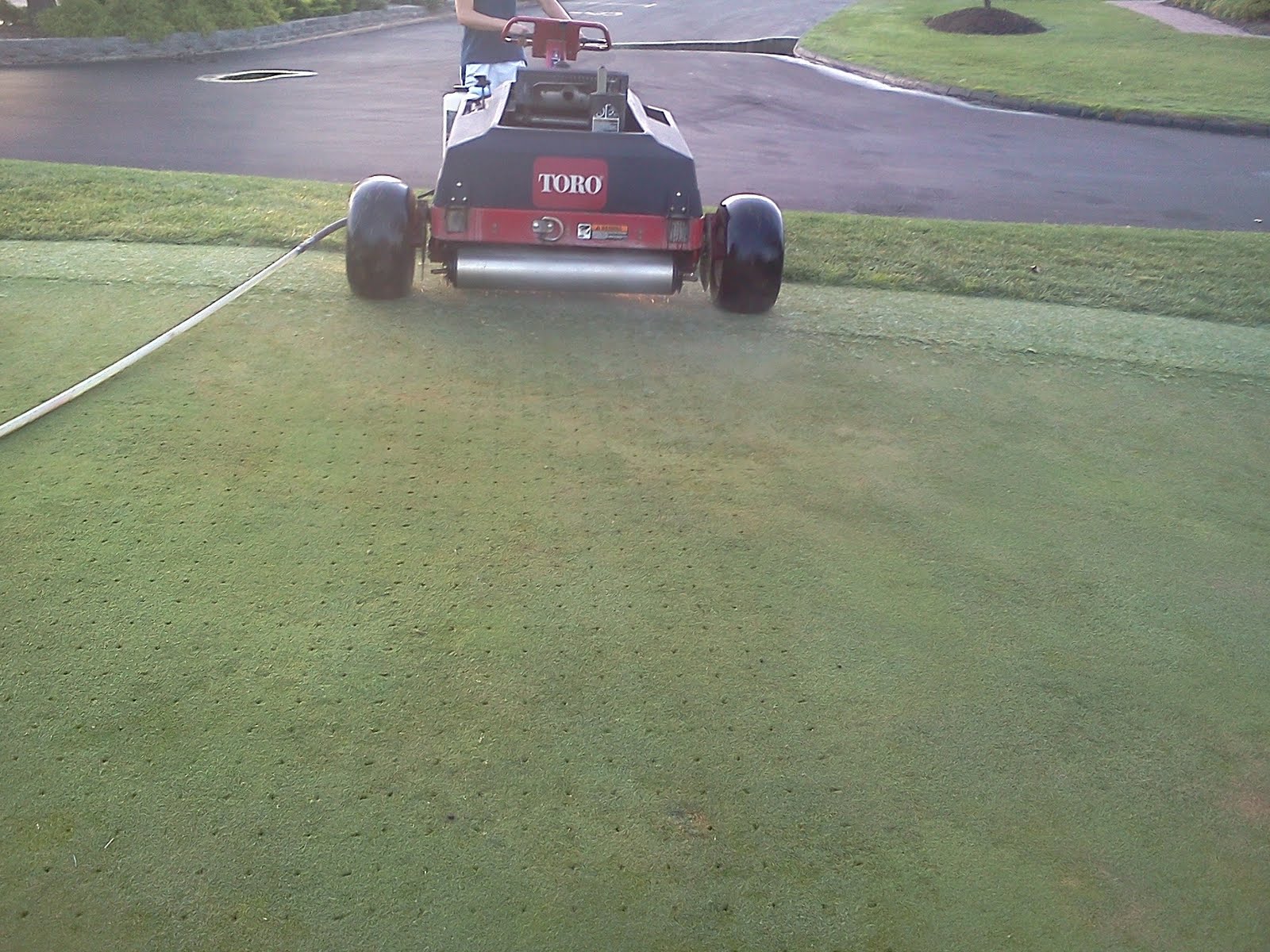
The first venting occurred around June 1st with a needle tining using our large tractor and verti-drain machine. The next two applications including today's are made by E&E Enterprises, a contracted service who provide three hydroject machines to our site. A row of 3000 psi streams of water are shot into our greens creating a near pencil sized hole that goes about 4-5" deep into the sand profile.
The greens were top dressed with sand before the venting, we then rolled them and brushed them after the hydrojecting was completed.
Below is an explanation of how air, gas and liquid are effected by this venting action taking place in our green profile.
The first venting occurred around June 1st with a needle tining using our large tractor and verti-drain machine. The next two applications including today's are made by E&E Enterprises, a contracted service who provide three hydroject machines to our site. A row of 3000 psi streams of water are shot into our greens creating a near pencil sized hole that goes about 4-5" deep into the sand profile.
The greens were top dressed with sand before the venting, we then rolled them and brushed them after the hydrojecting was completed.
Below is an explanation of how air, gas and liquid are effected by this venting action taking place in our green profile.
- The vent hole allows oxygen to enter the green sand profile improving the health of our roots and encouraging microbial activity.
- CO2 gas/carbon dioxide can build up in the soil and the venting holes allow this trapped gas to exit.
- The holes allow excess water to move through the profile quicker and at the same time if we were dry would allow moisture to enter the complete profile much easier. The vents also will help dry out our saturated sand profiles.
- The vents also help in reducing the temperature of our sand profiles, especially when they are holding water. Moisture is a great conductor of heat and will artificially warm up the soil much quicker when it is saturated than if the soils are at average moisture levels. As the soil profile increases in temperatures over 80-85 degrees, root hairs begin to die which are the structures where most water and nutrients enter into the plant. The less root hairs functioning, the more stress a plant will experience.
https://youtu.be/4HI5G5eKqcc
Monday, July 28, 2014
Hydrojecting Greens
E&E Enterprises was out this morning ahead of play hydrojecting our greens. Check out the video below for a little demo. Holes should heal in the next few days. We will be rolling the rest of the week in preparation for the St. Louis Women's District Golf Association Invitational being contested at the club Monday-Friday of next week. I was able to get a topdressing in at the end of the day just before dark which will improve ball roll as the sand settles down.
Thursday, May 29, 2014
Hydrojecting Greens this morning
This morning the greens were hydrojected. Please check out the video below which describes the work that was completed. Very minimal disruption to ball roll and will continue our work toward having healthy greens all season long.
Tuesday, July 23, 2013
Hydrojecting Tuesday 7/23
Hydrojecting this morning with 3 machines from E&E Enterprises. Should not interfere with regular tee time play. Early birds, that's another story.
Thursday, June 27, 2013
Greens Hydrojecting Completed
The hydrojecting of our greens was completed just a few minutes ago. Check out the video below regarding this process.
Wednesday, June 26, 2013
Hydrojetting greens Thursday 6/27/13

The holes in the surface of the green are very small and will have very limited effect on ball roll. Once the process is finished, the greens are rolled to smooth out the surface. This program improves gas exchange to the root system, allows water to penetrate through the green profile, provide a place for new roots to generate and will help to reduce the amount of moisture being tied up in the greens. A heavy flushing rain is okay from time to time but too much moisture can create long term root health issues.
We have scheduled another hydrojecting on Monday, July 22nd. We will plan for a needle tinning/venting of our greens in August and September. We attempt to schedule this work on Mondays but with a tournament this past Monday, we scheduled this work early on Thursday. The greens can get stressed during Member/Guest prepping and the actual tournament so I like to provide to relief from this pressure with the hydrojecting process.
Below is a link which describes in more detail our process.
http://geccgcm.blogspot.com/2012/06/hydrojecting-greens-on-tuesday-june.html
Monday, June 25, 2012
Hydrojecting greens on Tuesday, June 26th
I sent this message through the club email system but thought I should repeat it on the blog.
We have contracted with E&E Enterprises to Hydroject our greens on Tuesday, June 26th. They will arrive here at 5:30 a.m. with three machines and should be completed by 10:00 a.m. We have a route setup to reduce any conflicts with our members who will tee off after 8:00 a.m.
This process uses a stream of water at 3000 psi emulating a needle tine venting that we do with our verti-drain machine. The holes are less than a 1/4 in diameter, 4-5" deep and 3" apart. This process allows oxygen to enter the green profile and carbon dioxide to move out of the rooting area. It also allows moisture to penetrate more freely into the root zone and will also allow wet areas to become drier. We will roll the greens after each green has been completed. This a non-evasive process that should have little impact on ball roll. Within a couple days there should be no visible sign of the process on the surface of the greens. We have a second venting scheduled for Monday, July 16th after The Invitational.
For additional information, click on the link below to see the work that has been completed in the past using the hydroject machines.
http://geccgcm.blogspot.com/search/label/hydrojecting
We have contracted with E&E Enterprises to Hydroject our greens on Tuesday, June 26th. They will arrive here at 5:30 a.m. with three machines and should be completed by 10:00 a.m. We have a route setup to reduce any conflicts with our members who will tee off after 8:00 a.m.
This process uses a stream of water at 3000 psi emulating a needle tine venting that we do with our verti-drain machine. The holes are less than a 1/4 in diameter, 4-5" deep and 3" apart. This process allows oxygen to enter the green profile and carbon dioxide to move out of the rooting area. It also allows moisture to penetrate more freely into the root zone and will also allow wet areas to become drier. We will roll the greens after each green has been completed. This a non-evasive process that should have little impact on ball roll. Within a couple days there should be no visible sign of the process on the surface of the greens. We have a second venting scheduled for Monday, July 16th after The Invitational.
For additional information, click on the link below to see the work that has been completed in the past using the hydroject machines.
http://geccgcm.blogspot.com/search/label/hydrojecting
Thursday, July 21, 2011
Hydrojecting Greens
At least once each summer, we contract with Tom Edgerton of E&E Enterprises to Hydroject our greens. The hydroject is an aerator that uses a very highly pressurize bead of water to make a hole in the turf allowing for water and oxygen to exchange more freely in the green profile. This is a very non disruptive process to the putting surface and within a few days, you will not notice any holes in the surface of the greens. The bead of water can penetrate up to about 5" in depth and will give our greens a few weeks of relief from the heat. The hole pattern is about 2-3" spacing between holes. We had planned this process after the Invitational because of the usual stresses from a 3 day tournament of 120 people as well as the potential for some of the warmest and most humid weather of the year. Healthy root systems do not like highly saturated soils because they hold less oxygen and become very hot because of water's ability to conduct or hold onto heat. All of the greens were completed by 10:30 except for 17 which was finished by 11:00 a.m. Tom and his two sons each operated an aerator to help reduce the inconvenience to our members since the operation was performed on a open play day..
 |
| Stacey Edgerton, Tom's youngest son walking across the practice green with his aerator. |
 |
| The back of the machine and the hole pattern left by the aerator. |
Tuesday, July 19, 2011
Venting Greens
Our greens will be vented tomorrow using the Hydroject aeration system. E&E Enterprises performs this service for us. They arrive and begin the process around 5:30 a.m.and will be complete by 10:00 a.m. We will roll the greens once they have been vented to smooth the surface for the days play. The holes should close very quickly and cause little disruption to the playing surface. It is important this time of year to open the green surface to allow them to dry and place more oxygen near the root system.
Wednesday, August 11, 2010
Greens hydrojected today
All 19 greens were hydrojecting of our today by E&E Enterprises. Owner Tom Edgerton and his two teenage sons operated 3 machines that vented our greens in about 4 1/2 hours. Apologies to the 9 hole ladies who played through the last couple of holes as the guys were completing their work. The process will help to reduce compaction, exchange carbon dioxide with oxygen, allow for water penetration and will help to begin the process of drying out our greens from the wet and humid conditions of the past couple of weeks. Their is little if no surface disruption from this process. Check out the link below to see the aerator in action. This process along with our needle-tined operation with our verti-drain should assist our greens with their recovery once the weather breaks over the next few days and weeks.
http://toro.com/golf/cultivation/aerator/green/flash/clip1.html
The hydroject pulses high pressured water into the green surface creating a hole that goes about 4-5" deep.

http://toro.com/golf/cultivation/aerator/green/flash/clip1.html
The hydroject pulses high pressured water into the green surface creating a hole that goes about 4-5" deep.

Monday, July 20, 2009
Hydrojecting of greens/collars
(I originally attempted to post this on the day it occurred, Monday 7/20 but the video would not upload for some reason. Google must have a glitch in their system that did not allow some files to load properly. Well, the video will not upload so here is what we did last Monday with our greens)
During the summer months, we utilize an aeration contracting service to perform the hydroject aeration process on our greens. This service is used during the more stressful times of the season as a tool to improve air penetration to our greens and assist water to move through the profile. The last two weeks have been unseasonably cool and has helped tremendously in improving the health of our greens. It appears that summer will be coming back over this next weekend. We have another hydroject aeration tentatively planned for the middle of August.
The links below will give you an idea of how this aeration process works. There were 3 units operating on our course. They began a little after 6:00 a.m. this morning and were off property by about 10:30 a.m. We could have mowed or rolled right after the process but decided to let our greens rest today since we were closed. We chose to leave the machine in an uplifted position which gave us a slightly larger hole and deeper as well. The holes remained slightly open during the week but began to close by Thursday and Friday of this week. Rolling a few balls across the practice green and watching member's ball roll across the greens, it appears that ball roll is not affected. If the weather stays mild through the next few weeks, we will probably not do a second hydrojecting in the middle of August and will stick with our needle-tine operation using our verti-drain and tractor.
http://www.toro.com/golf/cultivation/aerator/green/flash/clip1.html
http://www.toro.com/golf/cultivation/aerator/green/flash/clip2.html
http://www.toro.com/golf/cultivation/aerator/green/flash/clip3.html
http://www.toro.com/golf/cultivation/aerator/green/flash/clip4.html
Subscribe to:
Posts (Atom)