Within the past 7 days, our staff have been to the beach and back a couple of times. No we were not on spring break but dealt with tons of sand. actually 71 tons of sand. Last Tuesday we posted the dryject work that was contracted out but our staff loaded the machines with 30 tons of sand.
Yesterday, we connected our tractor to our Redexim Verti-drain deeptine aerator and put about 144 1/2" wide by 8" deep holes per square foot for a grand total of about 8,736,000 holes in our greens.(Yes I counted them all) The operation last week was about the same spacing so over 17,000,000 aeration holes in our greens the past 6 days. We still have 3 greens to finish, holes 16-18 and we hope to complete those on Wednesday.
Our operation included the following:
Topdress the green with a heavy layer of sand
Aerate the green
Use our pull behind blower and backpack blowers to blow the sand in the holes
Brush the remaining sand on the green surface to smooth them out.
Roll the greens to help smoother over the holes
This operation should assist our early season green growth in the following ways:
Allow moisture to enter surface more readily and assist wetter areas in drying more quickly.
Increase oxygen into the green profile.
Improve and increase root growth to combat summer stress
Extra sand on the surface assists in smoothing the surfaces. Of course initially the surfaces are disrupted from the tugging and pulling of the aeration equipment.
Protects the crown area of the plant where roots and leaves begin their life.
It will take about a week of watering and rolling before we will mow the greens. This will allow the sand to settle and the turf to grow up through the sand canopy. The holes should be completely filled in within a couple of weeks. I anticipate the greens to back to normal around opening days for our members.
During the season, we will vent the greens with smaller tines about 3-4 times to assist in plant health. This is completed with a small 5/16" tine which goes into the surface of the green about 4-5 inches. It is usually non-disruptive to putting surfaces and the holes disappear in a couple of days but it is very important to plant health in the summer.
We will also do light and frequent topdressing which helps to smooth the surface and protect the crowns of the plants. It also improves ball roll out after a couple of days. A few videos below of the process as well as a couple of pics.
https://www.youtube.com/watch?v=zfDejFQFZ9A
https://www.youtube.com/watch?v=GOifOjolbUo
A little slomo action gives you an idea of the forces on the putting surfaces we place during aeration.
https://www.youtube.com/watch?v=Ut_al7WJ6Gk
Blowing sand into the holes. We had up to 4 guys also using backpacks to move sand into the holes
Brushed and rolled
Holes filled. Might be a stray hole or two not filled but for the most part they are all filled with sand.
Elvis Presley says listen up everyone as my dad gives you some information of what has been going on and will be going on at Glen Echo.
As we rolled into September and then October, I thought we might see a few tumbleweeds dance across the golf course as it dried for an extended period of time for the first time this season. Of course we have come to expect it in the late summer and early fall but this year was pretty extreme. It wasn't desert hot but humidity levels of under 20% and daily winds of 10-20 mph saw our largest use of water on the course for a 40 day period. Of course we wanted the course firm and fast for The Invitational and we were able to deliver some pretty good conditions. First time I took rolling out of the equation over the 3 day event since I've been here. Didn't want ball roll out to get out of control, especially since our guests don't get to play the course as regularly as our membership.
So the timing of rainfall was helpful to replenish the soil but is now going a bit overboard since we are planning aeration of our greens this week. We plan to deeptine 8" deep with an 1/2" solid tine, fill the holes with sand, smooth them out, fertilize and let them breath. Of course, rain is dampening our parade. We will have to work with the rainfall over the next few days and see if we can get a few completed a day.
We were also planning to begin the installing the new drainage across the 6th approach during the first week of November.(Pending aeration completion and weather) During the work in front of #6, we will be forced to close the 6th hole during this time. We hope it will take only about 5-7 working days to get the old pipe out and new pipe in and covered. This of course is all weather dependent and the pattern is looking more like some stopping and starting over the next couple of weeks.
3' drain pipe in the waiting room along the main road.
Tree removals along 7 pipe line that we will try to remove soon.
The arrows designate the beginning of the project in front of 6 green.
With the other work taking place, we will still be chasing leaves into December which will keep everyone busy.
Hundreds of courses in our business host a tour or major event each year but for thousands of others, there is a local event that is the major focus for its staff.
This past week, our club and staff were given the opportunity to host our major event at the club, The Invitational 2020. The work that was completed over the many months prior to the tournament plus the weather we were given over the last couple of weeks provided for great surfaces for our members and guests to play. Congratulation to Mr. Len Toenjes and his guest Mr. Russ Hanson who won the shootout and the overall title for the event.
We still have some great golf weather ahead over the next month or more. Most of our efforts emphasize putting our turf to rest for winter in the best condition possible so it awakens ready to grow next spring. Below are some the areas of focus we will have over the next month or two.
Raising Height of Cut
As our zoysia begins to go dormant, we raise our height of cut slightly to assist with wear and tear and energy storage. We have reset our fairway unit and tee mower to 3/4" which is just .150" taller than their normal height. Once the growth slows over the next couple of weeks, we will stop mowing completely for the season to allow them to get a little fuzzy for winter. I anticipate our amount of play and cart traffic will be up so the turf will get beat down a little. Drier conditions, cooler and temperatures and less sunlight help in reducing overall growth so we should still have excellent playing conditions.
We have also applied Potassium to our zoysia surfaces over the last couple of weeks to improve its ability to survive the winter onslaught of cold and frozen precipitation.
Our green turf height usually gets raised slightly during the month of November and we usually quit mowing greens after Thanksgiving depending upon the temperatures and if there is a need to continue mowing.
Aeration, When Are You Going to Aerate Greens
We will be performing the same process we did in the spring with our greens, Verti-drain deep tine aeration. Since all of our Mondays are full through the month of October, we will begin our aeration after the tournament being held on October 26th. We will do some greens each day to get the process completed. I've always been of the opinion, to do our greens past closing day to give our membership and guests the best possible putting surfaces during the best time of the year to play in regards to ball roll out and turf health.
We also will be pulling cores on our rough the next couple of weeks and will also be involved in some seeding in weaker areas of the rough. We did some initial seeding and aerating in our green surround areas a couple of weeks before the Invitational.
We will also be fertilizing our cool season rough over the next couple of weeks. We begin last week but had an equipment malfunction and are waiting on parts so if the rough smells a bit earthy, you will understand the reason. A part of our fertilizer in organic in its origin.
Drainage Project from # 6 through #8
We anticipate to begin the storm water drain project after the first week of November. The project will begin on hole 6 from the beginning of the drain along 6 property line to the first large surface drain in the left forward area of 6 approach. We expect the first section will take us about 7 working days or so. During the work on this section, the 6th hole will be closed to all play.
We would like to get the section that crosses 8 fairway completed next depending upon weather. This is the longest section of the project. We have some soil/dirt work to that fairway to help move water to the surface drain we exposed in the left side of the fairway. Our hope is to have some dry weather so we can move soil and get the section compacted properly and sodded.
Below are pictures of 2 trees that will be removed during October as we prepare the area for construction of the storm water drain replacement. The ash on the left is directly over the drain pipe and the Willow oak on the right is 2' off the center of the pipe. The trench at the top will be 12' or so wide. There is a 3rd tree that is the Ash to the left front of 6 green that will not be removed but it will be severely compromised by our trench. I expect this tree to not survive the construction due to the severe damage to its root system and surface construction traffic.
Leaves, Many Leaves
It's that time of year where first leaf drop is beginning with Cottonwoods, Ash, Walnuts and other trees which are under stress and or weakened. Our main leaf drop will occur sometime in November depending upon freezing temperatures. A great deal of backpacking, vacuuming, and large blowers plus grinding up leaves back into the soil with our mowers are all a part of the process.
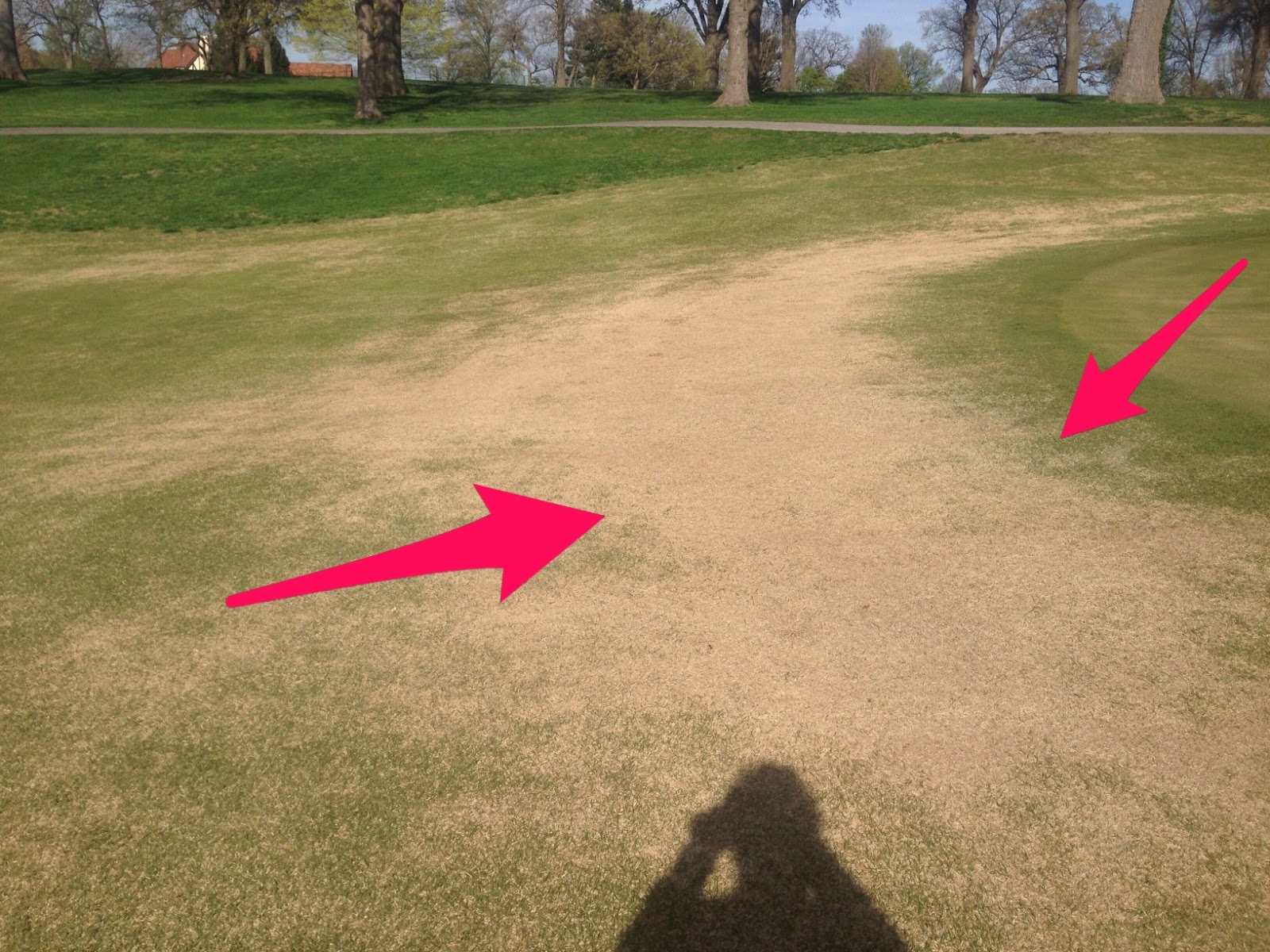
We've greened up nicely is many areas of our fairways but we do have some noticeable weakness in heavier trafficked areas such as approaches, shaded areas, north facing areas etc. There are a number of things that could be attributed to causing these issues. We talk mostly about the good and the work that takes place, every once in a while I have to talk about some bad.
I made the fall application like we normally do with our Bermuda reduction material. We were pretty dry in the fall which the Zoysia was under a bit more stress than normal. Of course going dormant, is a bit stressful as well. We normally come out of winter a bit more delayed than normal because of this spary material. The zoysia is tolerant to it but it can tinge it a little.
With the milder than normal temperatures this winter, our warm season turf staying in dormancy for our RoundUp application in February was a bit of concern. We do spray at the near lightest rate which is effective at killing the poa annua and not damaging the zoysia. The areas most effected, high traffic areas like approaches are a little thinner in dormant turf cover and more chemical material could have gotten down into the canopy and affected live tissue. We have pulled a couple of plugs and placed them in the greenhouse to see if they will green up in the next 10-14 days. If they do, we will be fine. If not, we might have to replace the approach area on a couple of holes.
The issue we are facing could have also been the 15-17 degree low temperature we had a few weeks ago when the plants were just greening up and were very susceptible to freeze damage.
Or it could have been a perfect combination of the 3 things happening all at the same time, weaker zoysia from the fall, just a bit more green up than normal in February and the cold temperatures after the early breakout of temperatures.
We will have a better feel about what is happening over the next couple of weeks. I think a majority of the spots will be fine. One thing I'm probably sure of is the Bermuda got its butt kicked as well.
Greens aeration was completed in 2 days by the guys. Looks good overall. Last major aeration work of the season besides monthly needle tining and maybe a hydrojet application in mid-summer.
# 1 green approach. This is about the width that I sprayed last fall with the Bermuda control product. Its also the width of the area sprayed in February. This also coincides with the turning area of the mowers and rollers which creates excessive wear in this area.
#2 looking across from left to right into front of the green. Same as #1.
This is an area along #15 we always have issues with. Narrow band of area that is emersed in deep shade for many hours of the day plus heavy cart traffic due to balls ending up on the down slope of the fairway. I did not spray this area last fall because of the weakness of the turf. Still having issues. Recommendation has been to remove at least 1/2 the trees in this area to allow more sunlight. It is also facing to the east southeast which is not a good situation for warm season turf growth.
Plugs pulled from the approach. Looks pretty weak. There appears to be life down in the stolen area but we will see for sure in 10-14 days.
Our fall greens aeration is our most concentrated project each season which requires using every staff member to complete this task. It is our most important project because it helps to improve the health of our greens more than anything else we do to them besides watering.
As mentioned in the past, deep-tine aeration provides the following benefits:
Drainage through and improves water's ability to penetrate into the profile both to get through it and into the areas where water is needed by the root system.
Gas exchange, oxygen into the soil and the release of harmful carbon dioxide which can build up in the soil.
Space for roots to grow, expand and improve.
Allows us to modify the sand profile with a coarse sand that provides improvement in all the areas listed above.
Improves the biological health, good microbes in the soil.
Thatch reduction by mixing sand with the thatch helping to dilute or break down the thatch.
Our process included:
Placing the sand on the greens. Approximately 1-2 tons per green based on their size.
Aerating punching about 110,000 holes 8" deep, 5/8" channel in each green.
Applying a soil amendment product to the green. Earthworks Renovate Plus
Blowing the sand in the holes
Brushing the sand in the holes and helping to spread the sand uniformly across the surface. .
Rolling to close over the holes and smooth the surface as best we can.
Changing the holes since they were damaged during the process.
We will need to brush the greens again to help work excess sand into the profile. We will roll regularly to help smooth the surfaces until we mow again which will be in a few days once the sand has settled.
The staff worked about 90 labor hours aerating the greens. Weused our Verti-drain deep-tined aerator with 1/2" solid tines going 9-10" deep with 5% kick.
We used about 30 tons of sand on the greens.
Our process included the following.
Sprayed greens over the last week with fertilizer, root stimulant and water penetrant product. This will encourage healing and reduce dew on greens which dries greens quicker for after aeration mowing/rolling.
The greens were mowed and then a granular soil conditioning product was applied. 1000# of Renovate Plus. Topdressing sand was applied heavily to the green. This required almost 2 full loads per green depending upon the size. Our light topdressing during the season usually requires one load of sand per 4-5 greens. The sand layer helps to reduce tracking from the aerator.
Greens were then solid tine aerated. The 5% kick occurs when each tine holder is at the bottom of its thrust into the green. This motion will fracture the soil layer that is 4-5" below the surface of the green which improves rooting, oxygen exchange and water penetration. The soil layer is the original surface of the green when they were constructed many eons ago.
We then used blowers both backpack and our tow behind blower to help move the sand into the channels. Our brush drag was used as well and it also provided a final smoothed surface.
The greens were rolled and holes were changed.
To get the guys home last night, we stopped before finishing blowing in the sand on18. It will be completed this morning.
This process will enhance our greens in the following ways:
Improved root development going into winter and next spring.
Water penetration and evacuation.
Gas exchange both oxygen good and too much carbon dioxide(bad).
Stimulate plant growth/health.
We will do additional brushing later in week where sand is a little mire concentrated to improve ball roll and assist with our first mow. Our first mow will be when it is dry later in week as turf begins to grow through sand.