Showing posts with label cultural practices. Show all posts

Monday, July 18, 2022

Overlay, Holey Moly, Petri Dish, Renovation and Bye Bye Bye

It's been quite a while since I've blogged. three months, a couple Marathons and about 15 pounds less and pff its July. 

Mother Nature was not overly kind to us in the month of June but we survived. High temperatures and a big water bill toward the last 1/2 of June and into July will make for an interesting Financial Statement for the Grounds Department for July. 

We also had a little damage to a couple greens at the beginning of last week but things seem to be turning around and a majority of the spots are healing. We have others greens at various stages of funk and lacking beauty but generally speaking we are in pretty decent shape as we begin another hot stretch of weather over the next 7 to 10 days. 

We've been doing a great deal of hand watering in the mornings and afternoons and at time it appears we are taking a step forward and 2 steps backwards. Many times you think you see some disease, you pull the sample and you send it to your turf pathologist to tell you what you've contracted and what you need to spray. On many occasions there is not a great deal of disease in the sample but Abiotic Stresses are usually the #1 contributing factor in the sample. So Joe, what are abiotic stresses? Common examples of abiotic stresses are created by severe and or adverse changes in one or more of the following conditions: 

  • Temperature
  • Humidity
  • Rain
  • Wind
  • Latitude
  • Soil Composition
  • Radiation(Sun)

So basically summer in the heartland of Missouri.

Your mind begins to wander as a grass grower during some of these stretches of severe conditions. "Am I seeing real issues or are we just seeing the effects of summer on living and breathing grass"? 

Your first thoughts are "I have to do something but experience has told me if you've done everything possible, the best thing to do is do nothing and allow the abiotic conditions to change to a improving plant health environment." 

Now don't get me wrong, you can't just give up just yet and say its abiotic stress and there is nothing we can do. One has to control water, continue to spray for plant health and be diligent in monitoring but patience is very important. 

CART PATH OVERLAY

Well, its that time again for some overlay on the golf course cart paths. Section 2 with the third coming next season. We will be laying roughly 12,800 feet of asphalt to over the next 5-7 days. Holes included in this run will be the completion of 4 from the Field Bar to the main road and 5-9. Also included will be holes 10 through 15 tee at the lake spillway.

  • Our plans are to begin on Tuesday, July 19th on holes 5-6, 7 tee to main road and 8 approach fairway back around to #9 green and the main road.
  • We will then pull out from the right cart path along 10 lake back to the main road. From the bridge on 10 approach back to the main road, 8 bridge tee back to main road. 
  • 15 tee from the lake bridge back through 13 tee/12 green. 
  • 12 green to the Field Bar, From Bridges at Field bar back to Cart path behind 7. Connect 4 and 7 back to the main road and we are complete.

I will make daily updates on Social Media and this blog.

Myself and staff members will be in the area helping to direct trucks and members/guests as we are working through the project.

Of course after the asphalt has ben completed, our staff will then begin the process of making smooth transitions between the new height of the path and the old grade along the side of the paths. This work will be ongoing through the rest of the summer and into the fall and winter as time allows. Of course cooler temperatures of fall and winter are more conducive to new turf survival but we will do what we can on the most severe drop offs to reduce the potential of accidents and or damage to carts or members in their carts. 

Just a reminder when operating the carts in the new asphalt areas, drive your cart at an angle so the cart wheels enter and exist with all tires hitting separately. This can reduce wear and tear on the new carts and protect our members and guests from injury. It would be wise to reduce your speed at entering and exiting the paths until we have opportunities to get these areas leveled. We will uses stakes and roping and or caution tape to alert you of any excessive differences in the height of the pavement and the exiting grade along the paths. 

 Asphalt Work July 2022 - YouTube

Contractor was out today grinding the areas that will have new overlay so they will butt up against them properly. This allows for a smooth transition between the new and existing asphalt.

HOLEY MOLY

We started fairway aeration a couple of weeks ago and has since been sidelined due to the aerator lift cylinder needing replacement. It has since been repaired so we will try to finish the remaining holes on the front 9, 1-3 and #7 over the next week or so as weather and work responsibilities allow for its completion. 

Below is a video of our aerator a couple of weeks ago. Many holes in those fairways and soil plugs pulled out onto the surface of the fairways. The rain on the weekend of July 9-10 helped clear up the soil on the back 9 and the Sunday  rain assisted to dissolve the existing soil back through the turf of the completed holes on the front 9. 

 Fairway Aerating - YouTube


PETRI DISH

This morning was a Turf grass Pathologists dream morning. High humidity, a layer of fog and warm. As I drove out the paths at Glen Echo this morning there were large patches of disease areas becoming active on the ends of the grass and down at the soil level of the turf. There were many plants with white mycelium which is where fungal disease is usually active. Its usually at the tips of blades due to guttation water coming out of the plants pores which is laden with nutrients that the fungus feed upon  Our superintendent text chain was lit up with photos of various levels of activity early this morning. 

One of the activities that assists in reducing this disease is the actual mowing of the grass and or rolling. These practices help to reduce the wetting time of the leaf which assists in reducing or stopping the additional formation of mycelium. Of course fungicides reduce this impact as well but we cannot afford or have the time to spray all of the rough to reduce this disease activity. We attempt to keep our greens, collars, smaller green and tee surround areas from infection which can look rather unsightly or weaken the plants.

Dollar spot on cool season grass. Phot credit LSU Ag.

TEE RENOVATION

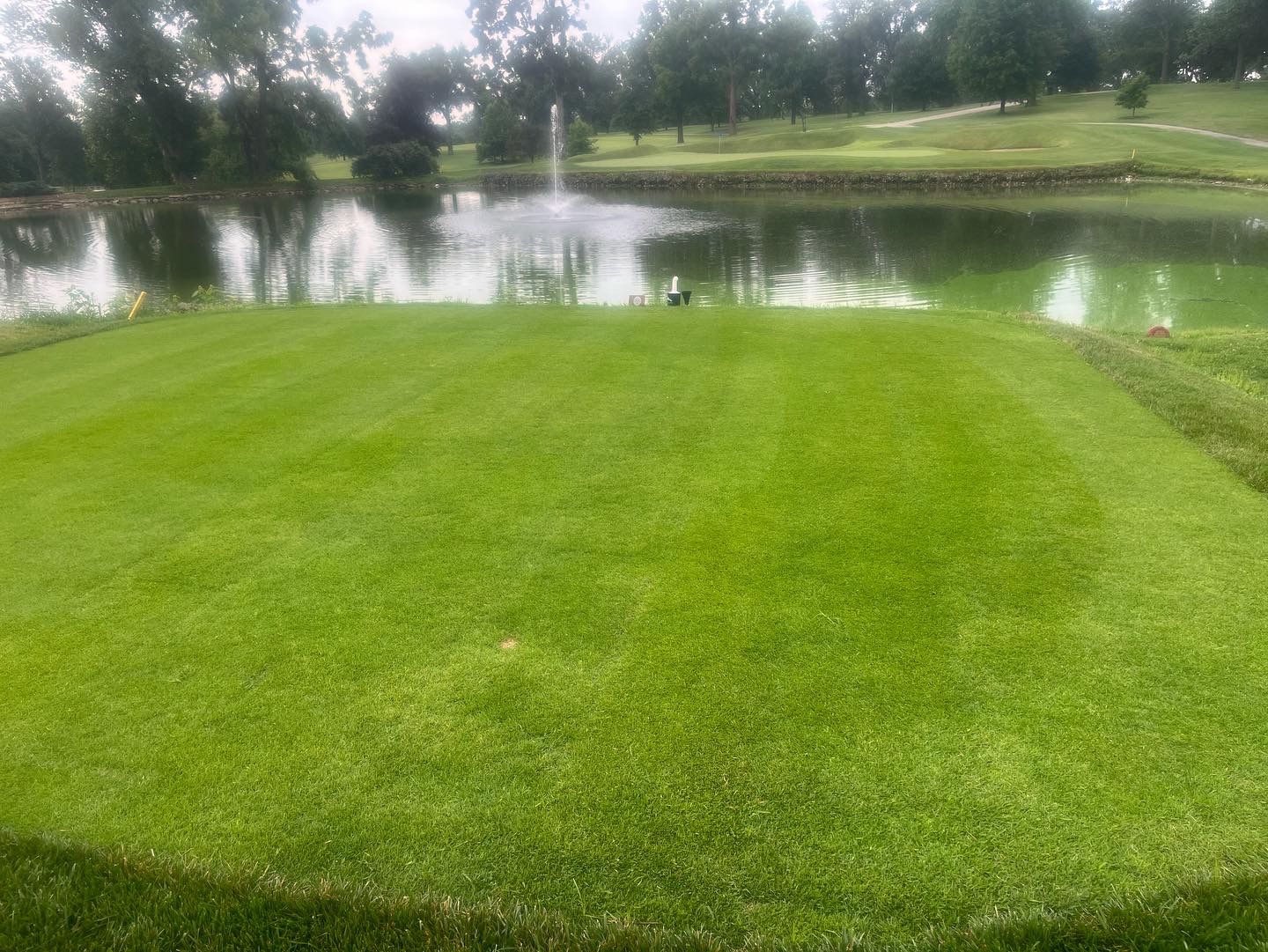
The tee renovations of the blue and red tee on hole 9 and the special event tee for 17 made near the patio I believe turned out looking really good and were ready for play within about 18-20 days after completion. It appears they are holding up well and provide great playing surfaces for the future. We plan on expanding the drop zone tee at 9. Enlarging it slightly and leveling it in the next week or two. Our first effort was a bit rushed and was not the quality of work that we attempt to create when we renovated it last season.

9 Red tee

9 Blue tee


Bye, Bye, Bye


Music and video by NSYNC.

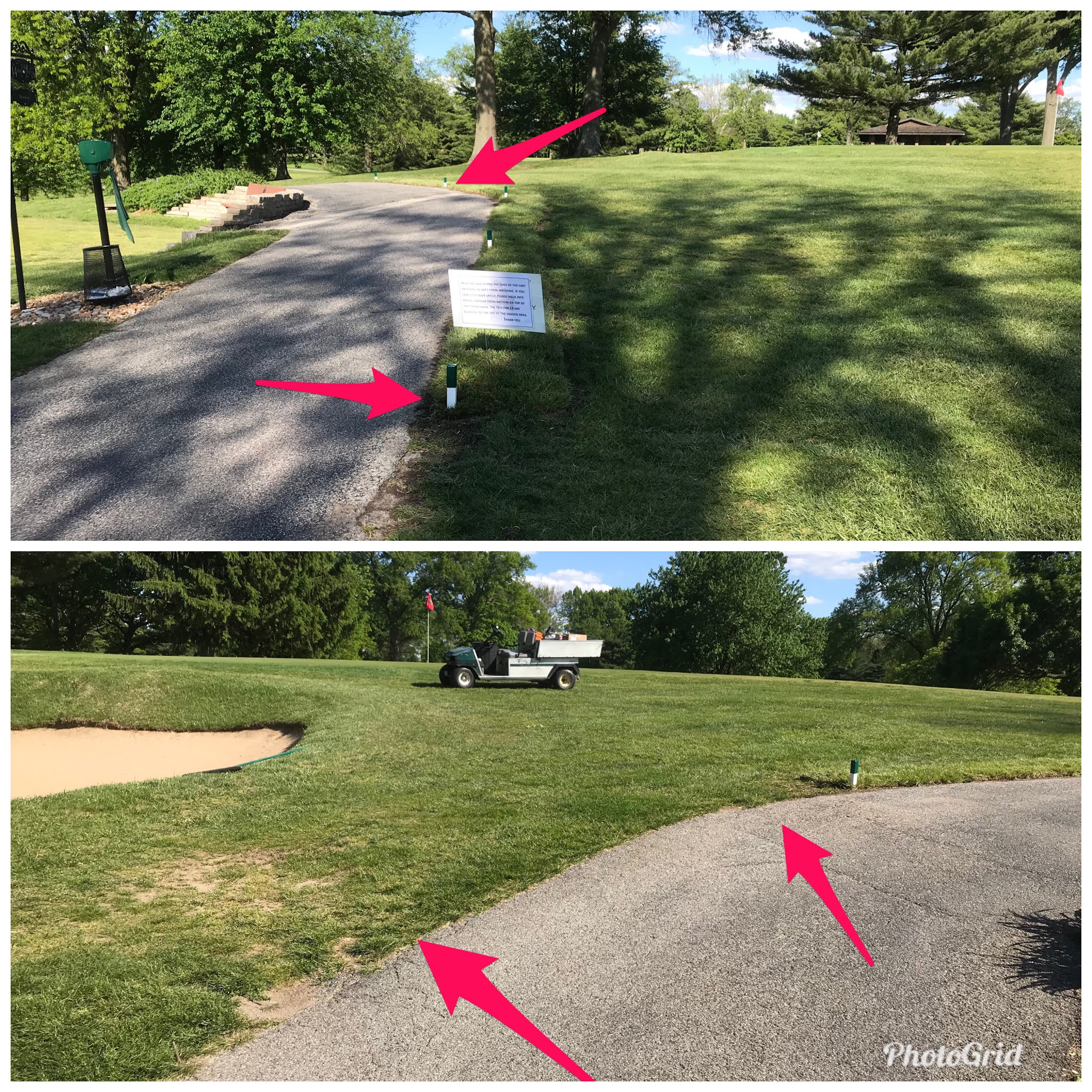
Well, we aren't talking about NSYNC but we are talking bye, bye, bye to the continuous mulching of the walk paths to the practice areas with new brushed concrete coming soon. Moles, washouts from rain were just some of the problems experienced on these paths over the years.

We intended to complete part of the paths this week but the asphalt contractor was available to come a week earlier so that project will get priority and we are on hold. We also have high heat coming in again this week so we have to make sure we have enough staff available to keep an eye on our greens, maintain the course and assist with the asphalt project We hope to start this work next week.
The paths will be 5’ wide and brushed to assist in reducing slipping.
Top photo is short path at long range. Bottom left is long path at long range and bottom right photo is short range. 

Thanks for your time. Come out and see us when you get a chance!


Friday, April 8, 2022

Edge, Vertical, Install, Removal, and Notch

We have not had the greatest weather over the last few weeks. A few dry days, then some cold and wet weather. Staff have been changing the pace more than Adam Wainwright to get things completed for the season at Glen Echo.

EDGING OF BUNKERS

The staff began the arduous task of edging bunkers and moving sand around in them this past week. They completed Holes 1, 3, 4, 7, and 5 with a little more work to be completed. I have a video below which will give you an update of the work and what it takes to get to the finished product which I will bullet point below;

  • Edge the lower side of the bunkers. Use a sharpened sod shovel to reform the edge removing the sod that has grown over the old edges. Shake the excess sand from the sod.
  • Locate the depth of the various areas inside the bunker to determine which areas need sand and which locations need some sand moved to the more shallow areas.
  • Shovel the sand or if there is room use the blade on the bunker rake and push into place.
  • Rake the bunker and move to the next. Took 4 staff members all day to work on about 11 bunkers.
https://www.youtube.com/watch?v=rLbqJOOWHfY

Completed


VERTICAL MOWING OF GREENS

This past Monday we took advantage of the golf course being closed and vertically mowed our greens. We have a set of reels that goes on our normal greens mower that mows up and down instead of a lateral mowing that we do on a regular basis. There are 37 blades on each mower that cut straight down into the canopy of the turf. These blades are about 3/4" apart and cut through the top of the surface of the green cutting longer turf blades and pulling up small amount of thatch in the process. We only set our cutters to about a depth of 3/8" so the healing process is pretty quick. The purpose of this practice is to help stand up the blades of grass and cut off the longer leaves of bent grass. Bent grass from its name lays over and can become longer relatively speaking. The longer the blade, the more friction placed on the golf ball which slows the balls roll out.

Once we've vertically mowed, we then use a drag brush to stand the turf up and spread the sand and thatch around on the green. The regular mower than mows the green picking up a majority of the excess leaves and thatch material. First video is of the vertical mowing and 2nd is the regular mowing to clean up the material off of the green. 

https://www.youtube.com/watch?v=SGZBxOAWgPM

Vertical mower, as you can see the blades are in the vertical position.


 https://www.youtube.com/watch?v=dJZCu9mnPn0


FENCE INSTALL

The fencing along St. Mary's Lane was made up of a lightweight aluminum fencing which is difficult to stand up against a large area mower. Of course its important that our mowers stay away from the fence as well but at times it would bump up against it and stretch it out of shape. We will be installing an 8 gauge galvanized fence from the Wallingford gate down to the entrance to the club. A majority of this work is complete. We need to bring in another roll of fence to complete the project.

Staff stretching the fence along St. Mary's.

Look from the installed side.

TREE MANAGEMENT PLAN

Over the last few weeks, we've removed another 5-6 standing dead Pin Oaks that succumbed to the Wasp Gall that have invaded our property. We still have 2 to remove on the right of 2 and a dead Sycamore along Lucas & Hunt as weather permits. We had hoped to have all ground out stumps filled with soil and covered with sod but have not been able to get this accomplished because of the lack of lengthy periods of dry weather.

NOTCH ON THE BELT

As most of you know, I've been on a journey over the last few months to improve my physical health and along with these efforts my mental health is improved with the release of hormones and other positive effects of the weight loss, proper eating and exercise helped to create.. My participation in the GO! St. Louis Marathon was an accumulation of efforts since December 10th that have led to weight loss of about 33 pounds and exercise in which majority of it included walking of over 300 miles. During the 12 week challenge with over 130 fellow superintendents, vendors and family members, we lost over 2,200 pounds and I lost 33 total but only 23 during the start of the event on January 1. As I continued to push myself to beat personal bests in waling distance and pace, I decided to do the 1/2 Marathon at the end of February. A couple weeks later after walking along with some jogging I went over 16 miles and the die was cast to try for 26.2 miles. 

My desire is for this to be a permanent change in eating and general exercise which. I still have a goal to get down to 170 pounds(11 more to go) and be at my college graduation weight. I appreciate the memberships support of me during the period. Its been a great experience to date.


I hope to see you out on the course soon.


Friday, March 18, 2022

Pound the pavement, Pound sand, You talkin about practice!

 Well, its been quite some time since I've made a blog post so let's get after it. 

POUND THE PAVEMENT

That's been my phrase since I became motivated to change my health regimen at the beginning of December. Thirty pounds lost with a goal of another fifteen over the next few months. Diet generally has changed with throwing wheat out of my intake. Pretty difficult initially when I consumed 6-8 servings a day which a majority of it included bread, donuts and cookies. Active here at the club and on my job but a lack of control and will power with food intake has been an issue forever for me. Hopefully, after discussing potential retirement in just a few years, its time for a permanent change in healthy eating and some regular movement away from the job.


POUND SAND

Over this past week we have brought in over 60 tons of sand to place on and or into our golf greens here at Glen Echo. We contracted with a company to perform the Dryject operation on our greens and begin to do our deep-tine solid aeration using our Verti-drain aerator. We used about 35 tons of sand in completing this operation.


Dryject machine injecting sand with a 3000 psi bead of water and sand into the green about 5". You can see the staff filling 5 gallon buckets of dry sand to load the machine. It takes about 2 buckets or more across the green before it will run out.

3 x 3 spacing after completion. Greens were brushed and rolled after this picture was taken.

We are planning on deep-tine aerating our greens on Monday, March 21st. We do not all of them completed in one day so decided to get some of the greens completed this week. We did greens 15, 17, and 18 on Wednesday and completed greens 5-6, 8-9 on Thursday. The aerating process included the following;
  • Sanding greens ahead to reduce tire rutting
  • Aerate greens
  • Apply soil enrichment fertilizer
  • Blow sand in holes
  • Brush greens and change holes
  • Roll greens and apply an organic fertilizer

Skip apply a heavy coating of sand on the greens before bringing the tractor on the green and punching hole. Takes about 2 loads of sand per green, approximately 2 tons.


Russ using our Verti-drain deep tine aerator on our greens. 3" spacing approximately 7-8" deep with 1/2" tines.

Staff using our new articulating blower and backpacks to move sand into the holes in the greens.

YOU TALKIN ABOUT PRACTICE


Pro shop purchased 8 new mats for long range wet, off season practice area. Our staff power washed the concrete, removed the old mats and installed the new mats. The mats accept a regular tee so you will not have to hit from the rubber tees. We are providing a rubber tee on the mat for anyone who does not want to tee as high as a standard tee. These will also be available for groups to hit from as well during our tournament season. I've included a video regarding the new mats as well as a discussion regarding when will be opening the grass tees. Probably will be at least a month or more. 


Thank you for being a part of this great club. We look forward to the upcoming season of golf here at Glen Echo. Remember you can follow regular daily updates on Instagram, Twitter and Facebook regarding the property we manage for you. I will give you as many details as you can stand.


Monday, October 25, 2021

Aeration, Germination, Hibernation, Foundation

Its been a while since I've made a blog post. I'm making daily posts regarding course opening, carts and practice range restrictions or lack thereof on social media. Allow me a few moments to expand upon the work we have completed this fall so far and what there is to come.

We attempted to delay any aeration of main playing sources until we've gotten through most of our calendar of events in September and October. We began the aeration work around our greens using a 1/2" coring tine after slit seeding fescue around the greens to improve our coverage of turf grass. Our process included slit seeding, then aerating, spreading seed with a rotary spreader and then dragging in the material to make good soil contact and mowing. We should get seed germinating in the areas over the next couple of weeks and will then mature in the spring. We plan on using our rough aerator that makes a little bit larger hole a further out on the green surrounds over the next week or two which will improve its overall health as well.

We will begin to use our pull behind rough aerator in our rough soon as time and weather permits. Cores or plugs are pulled and we use a metal drag to break them up. This assists in reducing compaction and helps with stimulating new growth in our rough plants.

https://www.youtube.com/watch?v=a4cVFB2DlRQ


Greens aeration will begin on Monday, November 1st. Depending upon conditions for the first day, it might take us a 2nd day or so to finish up the last few greens. We will use our deep tine verti-drain aerator and go about 7-8" deep. The holes will be filled with sand and surfaces brushed to smooth them
out.
 https://www.youtube.com/watch?v=kQ0xEew0b9I


Our warm season turf grass zoysia was fertilized with potassium in September to assist it with winter hardiness. It thickens the cell walls and improves water and energy uptake. As zoysia goes into dormancy, it is storing energy which assists it in fighting off excessive cold temperatures.

We applied fertilizer to our cool season rough grass in the past couple weeks which will assist in providing new energy for our turf. As temperatures begin to fall, it utilizes less energy and begins to store energy for the next season. Once cold temperatures arrive in late November and early December it goes into a form of dormancy even though it is fairly green. The stored energy then allows the plant to green up a little earlier than non-fertilized turf.

A couple of weeks ago, I asked our contracted tree expert Tim Gamma to come out on property and assist me in evaluating trees that have been damaged by the gall over the past year or two that should be removed. There are 35-40 trees that were identified for removal in which 21 are Pin Oaks. There are a few Ash, Siberian Elms and Maples in which some were damaged by this summer storms and or have been scheduled for removal over the past year which make up the total number of trees. Some of these trees will be removed completely by our staff but others will require assistance from our contractor. They will top them leaving a stub and we remove the large limbs that can't be chipped and the log. Our budget does not have the funds in it to remove all the trees. GM Tim Grossman and the Board are working through the finances to determine the number of trees we can remove with the available finances. 

We made our last mowing early last week on our zoysia tees, approaches and fairways. They might grow slightly over the next week or two and will then go into dormancy as our temperatures get cold enough for frost. We have also made our large patch zoysia fungicide application over the past few weeks to reduce the effects of the disease. The fall application of the fungicide assists in reducing the severity of the disease in the spring but we also must make another application in the spring to keep the disease under complete control.


Thanks again to the Foundation for the recognition of the work accomplished over the years here at Glen Echo by our staff.     


Tuesday, August 31, 2021

Part Deux, Puffy, and Overlayed


 As meteorological summer began in June, we thought we were in for a hot and dry summer. The end of June and into July brought copious amounts of rain.(As wise men once said it never rains in July). Along with the rain storms came tremendous damage to THEM things which created some issues for our staff but they stepped up and handled the situation as best could be expected.(As seen on Social Media I will not use the word Trees as I now refer to them as THEM. Its a coping mechanism so work with me here)

Well, Part Deux happened again last week but luckily to a smaller extent.We struggled a bit through some horrific weather last week but have made it through to the other end. We hope to have the rest of our mess cleaned up for the holiday weekend including getting some support posts put back up on the tennis courts to stop any further damage. The new wind screens are being removed for the season to reduce any further damage to the existing structure until we get it shored up and strengthened for next year.

 1 green after tree fell on irrigation system causing 2 heads to come on. I came back to turn off irrigation not knowing this had occurred. Happy I came back.

 Over the last few weeks, our greens have struggled from soft and puffy conditions. Temperatures have averaged more than 3 degrees above normal including that all important night lows which has not allowed recovery time of our turf. Consistent and regular rainfall on our greens which do not have drainage has led to soft surfaces and fat/lazy grass plants who do not like to give up additional ball roll out. We have been forced to not mow greens on a number of days because of the rain or damage which has occurred on the course. We have also had issues with scalping out in the middle of greens and over the top of our hole locations. We use a plate that we stand on which reduces the heaving of the greens as we pull out the 8" plug from the green but we continue to have issues. Also, with an inch or two of soil at the bottom of our hole this creates great suction when the greens are wet. We attempt to reduce this suction using various techniques but sometimes to no avail.

                              This has been experienced many times this summer at Glen Echo
 

 Heat and moisture leads to high microbial activity in our sub surface's and the release of additional nutrients for plants. We attempt to control this growth by the use of regulators but that has been very difficult for us to accomplish over the last few weeks. High heat shortens the window of the chemical's useful life and then chaos hits the course either in 1-2" rainfall and or high wind conditions and we've missed some of our windows for spraying. One of the chemicals is a product which has to dry on the greens and the other must be watered in which also creates its own set of issues. When you are already wet do you add more moisture and possibly make your greens sick just to control growth. Sometimes you just have to do nothing until the environmental conditions change. We anticipate with cooler weather the next 7 days to get back on track with sand topdressing, brushing mowing and rolling. 

We are looking forward to more of this!

  We had hoped to have some cart paths back filled with soil and sod added in the worst areas between 1 tee and 4 but have not been able to accomplish this to date. We hope to begin this process as time allows. To a man and women, we are much appreciate of the effort to clean up our cart paths. You can do all you can to have great turf but having your equipment banged around with heights of cut set at thousandths of an inch can lead to issues on our best surfaces. I see staff members driving down the middle of a fairway to avoid the rough nature of our paths. Some have mentioned, why not concrete? Well, if we had a choice of course we would go with concrete but the cost is astronomical in comparison. Our local superintendent has a text thread where we throw out questions or look for guidance. Been told by a reliable source that has been doing concrete over the years that replacement of asphalt and going to concrete would be easily into 7 figures. I would like to have the most modern bent grass on our greens and complete drainage in each green but it can't happen right now. 

                                                                 The old and the updated!

From November through March, we have a tendency to have some large equipment on our paths.Our dump truck is 7'10" wide. An 8' cart path leaves you no room for error. An 8'4" cart path basically the same but does give you just a little wiggle room. Our backhoe is over 7' wide and our lift is nearly 8' wide and heavy. We work in the winter during freeze and thaw conditions which is the norm around St. Louis since we don't stay nearly as cold. As we are driving on our existing roadways you literally see them flex up and down.creating more path repair work the next season. Kind of makes you sick to your stomach knowing to accomplish your work you have to tear up something and create more work. Over laying these paths will help to strengthen our existing surfaces and allow us the time to continue to improve our facilities to the best we can make them.


We of course focus our efforts on our daily work but our biggest event of the season if coming up rather quickly. The Invitational 2021 opening round is about 403 hours away. I anticipate you will see some ever changing conditions over the next 16 odd days. I hope you have pleasant day.


Thursday, May 13, 2021

Yep its Weather, Getting Dirty/TIlling Deep, Zoning Out, and Early Range Shutdowns


 Its been a while since I've made a blog post. If you follow me on other forms of social media you've seen a regular plate full of details regarding the work our hard working staff are accomplishing on a daily basis.

Weather

First and foremost, lets talk about the weather, especially the colder than normal temperatures we have experienced in late April and May. The average temperatures in April were a couple degrees above last season. Now, May 2021 is a different story. We are currently 8 degrees behind average in both daylight highs and night lows. Last May we were actually a degree above normal. More importantly, our soil temperatures have dropped since the first of May to 63 degrees.

Soil temperatures at this level are excellent for our rough grass(cool season) and greens. Our bent grass likes temperatures to be slightly warmer, especially at night but they are in full production of energy which contributes to root growth and adds to storage within the plants. 

It is most difficult for our dominant short grass zoysia, especially our tees and areas of fairways with heavier cart traffic and additional shade. We've cleaned up our zoysia mowing only weekly at this time due to the lack of growth. Some of our weaker areas we will keep the mowers away completely. It appears we might begin to see some increases in heat over the weekend and into next week. We can't force the plants to grow. The systems within the plant currently are slowed because there is not enough energy to produce growth.

It is very important during this time that membership operating carts reduce traffic in fairways as much as possible. Using a 90 degree angle from the cart path to your ball in the fairway reduces traffic in the fairway. Once the ball is struck, move the cart back to the rough and cart path when possible and proceed to where you ball is located. We are still seeing a tremendous amount of traffic going from the teeing ground area directly through the rough off of the tee and into the fairways and then driving another 50 to 100 yards down the fairway. Your assistance is greatly appreciated to reduce this type of activity.

Soil and Sod 

Stumps from a few trees removed were ground a few weeks ago, remnants cleaned out and this past week they will filled with soil. Yesterday and today, our staff edged the existing filled areas and laid sod to cover the spots. Six in total were cleaned up. Our contractor will be out in the next couple of weeks to grind the remaining stumps that we have on property so we can get them cleaned and covered for the summer.

Sycamore and Sweegum that were in the club lawn to the right of 9 cart path were covered with sod. Also, 9 tee, a pine tree in the club lawn and in the triangle between 5/7/main drive. 

Some additional soil work was completed along some seriously compacted cart path edges behind 11, green, at 13 green and at the curve just short of 15 green by the 16th tee. We used a heavy duty tiller going as deep as 6-8". We added some black gold compost from St.Louis composting and covered with fescue sod. These areas will be kept very moist over the next week or two so it is important that we do not step into the 20" width of sod that are next to the path. Access to the green areas are still available at the top end of these renovated areas.

https://www.youtube.com/watch?v=No8JNhqkE78


From the 11th cart path going up the hill to 12 tee. We have this section roped off and are asking cart to proceed to the top of the hill at the circle turn for the 12th tee to enter the 11th green complex. This area has been very problematic because of the severe slope and the large Pin Oak that keeps this area  depleted from moisture and into heavy shade. Hopefully this extra work will finally keep this area in better shape.

This area leads up to 13 green. We tilled from just above the left tee up to the top of the hill in the bottom picture. You can access the green from below or above the section. Some can step across the sod without issue but please be reminded this area will be kept wet for a week or two to help it root properly. We will also keep the tees up on the upper tee of 14 for a week or more so more the reason to pull up to the top of the sodded area.


No pictures of 15 but this area will be roped off and will be obvious for our golfers. Carts can stop short of this area and or proceed to the circle for 15 green/16 tee.

Drop Zones

We have one established drop zone at the club which is the red teeing area of hole 9. As play has increased, so has the wear and tear to this teeing ground. It is also a fairly small tee with an extension that was added a few years ago that frankly speaking needs to be renovated. Teeing grounds are not the best locations for these drop zones so a couple of changes will be occurring over the next couple of months. 

On hole 9, we have rough graded in a new drop area beside the 9th red tee. We will be covering this with zoysia over the next week. Later this summer,(after July 4th, we intend to close the red tee and blue tee on #9. We will strip the sod from the tees, enlarge the red tee forward, to the right and a little off the back. We also will strip the blue tee and will extend its teeing ground to the right. We anticipate these tees will be ready for play by August 1st with the heat of the summer pushing a quick grow-in. In the meantime, we will utilize the new drop zone for the red tee/drop zone and the white tee will have the blue tee added.

New drop area to the right of 9 red tee. We still have some work to complete on the slopes and some leveling but its roughed in. We anticipate the red tee to split the different between the existing tee and the new drop zone.


The golf committee and green committee has been in discussion regarding a potential drop area to be established for the 15th hole. We will be placing a drop zone about 35' from the cart path about 10' from the Egan's Lake. It will be mowed at a reduced height of cut and a circle designating the area will be put in place. 

Driving Ranges

There are signs at each driving range that mention the range will be closed early on Thursdays. This must occur so that all balls can be removed by the pro shop staff and readied for our staff to mow before the first golfers whom arrive on Friday morning at 7 am. This program is usually implemented in late April and runs into June and or until the grass begins to slow its growth. Its important that the grass be cut twice a week so staff can see the balls and remove them so they are not chopped up by the mowers. 

On event day Mondays, our staff usually picks the ranges clean and mows after the groups begin play. The pro shop staff assists us with as much removal before dark on Sunday evenings. We do not close the ranges early on Sundays so our membership are not inconvenienced by our necessary operations. We appreciate your understanding during this time.


I hope you get a chance to get out and see your golf course over the next couple of weeks. Ball roll out has been pretty good I hear and hopefully the rain starts falling at night and leaves our weekends free to play golf.


Tuesday, March 23, 2021

Holey, Holey, Holey!!

Within the past 7 days, our staff have been to the beach and back a couple of times. No we were not on spring break but dealt with tons of sand. actually 71 tons of sand. Last Tuesday we posted the dryject work that was contracted out but our staff loaded the machines with 30 tons of sand. 

Yesterday, we connected our tractor to our Redexim Verti-drain deeptine aerator and put about 144 1/2" wide by 8" deep holes per square foot for a grand total of about 8,736,000 holes in our greens.(Yes I counted them all) The operation last week was about the same spacing so over 17,000,000 aeration holes in our greens the past 6 days. We still have 3 greens to finish, holes 16-18 and we hope to complete those on Wednesday.

Our operation included the following:

  • Topdress the green with a heavy layer of sand
  • Aerate the green
  • Use our pull behind blower and backpack blowers to blow the sand in the holes
  • Brush the remaining sand on the green surface to smooth them out.
  • Roll the greens to help smoother over the holes
This operation should assist our early season green growth in the following ways:
  • Allow moisture to enter surface more readily and assist wetter areas in drying more quickly.
  • Increase oxygen into the green profile.
  • Improve and increase root growth to combat summer stress
  • Extra sand on the surface assists in smoothing the surfaces. Of course initially the surfaces are disrupted from the tugging and pulling of the aeration equipment. 
  • Protects the crown area of the plant where roots and leaves begin their life.
It will take about a week of watering and rolling before we will mow the greens. This will allow the sand to settle and the turf to grow up through the sand canopy. The holes should be completely filled in within a couple of weeks. I anticipate the greens to back to normal around opening days for our members.

During the season, we will vent the greens with smaller tines about 3-4 times to assist in plant health. This is completed with a small 5/16" tine which goes into the surface of the green about 4-5 inches. It is usually non-disruptive to putting surfaces and the holes disappear in a couple of days but it is very important to plant health in the summer.

We will also do light and frequent topdressing which helps to smooth the surface and protect the crowns of the plants. It also improves ball roll out after a couple of days. A few videos below of the process as well as a couple of pics.

https://www.youtube.com/watch?v=zfDejFQFZ9A


https://www.youtube.com/watch?v=GOifOjolbUo
A little slomo action gives you an idea of the forces on the putting surfaces we place during aeration.

https://www.youtube.com/watch?v=Ut_al7WJ6Gk
Blowing sand into the holes. We had up to 4 guys also using backpacks to move sand into the holes


Brushed and rolled

Holes filled. Might be a stray hole or two not filled but for the most part they are all filled with sand.


Thursday, March 18, 2021

Drain/Cover, Restrict/Educate and Pound Sand

 Well, it appears we are coming out of winter in pretty good condition generally speaking. All of our turf has not awakened but I am seeing a tinge of green in some of our zoysia areas. We still have to see if some high traffiked areas are damaged from foot and or carts. More on traffic later.  

DRAIN/COVER

The drain and cover part our blog would not have occurred without some dry weather at the first of the month. This allowed us to make great progress on the drainage project from 6 cart path all the way down to 8 cart path. We finished installing of our small drain lines and covered as much as we could in sod. Over 1,800 yards of zoysia and fescue were laid in various areas. The front of 6 green approach and 8 fairway were covered in zoysia. The left rough on 8 and a few strips along the drain line in front of 7 tee were covered. The remaining areas still need some additional soil and a little bit of settling time.


Laying zoysia sod in front of 6 approach. 30 yard rolls.

After adding some additional soil to the left of 6 green Skip is smoothing it out. Still need to add more dirt to the area and more grading once the rain has stopped.

Some finish soil to help smooth out 8 fairway drainage site.

Skip grading on 8 fairway.

We used the forks on the box to break up the soil surface. We then graded with the box blade finished graded with our bunker rake. Our sod producer who was one of the owners of the company complimented us on our finish grade work. Sorry, for some reason didnt take a finish grade picture.

Big roll sodding 8 fairway.

Almost complete, had to bring in more zoysia the next day with the fescue.

Looking from the green side of 8 across the zoysia.

Big roll fescue going in on the left rough.

From 8 cart path looking across toward 7. Just waiting on some drier and warmer weather weather to get this area opened. It will need to firm considerably before we open it for play.
Signage and ropes asking you to avoid these wet areas at the bottom of 3 green.

Looking across 8 near the intersection of 7 tee cart path. With exposed soil above the newly sodded area, we decided to put some hay bales across to catch the soil from washing down on the new sod until we can get it covered with grass. Bottom right foreground are a few stips of fescue we had left over from 8 rough that we laid on solid ground that was not disturbed except from construction traffic ..

RESTRICT/EDUCATE

With the warm weather comes an increase in cart traffic. With increased cart traffic comes the need to restict cart traffic to slow the potential damage to emerging turf which is slow to awaken from its winter slumber. I made some soical media posts regarding cart traffic and the damage that can be caused from excessive wear. I thought it would be important to include it as a part of the blog post for those of you who do not follow our social media accounts.

We have various areas of the course which have springs coming out of them until the summer. There is of course just regular water weeping for short periods of time after heavy periods of rain from slopes into lower lying areas like illustrated below on 3. We have cart signs and ropes in areas on #3, #12 and #13 at this time. There could be other areas that develop over time that we will monitor and might have to place additional restrictions.


3 Fairway directing carts around wet areas next to hill side.

We have a number of holes that have permanenent stakes and decorative rope to force traffic to stay on the path until arriving past the starting points of the fairway. In most cases, carts should be driven on the path and then turn 90 degree into the fairway. Going directly from the teeing ground straight through the rough into the fairway creates signicant wear and tear at the beginning of the rough and fairway. 

Many are using these areas like they are interstate on ramps. 

We understand if you hit a shot that is short of the fairway. Its okay to take your cart to the ball and then move to the fairway. Golfers in carts are kind of like cattle and or dogs, They walk or drive the same trail, walk along the fence the same place without thinking of the damage that is occuring. Excess wear and tear costs money and time in renovation and makes the course not look its best. 

This is a pirme area of concern off of 3 cart path. The path comes straight down the hill and turns to go alongside of the fairway. The area at the bottom of the hill has a tendency to be a little wetter than other areas as well. You should not drive straight through to the fairway. 
No means NO CARTS proceed through this area. Carts should remain on the path and then turn left somewhere past the drain area to go across to your ball laying in the fairway. If its over in the left tree line, you can still cross the fairway at a 90 degree angle from the cart path.
Area at the start of eight fairway is roped off to reduce wear and tear. We have also roped off areas on  four, five and seven. As you might not be aware, this takes time away from 
the mowing team as they are mowing the rough. You have to get off your mower, take the stakes down, mow through and then get back off the mower and put them back in place. At times, a manager will be doing other things and will stop in and help remove the stakes but it takes time. I like the natural look of a course and don't like to have to put up stakes and signs but this is something we are forced to do if we want these areas to look good.

Please assist us this season in reducing cart traffic issues by following a 90 degree rule as often as possible.

POUND SAND

No, were are not saying get lost. We are pounding sand into our greens to improve the overall growth of our greens both above and below surface. Our contractor arrived on Tuesday and used three machines to do this work. Cloudy and wet conditions slowed our process but we were able to complete all nineteen greens by the end of the day. 

Dry sand is injected into the surface of the greens with a bead of water with a force of 2-3000 psi. The work is completed on 3"x3" centers. It takes about 10-15 gallons of sand for each pass on the green. Our staff had to move about 40 tons of sand in 5 gallon buckets at a time to fill the sand hoppers on the units. We normally brush and roll the greens but we had to wait until Wednesday to complete this operation. There area a number of benefits in doing this process;
  • Opens the surface of the greens to improve infiltration of moisture into drier areas and allows wetter areas to dry more quickly
  • Allows sand to be injected into the green mixing with the thatch and assisting in its control
  • Provides new pathways for roots to grow and branch/spread
  • The sand expands out wider than a normal 1/2" aeration hole as it reaches the 4-5" range of depth
  • There is not a lot of excess sand on the surface which is a positive of the process. The remaining sand is brushed into the canapy which improves protection of the crowns of plants and also helps to smooth the greens surface.
Below is an illustration from the Dryject website on how it works. Further down the page is a quick video of the process. We also intend to deep tine our greens to about 8" if the rain ever stops. We might be forced to do this over a number of days and do it when we are open. We will do everything we can to not inhibit play  I wll keep you informed as time goes by when this process will begin. This double aearation process is necessary to help improve the drainage in our greens.


Monday, September 28, 2020

Plans for the Fall, The Invitational 2020


Hundreds of courses in our business host a tour or major event each year but for thousands of others, there is a local event that is the major focus for its staff.

This past week, our club and staff were given the opportunity to host our major event at the club, The Invitational 2020. The work that was completed over the many months prior to the tournament plus the weather we were given over the last couple of weeks provided for great surfaces for our members and guests to play. Congratulation to Mr. Len Toenjes and his guest Mr. Russ Hanson who won the shootout and the overall title for the event. 

We still have some great golf weather ahead over the next month or more. Most of our efforts emphasize putting our turf to rest for winter in the best condition possible so it awakens ready to grow next spring. Below are some the areas of focus we will have over the next month or two. 

Raising Height of Cut 

As our zoysia begins to go dormant, we raise our height of cut slightly to assist with wear and tear and energy storage. We have reset our fairway unit and tee mower to 3/4" which is just .150" taller than their normal height. Once the growth slows over the next couple of weeks, we will stop mowing completely for the season to allow them to get a little fuzzy for winter. I anticipate our amount of play and cart traffic will be up so the turf will get beat down a little. Drier conditions, cooler and temperatures and less sunlight help in reducing overall growth so we should still have excellent playing conditions.

We have also applied Potassium to our zoysia surfaces over the last couple of weeks to improve its ability to survive the winter onslaught of cold and frozen precipitation.

Our green turf height usually gets raised slightly during the month of November and we usually quit mowing greens after Thanksgiving depending upon the temperatures and if there is a need to continue mowing.

Aeration, When Are You Going to Aerate Greens


We will be performing the same process we did in the spring with our greens, Verti-drain deep tine aeration. Since all of our Mondays are full through the month of October, we will begin our aeration after the tournament being held on October 26th. We will do some greens each day to get the process completed. I've always been of the opinion, to do our greens past closing day to give our membership and guests the best possible putting surfaces during the best time of the year to play in regards to ball roll out and turf health.

We also will be pulling cores on our rough the next couple of weeks and will also be involved in some seeding in weaker areas of the rough. We did some initial seeding and aerating in our green surround areas a couple of weeks before the Invitational.

We will also be fertilizing our cool season rough over the next couple  of weeks. We begin last week but had an equipment malfunction and are waiting on parts so if the rough smells a bit earthy, you will understand the reason. A part of our fertilizer in organic in its origin.

Drainage Project from # 6 through #8

We anticipate to begin the storm water drain project after the first week of November. The project will begin on hole 6 from the beginning of the drain along 6 property line to the first large surface drain in the left forward area of 6 approach. We expect the first section will take us about 7 working days or so. During the work on this section, the 6th hole will be closed to all play. 

We would like to get the section that crosses 8 fairway completed next depending upon weather. This is the longest section of the project. We have some soil/dirt work to that fairway to help move water to the surface drain we exposed in the left side of the fairway. Our hope is to have some dry weather so we can move soil and get the section compacted properly and sodded. 


Below are pictures of 2 trees that will be removed during October as we prepare the area for construction of the storm water drain replacement. The ash on the left is directly over the drain pipe and the Willow oak on the right is 2' off the center of the pipe. The trench at the top will be 12' or so wide. There is a 3rd tree that is the Ash to the left front of 6 green that will not be removed but it will be severely compromised by our trench. I expect this tree to not survive the construction due to the severe damage to its root system and surface construction traffic.


Leaves, Many Leaves

It's that time of year where first leaf drop is beginning with Cottonwoods, Ash, Walnuts and other trees which are under stress and or weakened. Our main leaf drop will occur sometime in November depending upon freezing temperatures. A great deal of backpacking, vacuuming, and large blowers plus grinding up leaves back into the soil with our mowers are all a part of the process.


Enjoy your fall on the course!