Well, we've survived the meteorological summer(June-August) with a little less than 3 weeks before fall. Overall had a pretty good summer. I would have liked the greens to be a bit firmer but humid(wet) and hot conditions do not make it easy to produce that type of playing surfaces. No doubt they will get firmer and roll out will be great here in September/October.
Weather highlights for July/August
4th wettest July on record 9.07"
22 Days over 90 in July, normal is 12.
16th wettest summer(June-August) of all-time 16.49"
26th warmest summer on record.
So what have we been doing on the course the last month or so.
Sliced, knife aerated the fairways
12 hubs, 16 blades on each hub for a total of 192 blades. Aerator is 6' wide. Blades go in about 2" deep and leave a cut about 3" long in the fairway. Normally in previous years the slits would turn a little brown due to less rainfall/drying on the edges but with our fairways being fairly moist when we did this work, they stayed green.
Deep solid tined the approaches and tees
There are 6 tine holders with 3, 1/2" tines and 2, 3/4" tines for a total of 30 holes every 3" as the aerator rolls along. We set the aerator to go about 4-5" in depth. This will assist in root growth and moisture penetration into the tees.
Sprayed 2 applications of fairway, intermediate and zoysia green surround bermuda eradication chemical products. Fairways are not crispy, just slightly off color from the spray. The club spent $ 250,000 to put the zoysia down in 1995. We are trying to keep the bermuda grass out of the fairways.
Other work completed included but not limited to the areas below.
Needle tined greens at end of July
Trimming fence lines trees, vines etc.
Topdressing and brushing greens and tees with sand to improve ball roll out and smoothness
This was some of the major work accomplished over the last month or so. Of course there are many hours spent mowing, spraying and daily routine work that takes place as well.
The month of October we had scheduled a tee renovation project for #4/#12 tee complex. The Glen Echo Historical Foundation had raised money for this project through member donations and the Gala.
There is a 3' drain pipe that takes the storm water from Glen Echo Park subdivision and sections of the course from #6 to the lake in front of 10 tee. One of our rough mowers ended up rest on top of one of the pipes near the edge of 8 fairway when a cave in occurred. The galvanized pipes running underground are completely compromised, rusted out in the bottom which is creating sink holes in various sections of the pipe. We have completed minor repairs over time but its finally time to repair this situation properly.
The project will be broken up into 4 sections. Three sections average about 100-130 feet and begin and end at large drain chambers where the pipes are encased in concrete. The longest run is from a drain we exposed in the left side of 8 fairway to the cart path in front of 7 tee. We intend to place some additional drainage in 8 fairway and to the right of 8 fairway which stays wet for a long period of time in the spring. We also intend to reshape the bottom of 8 to help direct water into the large basin.
I'm evaluating a potential timeline and will discuss it in the future. We have not had a Green Committee meeting since this situation occurred so more details will be forthcoming. We intend to wait until at least mid November since we will have a great deal of work on the course to complete over the next couple of months and of course we want to give our members ample opportunity to play the course during the middle of fall.
I am a proud member of the GCSAA Golf Course Superintendents's Association of America which is our national trade association. The association has a weekly segment on the PGA Network on Wednesdays at 5. With the Olympic Games originally scheduled for next week, I was asked to be on the program to speak about Glen Echo and our place in Olympic history. As we all know, Covid has since delayed the Olympics for a year but it was decided to go ahead with the interview. Below is some information regarding the weekly broadcast and how it can be located on satellite radio. There is also a podcast that is made available after the interview that I will put on the blog when it is ready for those of you without satellite radio.
Listen to GCSAA on PGA Tour Radio Network
“Katrek and Maginnes On Tap" Wednesdays on SiriusXM radio
GCSAA has joined forces with the PGA Tour Radio Network to feature superintendent and GCSAA-related topics weekly on SiriusXM radio. Every Wednesday at 6 p.m. (Eastern) on Sirius channel 208 and XM channel 92, the subject matter will be part of the popular show "Katrek and Maginnes On Tap.”
The program is hosted by Emmy-award winning broadcaster Brian Katrek and John Maginnes, a former PGA Tour player, who spent more than 15 years playing professional golf before starting a second career as a golf announcer in 2005. He won several times on the then Nationwide Tour and had a second-place finish on the PGA Tour at the 1996 B.C. Open, where he was paired with a young rookie, Tiger Woods. He got started on television for the USA Network and then the Golf Channel. He joined the PGA Tour Radio Network in 2005 and has been a fixture there ever since.
We have had a pretty warm July with over 20 days of 90 degrees or better. Our average for July is normally 14. Timely rains have kept the course green from wall to wall so we have that going for us which is nice. Of course a little quote from 'Caddyshack' which had its 40th anniversary the other day!
Its that time of year for where we try to get a Needle-tine venting of our greens. This process is completed for the following benefits:
Exchange of gas. Oxygen into the system and hopefully the removal of some harmful build up of carbon dioxide which can build up in the soil
Movement of moisture into and out of greens. Some sections of greens are dryer and or wetter based on their location, irrigation head set up and other factors. The drier sections of greens will accept water more readily with some holes in them and the wetter areas will dry quicker with more air entering through the holes.
Root growth is at a minimum but root life is essential. These small narrow channels provide optimum growth potential if the plants are able to respond.
Our process includes mowing the greens, doing a light topdressing since temperatures are to be in the 80's, needletine, than roll to smooth down the holes. We usually roll the next day to reduce the potential for scalping than start mowing again on the 3rd day. We were able to complete the PG, 1-9, 12 and 18. We will complete the remaining greens this morning.
We had hoped to get some bermuda sprayed on fairways but weather and timing did not allow us to do this work. We will begin spraying in the next week as weather and time allows. Hopefully will get a 2nd application completed to where the effects will not be seen for Member/Guest at the end of September.
We will also begin spraying collars to reduce bermuda competition. More blogging on this work as it begins over the next few weeks.
Hopefully we will see you on the course over the next couple of weeks.
Happy Father's Day. My Dad has been gone for 28 years now. A great deal of life has occurred since he went to be with our Lord. Follow the best I can with the lessons he taught me daily on how to live a full life. Sharing your time and treasure to lift up people was one trait he shared regularly. The last day of his life he spent a day in a small town trying to build a new Kiwanis Club that would share in the giving he believed in so much. Its an honor to be your son!
A busy couple of months on the golf course as we barge head first into summer. Allow me a few moments to summarize our work.
Our new zoysia tee and surround areas are trying to establish themselves and mature. Some a little better than others but we moved into some warm weather conditions that will help push it along. Teeing ground turf will be a little slower to respond because of its concentrated wear from teeing it up but we will continue to encourage its maturity. Will begin some sand topdressing to help smooth out the surfaces and help them fill in.
We sprayed the weed contamination on the surround on 5 and 6 where the turf is established. We also sprayed some bermuda encroachment in these areas as well. Speaking of bermuda eradication, we will begin our fairway applications in the next few days as weather allows. Please see the video below for further explanation.
6 Green surround continues to improve. Weed control applied and we've opened the right side bunkers for play.
Fairways and tees were aerated last. We still have a few tees left including the ranges, the approaches and close green surround zoysia areas. We will do this work as weather and time allows over the next week or two.
We also Vented the greens using a very thin 5/16 needle tine. We also double topdressed the greens over a 5 day period last week.
Why vent the greens? You just aerated them at the end of March twice. Venting is a process that is used because it reduces surface disturbance but improves performance of our root growing area in the plants.
It improves gas exchange. Oxygen in and carbon dioxide out which can build up over time in the root zone.
Allows water to penetrate in hard to wet areas and can dry wet areas more quickly with air entering the subsurface.
The surface closes rather quickly but the small channels into the green surface going down 4-5" allow for roots to improve and thrive. Research has shown that these small pathways can be effective up to 3 weeks.
The lack of basic infrastructure in our greens(no drainage systems) places puts us at a disadvantage when it comes to dealing with adverse conditions including high heat and heavy moisture. This regular program allows our greens to combat some of the problems we face.
As you will see in the video below, there are 48 venting tines on the machine. Our greens average about 5,000 sq ft. Thats about 145,000 vents into each green assisting approximately 142,000,000 million bent grass and poa plants to survive. Approximately 1,500 plants per sq foot.
We have not been walking mowing our greens but plan on getting that started this week. We have 3 new staff members for the summer who we will begin to train along with our experienced group to incorporate this into our program for the summer to improve green conditioning.
Thanks for your time and I will try to get back to posting some additional work on the blog in the upcoming weeks ahead.
What a whirlwind the last two months have been if you are a sports fan in our fair city. Great run for our St. Louis Blues as Pierre Laclede can attest outside city hall last weekend!!! #LGB
Speaking of stimulation which our Blues did plenty, we have finally been turning to the good side of weather over the last few weeks even though Friday and Saturday have been wash outs for the most part.
Glen Echo is a warm season golf course. Our largest area of fine mowed turf are our fairways and tees which account for almost 30 acres of warm season grass, mostly zoysia. The bermuda grass which I have a love/hate relationship with is required to help round out our course and fill in where we have voids in cool season fescue, poa annua and bent grass which invades our rough. The long cold winter has slowed its emergence in higher traffic areas but warmer temperatures are beginning to help it fill in where we need it.
There were enough gaps in the rain during Stanley Cup winning week so we could apply fertilizer on the fairways/approaches which will improve green up and also begin to help the turf fill in as needed. Most areas where we have needed to replace turf in fairways occurred from some of our bermuda eradication work last fall and some winter kill of both bermuda and a little zoysia. Also we experienced a few thin areas in north to east facing slopes 10 and 12 approach and also from excessive shaded conditions.We still have a few more places to do some sod patching on fairways, intermediate, and a few green approaches and surrounds. As temperatures increase which increases soil temperatures, this will also speed up growth of our warm season grasses. We did modest fertilizer application around the greens to improve fill in of the bermuda and give the cool season turf just a bit of energy to fight through the rest of the summer. We will do some additional spray-able and granular apps along weaker fairways and around all fairways in the first pass of the rough. This will improve color and thicken the rough for the summer. Oh joy he's going make the rough rougher, yes, yes I am.
I think overall our rough is about in the best shape I can remember since arriving in August of 2008. Still fighting some weeds in various parts but are getting some good kill throughout the property. applications.
We had hoped to begin aerating fairways on Monday but it appears we will be too wet. We will try next Monday on our closed day which allows us to get a full day in. We will also do some individual fairways this upcoming week if we begin to dry down.The fairway aeration program should improve the turf in a number of ways:
Reduce thatch through increased microbial soil activity
Increase water penetration and drying down in wetter areas
Assist with disease management including fairy ring
Stimulate turf growth
Reduce compaction in our fairways soil
Breaking of the cores will help to fill in small imperfections in surface areas.
Russ mowing 2 fairway.
From behind #2 green
The course continues to tighten and improve as we work our way into the first week of summer. Tree trimming, tree removal, sodding, aeration, and just general clean up of all areas are ongoing
I've included a Countdown Timer on the main page of the blog for the
upcoming Invitational Member/Guest coming up in July. Amazing to think
we are less than 30 days away from this great event.
The following statements were made by Dr. Lee Miller, University of Missouri Extension turf grass Pathologist. They were opening remarks to his last four messages over the past two months. He supplies biweekly reports regarding turf grass issues that are being seen throughout our region. He talks about what he is seeing and then discusses potential cultural practices that have proven effective to improve turf conditions. Of course, when most of the issues are environmental and or weather related, one has to wait and be patient before real and effective improvement is seen. 4/5/19
March madness may be over, but the consistent wet and cool weather pattern seems to be sticking around in MO. Temperatures are slated to rise slightly over the next few days, and infection of zoysia grass by the large patch pathogen will presumably be occurring. The over abundance of rainfall may not only flood the Missouri River, but also result in a flood of large patch in the region.
"This wet weather pattern is shaping a severe season for this disease, and this weekend's warm-up will likely get large patch pressure cooking. With the amount of rain the region has experienced, I expect fall fungicide applications may not be entirely sufficient for control and spring applications may be necessary.”
4/23/19
The wet winter and spring is causing some head or belly aches for some zoysia managers in STL and mid MO. The wettest winter since 1984-85 and subsequent cool and rainy spring pattern has resulted in slow, and perhaps no, green-up thus far. Widespread winter kill of well maintained ‘Meyer’ zoysia would be a first since I arrived in 2010.
"Several reports in the last week have expressed extreme concern over the lack of zoysia green-up, and the potential for large amounts of winter kill on some golf courses and home lawns. As mentioned previously, the 2019 winter was the wettest since 1984-85, and the 5th wettest on record.”
5/14/19
Spring is running about 50-70 base 50 growing degree days slower than last year, but most plants and spring turf grass diseases are in full bloom. This week’s warm up will hopefully spark warm-season grasses out of their slumber, and let worried turf grass managers and homeowners know if the wet winter won the battle.
6/4/19
A ton going on in the past week, and unfortunately a lot of it falling from the sky. Preliminary reports are that May probably will be the wettest on record in Missouri and those in Kansas City broke the record for sure with an astounding 12.82” in the month. Winter kill reports on warm-season grasses are also widespread across the state. In the good news category, cool-season grasses are faring well in this mild weather.
Even though it seems that rain has never let up, we have been able to make progress on the golf course. The wet conditions have still made it difficult to mow regularly but when we have been given a little open window, we have been able to improve overall conditions throughout the course over the last couple of weeks.
We just fertilized our warm season tees about 10 days ago. We hope to get our fairways fertilized soon but conditions have been so wet and or storms being predicted that we did not want to lose the benefits of the fertilizer so we have delayed this application. We use about 5-6,000 pounds so its important to make sure most of it stays on our property at Glen Echo.
We are starting to see some growth in the fairways even without the fairway fertilizer. We mowed last Friday and Monday and there were some clippings beginning to accumulate from the mowers so we are getting growth.
The slowest that I've had greens to heal after aeration over the last 10 years at Glen Echo. When we completed the aeration in March, our average temperature model was about two weeks behind last year. As we moved closer to May 1st things began to tighten up. We had a number of night time lows below freezing which stunted the healing process in March and April. We also provide significant growth regulation in the early spring to our greens to reduce the impact of seed heads in the stand of poa annua we have throughout our putting surfaces.
Our control this season was exceptional for the most part but it did significantly effect the healing process. Once we were a month into seeing the holes were not closing, we allowed our regulators to run out. From around May 1st on the greens have not been regulated but have been very slow to grow. This is mostly due to wet soil conditions and reduction of overall sunlight. We've been able to mow one day and roll the next because of the slow growth. As we have begun to warm, we have been increasing to almost daily mowing to improve ball roll. We have also started rolling on days that we mow to increase roll out.
We've had pretty good success in combating large zoysia patch on fairways with just a spring application of fungicide but this season was not very good. Probably the worst I've seen in the 29 years I've been in the business. It does thin the turf but once we apply a curative application, the disease usually begins to go into check and the grass begins to fill in. We will probably do a fall application on the most severely impacted fairways this season to discourage a repeat performance in the spring of 2020. There are still some areas of activity but they are smaller in scope and should begin to fade as temperatures increase and the rain hopefully subsides.
We've also treated fairy rings that have popped up as well. Most are in check but some appear to have loss of turf. We will replace these over the next couple of weeks.
Over the last 10 years, we have worked diligently on attempting to corral the berrmuda grass in our fairways and intermediate through mostly chemical treatments but also with sodding. We have some areas that need repair and we will work on those over the next couple of weeks.
We will be spraying our healthiest fairways where the bermuda is beginning to pop up in small spots to allow the zoysia grass to spread and improve. We will also begin to aerate fairways and tees as conditions begin to dry. We will probably not do a large scale aeration operation but will be foreced to do individual fairways at a time during the month of June. Our goal is eliminate the disruption of the fairways before the end of June to allow our zoysia to heal and be in great shape from July 4th through the end of October. We have spent tens of thousands of dollars on chemicals, sod and man-hours improving these surfaces and will continue this work. We do not want to take steps backwards.
We have been pretty lucky here at Glen Echo this season on the amount of total turf loss we've experienced in our zoysia. Some clubs have had to replace complete fairways. We have a few isolated areas. Our thin areas will begin to improve as we dry, warm up and apply nutrients.
The staff have worked very hard at keeping damage to a minimum while operating equipment which has caused some difficult conditions for you and the game you love to play. Last week, we were able to string trim around all trees through Hole 15. We've been able to do a little less push mowing of certain areas. I still warn you if you are in the lowest area of a hole, it is probably the wettest spot and could lead to damage or a cart being stuck so be careful out there.
We've been for the most part hand raking bunkers this spring to allow the sand that we added in late winter to firm. Two tee looks great but was very slow to set roots but we finally opened it last weekend. We added about a foot of dirt to the surface which had to firm causing additional delays in our sod being laid. Much different than the fifth tee last season which was basically leveled on the existing surface. A few limbs and or small trees will be removed to increase sunlight which will be necessary for the zoysia to flourish on this new teeing ground.
One of the things that my experience has taught me is to remain patient. I've come to understand that most of the difficulties we face as turf managers comes from within and being impatient and trying to force mother nature and do too much. Mother nature always wins these battles so I remain patient and attempt to not freak out like the guy below. Hope to see you on the golf course soon!
We've been able to mow more and more turf over the last week but conditions are very wet in various areas. It appears there will be a change in the pattern beginning over the weekend. We can't wait!!!!!!!
Randy and Rollo push mowing the area between 7 tee and 8 approach fairway which is too saturated for a big mower. You can still see the smaller tracking from the 22" mowers.
Bermuda eradication work on the course is ongoing. We attempt to suppress the bermuda in the late summer and early spring. You can see some of the areas that have worked pretty well in the intermediates on various holes. Our goal is the reduce the competitive advantage of the bermuda through early summer. We then do everything we can to repair the damaged bermuda areas and allow the zoysia to take over other areas by mid-June as we prepare for the rest of summer play and of course 'The Invitational' in July. We've made great strides with this work over the years but must continue with maintenance applications to keep the bermuda in reasonable check. Notice I said check and not eliminated. I posted a video below which is a bit longer than normal but goes through the thinking of our program and what we are attempting to accomplish.
Over the last few weeks, the staff have been chemically treating our collars in an effort to weaken the bermuda grass that has invaded them. We've made 2 applications of a product called Pylex which is safe to use on collar height bermuda. Today, the guys are renovating the collars and planting some bent grass seed around each collar. The overall process will not be completed until next spring. It will take the bent grass plants time to mature and spread. We wll have to also continue our bermuda grass sprays next spring and will have to work our way off the greens to reduce the amount of competition that enters the collars in the future.
The process we used today is illustrated below and in video as well:
Used our Toro Walk behind aerator to place small and shallow holes one pass around each collar.
10 small tines per holder. We are using 3 sets on our machine which is about the width of the collar.
As you can see, my pinkie still dwarfs the tine. The tine goes into the surface no more than about 1/2" which provides enough room for the seed to drop in and be protected from a mower and adverse weather conditions such as high temperature.
The remaining process will be illustrated in a couple videos below.
We then use our walk behind slit seeder to slice some lines into the collar creating a slight channel for the plants to germinate and mature.
We then take a drop spreader with some sand and bent grass seed and drop it onto the collar surface. This is to insure we get seeds into the open spaces and the job saver tine holes.
The collars are then hand brushed with a stiff broom and they are mowed without baskets to insure the bent grass remains on the green or collar edge.
Its pretty obvious the fairways that were sprayed with our bermuda eradication chemicals a few days ago. The bermuda has turned an off color red. There is one fairway, #8 which I noticed a skip in the spray which gives a good example of bermuda under attack and green and in good shape. Video is below.
Video from 5 fairway regarding our herbicide application on holes 4-5, 7-8, 10-13, 15, 17-18. Holes 1-3 were sprayed a few weeks ago at what amounted to a lower rate. Came back with an updated rate on the holes above which will show more damage to the bermuda.
2nd application went down the other day on our collars and we also hit some of the approaches missed by the first spray. Also did some backpacking where the zoysia came up next to the greens, mostly on approaches since the zoysia cannot handle the over spray of this material.
Last week, Tom sprayed the collars that had bermuda contamination in various stages. We still must backpack spray areas that have zoysia next to them because the chemical is harmful to zoysia so we will do it very carefully with our small sprayer where bermuda has contaminated the collars next to zoysia.
This week the bermuda has turned white if you have been out to the course the past few days. The chemical used (Pylex) disturbs the cartenoid biosynthesis. Carotenoids serve two key roles in plants. They absorb light energy for use in photosynthesis, and they protect chlorophyll from photo damage. By turning white, the chemical is disrupting chlorophyll production in the plant. We are applying this product at 1/2 ounce per acre because it is being applied over the top of bentgrass. It can damage the bent so we are going with lower rates to offset injury to the bent. Standard use rates on more tolerant species are only 1 to 1.5 ounces per acre so as you can see a highly effective product at low dose rates. We must do 3 consecutive applications over about 1 1/2 months to kill the bermuda. Of course, you must then go after the bermuda that is outside the collar so it is an on going process.
Collar on 10 turning colors from green to white. Part of the plant is still green. Successive sprays should for the most part kill it.
This is a section a few feet away in the approach that was not sprayed.
I also sprayed 3 fairways with our fairway eradication product last week. You are beginning to see some changes in fairways 1-3 and a little on 18. The bermuda in these areas will turn a little reddish as the chemical works its way into the plant. I'll have pictures of this over the next few days as the chemical begins to do some damage to the bermuda. I need to spray other fairways but rain and high heat have gotten in the way. I'll probably spray them right before Echofest so it does not disrupt the color until after the event is over. We also must get these sprays completed before the zoyia grass goes dormant which could effect its ability coming out of dormancy next spring.
I apologize for little activity on the blog lately. Time to catch up. Course has held up well this fall. A little bit of rain has been helpful for the seed that was drilled in during late September and early October.
Frost is predicted over the next couple of days. What does that mean? Course will remain closed until frost has lifted from playing areas. We of course are most concerned about greens so this means the practice green and practice facilities are closed until frost has lifted off of those surfaces. What can frost do? Watch the following video from the USGA, they explain it perfectly. The frost delays are normally shorter in length this time of year since the ground temperatures are still elevated. As temperatures cool, the delays increase in length. Factors that affect delays include cloud cover and wind speed as the sun comes up. Remember, the last thing we want is to delay golfers from getting out on the course but our goal is not do damage to the turf that could create issues going into winter or coming out of winter into spring.
Fall aeration is planned on Monday 10/30 with probably 12-14 greens getting completed we hope. We will get the others completed over the next couple of days trying to finish before early bird players catch up to us. We intend to do a deep solid tine aeration, about 8-9" deep. We will fill the holes with sand which will assist the holes in healing and will improve ball roll out. Greens should be pretty good to go as the week goes by. In the video it illustrates coring, pulling a core out of the green about 2-3" deep. Our process will not involve pulling out a core but placing a deep 1/2" tine into the green about 8". These deep holes penetrate into our soil layer which is about 5" below the surface of the greens and assists with root growth and moisture penetration. I'll explain more next week after our process is completed.
Staff has been busy removing part of the ornamental planting along the east side of 9 lake over the last few weeks. With the addition of plantings around the clubhouse and pro shop, our horticulturist Becky has just too much for one person to manage. This bed was going to need a complete overhaul but I thought the best way to handle it was to put it back to turf grass. We had a difficult time making the steep sloped bank look good in the first place. I think next season along the turf to grow a bit along the steep side of the bank will look pretty good in place of an out of control planting bed.
Lake bank sodded and seeded along 9. Saved some money and decided to seed the top part. Area next to it is bermuda and will over run the seeded area next summer. Why waste money on something that won't be there for long.
This is our practice green collar that was sprayed with a product called Pylex used at a rate of 1/2 oz per acre. We've made another application since this photo and hopefully will remove some of this pesky grass out of our collars.
Picture above is a fairy ring on #10 fairway. We've had these from time to time on our fairways but not to the size and killing rings that we have been experiencing in the last year or so. We are looking at a couple of different potential treatments next season. First is possibly changing to an organic fertilizer which reduces thatch and improves the microbial population that are antagonistic to the fairy ring organism. 2nd would be a fungicide application. I like improving soil health through the organic fertilizer option.
We've had a little bit of Large Patch on Zoysia break out a couple of weeks ago. Largest spots were up toward 13 green. We did some spot spraying with a fungicide to help knock it down. The worst time of the year is spring for this disease. The spot spraying this fall will help reduce some of the activity next spring but we will still spray some of our areas where the disease occurs on a yearly basis. The organic fertilizer option could help to alleviate this disease but it takes a couple of years to throw the soil microbe population to the good guy side. Organic does cost more but in the end does it really when you have to keep spraying fungicides on a regular basis?
MSD is doing some storm drainage work in the subdivision next to us in Glen Echo Park to reduce storm water getting into the sanitary sewer line that runs through our course along the lake system. The excessive loading of the sanitary sewer creates issues along Wilson Street in U-City which has been on the news many times in the past from flooding. Part of the work will be some repairs and storm drainage being improved between the property line fence on 9 and the lake. This work will start in the beginning of winter and will be completed before the golf season next spring. Outside contractors through MSD will be completing the work. Some large storm water lines will be installed into our property and a open grass basin will lead water into another pipe that will go into our 9 lake. Our staff will be removing irrigation lines that will have to be dug up and replaced once the project is completed. The club has been reimbursed for work our staff will have to do for this project.
First early morning arrival to the course in a while. Don't miss getting up at 4:30 but do miss the course waking up. Shot a little Bermuda Eradication video and yes we will be killing some Bermuda after the Invitational. I have not sprayed this year due to some weakness in the Zoysia.
Fairways overall continue to improve with some filling in needed on 1,2 and 4. Tees were aerated last week, fairways were spiked which is the reason for the little slices with the brown edges where they dried out. Most of those areas have recovered. Yes and I have the finger ready for the video!
We've greened up nicely is many areas of our fairways but we do have some noticeable weakness in heavier trafficked areas such as approaches, shaded areas, north facing areas etc. There are a number of things that could be attributed to causing these issues. We talk mostly about the good and the work that takes place, every once in a while I have to talk about some bad.
I made the fall application like we normally do with our Bermuda reduction material. We were pretty dry in the fall which the Zoysia was under a bit more stress than normal. Of course going dormant, is a bit stressful as well. We normally come out of winter a bit more delayed than normal because of this spary material. The zoysia is tolerant to it but it can tinge it a little.
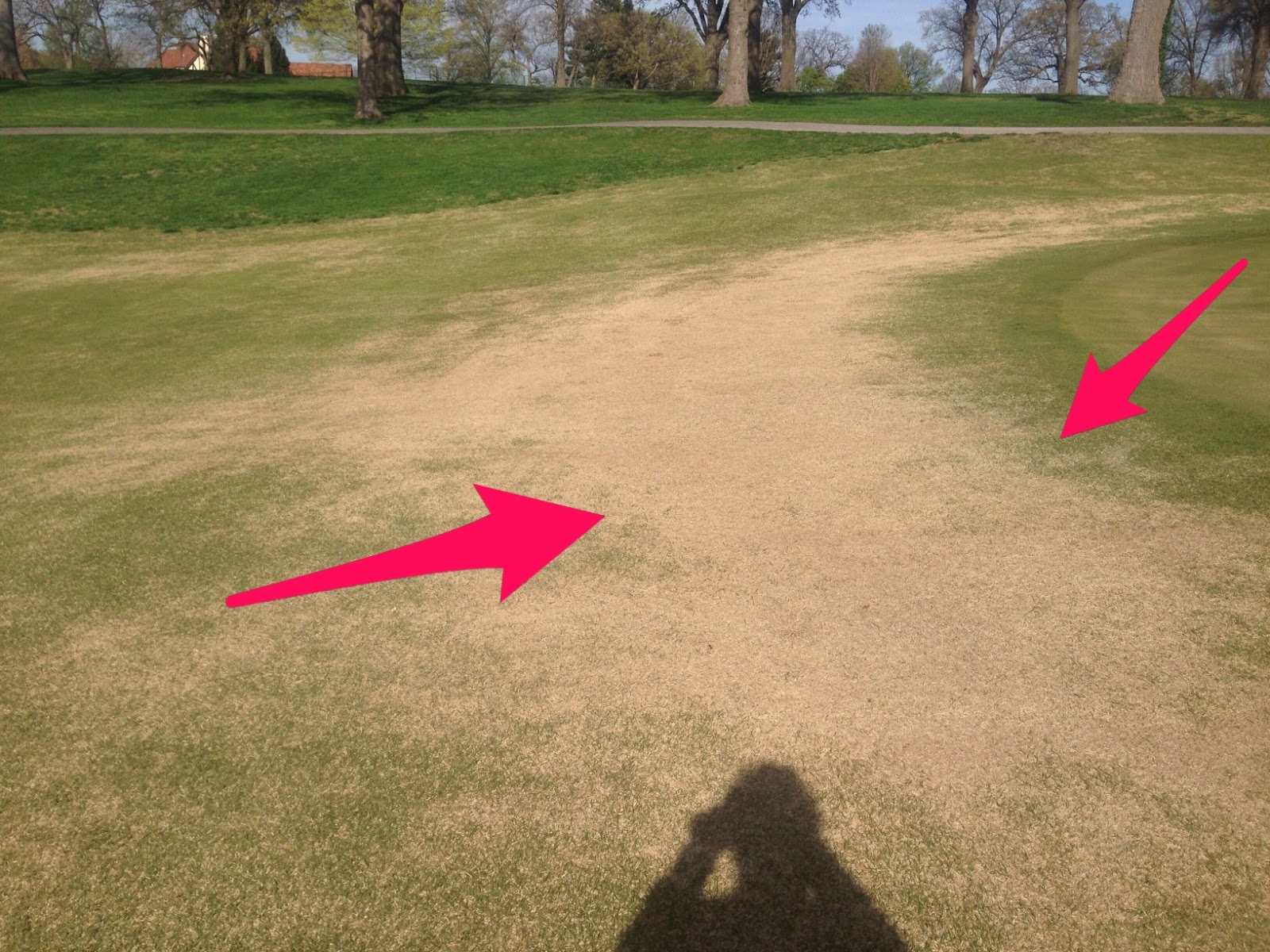
With the milder than normal temperatures this winter, our warm season turf staying in dormancy for our RoundUp application in February was a bit of concern. We do spray at the near lightest rate which is effective at killing the poa annua and not damaging the zoysia. The areas most effected, high traffic areas like approaches are a little thinner in dormant turf cover and more chemical material could have gotten down into the canopy and affected live tissue. We have pulled a couple of plugs and placed them in the greenhouse to see if they will green up in the next 10-14 days. If they do, we will be fine. If not, we might have to replace the approach area on a couple of holes.
The issue we are facing could have also been the 15-17 degree low temperature we had a few weeks ago when the plants were just greening up and were very susceptible to freeze damage.
Or it could have been a perfect combination of the 3 things happening all at the same time, weaker zoysia from the fall, just a bit more green up than normal in February and the cold temperatures after the early breakout of temperatures.
We will have a better feel about what is happening over the next couple of weeks. I think a majority of the spots will be fine. One thing I'm probably sure of is the Bermuda got its butt kicked as well.
Greens aeration was completed in 2 days by the guys. Looks good overall. Last major aeration work of the season besides monthly needle tining and maybe a hydrojet application in mid-summer.
# 1 green approach. This is about the width that I sprayed last fall with the Bermuda control product. Its also the width of the area sprayed in February. This also coincides with the turning area of the mowers and rollers which creates excessive wear in this area.
#2 looking across from left to right into front of the green. Same as #1.
This is an area along #15 we always have issues with. Narrow band of area that is emersed in deep shade for many hours of the day plus heavy cart traffic due to balls ending up on the down slope of the fairway. I did not spray this area last fall because of the weakness of the turf. Still having issues. Recommendation has been to remove at least 1/2 the trees in this area to allow more sunlight. It is also facing to the east southeast which is not a good situation for warm season turf growth.
Plugs pulled from the approach. Looks pretty weak. There appears to be life down in the stolen area but we will see for sure in 10-14 days.
The Zoysia fairways are greening up early this season. Our fairways at Glen Echo have a tendency to be a bit behind because of our Bermuda Eradication work we are doing with late Summer early Fall herbicide applications. I think most will agree we will take being a little bit behind in trade for the great shape they have been in mid-summer until the end of the season the last few years. First video of the year about our Eradication program describing the area on the north side of the main road of #8.
Video below discusses our ongoing Bermuda eradication work within our fairway and intermediate. I could not be more pleased with the results we are having but we must continue to reduce the Bermudas ability to spread by pounding it with our chemical treatments before fall sets in and it goes dormant. Hopefully mother nature will give us some help this winter and freeze more of it out!
Video updating Bermuda eradication work. We did lose a few pieces of sod from our earlier replacement and will be removing in next couple of days. Other than that, work is going as good as can be expected. Next spray will be after MAGA Amateur in early August. Can't stop, won't stop till its gone!
I know, does'nt have a darn thing to do with Bermuda grass. Lady at Invitational 2013 or 2014
Yes, I am going again President Reagan! Time for the 2nd app to the fairways of our Bermuda eradication program. Sprayed 10 acres today through Hole 10. I will spray the remaining fairways on Monday. I did not apply in some weaker areas and intermediates where the Bermuda is too heavy. As you've seen in other posts and other forms of social media, the staff have been laying a great deal of sod in many places to improve our zoysia coverage. We have a little more to do but for the most part that will end but we will continue to add some sod where we have some especially thin turf areas from our nursery over the next few weeks.
Some might question why spray again? Our fairways are a little weaker than other places in the district. We have spent a great deal of time, sweat and money in sodding and treating our fairways with chemicals to reduce this weed's competitive edge. It's important to continue the program or the gains we've made will have been wasted.
I would expect the turf to begin to show its effects from the chemical early in the week and the Bermuda will begin to be effected more severely within the next 10-14 days. In about 2 weeks, the Zoysia should begin to change from a lighter green to its normal
green color. We will also be fertilizing our fairways early next week which will encourage the Bermuda to take in the chemical and help the Zoysia return to normal.
We will discontinue spraying because of our busy July schedule and will commence again after the first week of August and the Metropolitan Amateur Championship.
10th Fairway with indicator foam to mark the passes to insure overlap does not occur.
As the staff was cleaning up the course yesterday from weekend play and prepping for a tournament, eight more pallets of zoysia grass rolled in waiting to be laid today. Praying for no rain as I mowed fairways this morning at 230 a.m(no that's not normal) clouds hung around but the rain stayed away. Had the crew split between three main jobs, course prep for The Lorette Medart Tourney, tree work on 3 and sod work on 8 approach and then the start of 17. The guys busted their butts today. Placed about 325 yards between 8 and 17. Still have another 75 yards for 8 on Wed. Of course not forgetting about two other hard working people. Becky is in the middle of planting her near mature babies she's nurtured since mid-March. Of course she having to dodge some smart and excited hummingbirds who flirt in and out looking for some great nectar. Dave is hard at work keeping our aged fleet up and running.
The sod removal process involved:
Cutting out the old stuff with a sod cutter and hauling it to the dump
Hand raking smooth
Applying some fert to get the sod started rooting
Laying the sod
A little drink of water, finished.
Hard work plus the added pressure from the boss to leave the area before our ladies groups passed through. These areas were sprayed with our Bermuda Eradication spray. In some cases, just a few hairs of Bermuda trying to creep back in. We will continue to spray these after the Zoysia roots to continue to knock it back.
If you missed the earlier video from youtube regarding our plans on #8, its at the bottom of this group of pictures.
Alphonso and Latrell cutting the new sod in place.
Randy and Jeremiah lifting the old stuff in the top near the bunker. Old sodcutter resting and waiting for its next task.
I captured this from the blog/video I posted regarding our plans a couple weeks ago.
Finished area looking good.
Russ, Latrell and Jeremiah. Also had Tom, Jason, Parker and Skip who rammed this work through for me.
As you know, we've been installing Zoysia the last couple of weeks as a part of our Bermuda Eradication Program. This week we were able to finish on 10, did the start of the fairway on 15, the intermediate near 16 approach and at the bottom of the approach on 18 green.(still a couple pieces to lay at press time). There has been mention regarding from the main road to 8 green and I did a video discussing what we are doing on this hole. We will be replacing some of the sod on this hole and will be allowing the Bermuda do grow back to fill it back in. We've given the Zoysia a good start in some of these spots and might go back in and reapply product where the Zoysia is strongest.
I will be applying one more application to the fairways before summer arrives helping to knock the Bermuda back that is mixed in with the Zoysia, that will occur in the next couple of weeks. After that, I will be allowing the fairways to grow no matter what the grass so they will be in good shape for the rest of the summer season. I will then go back in again in late summer and hit the fairways again to set up the Bermuda for winter kill.
Not how we normally roll out sod but the guys decided to just roll it out and then were going to make some adjustments. Early season Zoysia in big rolls is not usually the easiest to work.
https://youtu.be/Z2mKYopfr1A
https://youtu.be/D8eMX2mJT3I
18 Approach at bottom of the hill in the intermediate