Showing posts with label irrigation. Show all posts

Thursday, July 21, 2022

Day 2 Asphalt Overlay

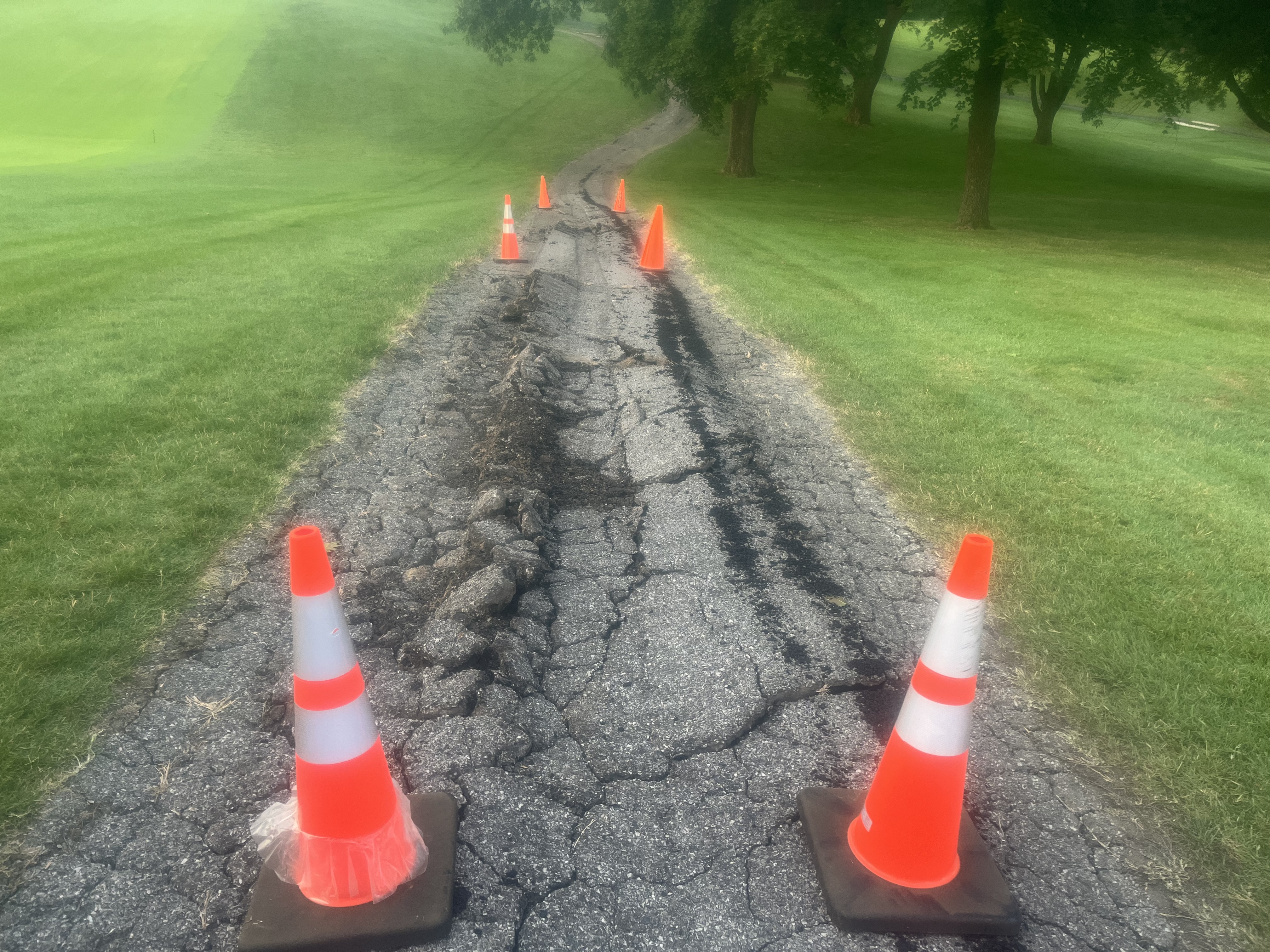
 Had a pretty good day today but a couple issues cropped up. Laid overlay from 15 lake crossing through 13 tee and onto 12 but then it happened. 2” waterline gave way pouring a torrent of water down into the already wet area below the red tee on 12. We were able to get our 3 trucks asphalt out and laid, rerouted the trucks and moved over to 7 and pulled down to red tee on 7. Approximately 3,000 more feet with a little over 5,000 to go. Along with the work comes some additional damage due to the overall condition of the paths in some spots. 

We've been pretty much buried in work the past couple of days and have not had the opportunity to do much roping and staking in areas where the overlay does much up well with the soil around it. Please remember to use caution upon entering and exiting the new cart paths. We appreciate your understanding during this work. 


Blowout above 12 red tee. Luckily the shutoff was nearby and we were able to isolate  fairly quickly but not before hundreds of gallons ran down the hill.

Pulling out from the lake crossing at 15 tee.

Inevitably some damage going down the hill on 11. Brittle old asphalt ultimately won't hold up. Guys are pulling this out as I type and an extra layer of asphalt will be put in place.

Working toward 7 red tee.

Another area we were concerned about coming down hill in front of red tee on 12. Had about 20 trucks trips over this and it gave out. Luckily we routed trucks out a different way from the beginning of the day to reduce wear and tear which would have been much worse.

Monday, October 26, 2020

Tumbleweeds, Timing, and Hole Poking

 Elvis Presley says listen up everyone as my dad gives you some information of what has been going on and will be going on at Glen Echo. 


As we rolled into September and then October, I thought we might see a few tumbleweeds dance across the golf course as it dried for an extended period of time for the first time this season. Of course we have come to expect it in the late summer and early fall but this year was pretty extreme. It wasn't desert hot but humidity levels of under 20% and daily winds of 10-20 mph saw our largest use of water on the course for a 40 day period. Of course we wanted the course firm and fast for The Invitational and we were able to deliver some pretty good conditions. First time I took rolling out of the equation over the 3 day event since I've been here. Didn't want ball roll out to get out of control, especially since our guests don't get to play the course as regularly as our membership.


So the timing of rainfall was helpful to replenish the soil but is now going a bit overboard since we are planning aeration of our greens this week. We plan to deeptine 8" deep with an 1/2" solid tine, fill the holes with sand, smooth them out, fertilize and let them breath. Of course, rain is dampening our parade. We will have to work with the rainfall over the next few days and see if we can get a few completed a day.


We were also planning to begin the installing the new drainage across the 6th approach during the first week of November.(Pending aeration completion and weather)  During the work in front of #6, we will be forced to close the 6th hole during this time. We hope it will take only about 5-7 working days to get the old pipe out and new pipe in and covered. This of course is all weather dependent and the pattern is looking more like some stopping and starting over the next couple of weeks. 
3' drain pipe in the waiting room along the main road. 


Tree removals along 7 pipe line that we will try to remove soon. 


The arrows designate the beginning of the project in front of 6 green. 


With the other work taking place, we will still be chasing leaves into December which will keep everyone busy.   


Friday, March 27, 2020

Sand, Holes, More Sand, More Holes and Project Updates

During this most difficult time, your grounds staff is preparing the course for what we hope will be some normalcy in the future. Our seasonal/summer staff will not be added until our club is back in full operation. We are lucky that our staff on hand including managers has over 175 years experience in working courses with a majority of that being at Glen Echo.

As weather improves, we will be finishing the project that was started last fall which includes zoysia around the back of 5 green and grassing the 6th green complex with zoysia. This funding is provided through the foundation and has already been allocated for this project from 2019. We hope to have the tee open sometime around May 1st if the weather cooperates. I would expect to have the sod completed around the greens by May as well.

We had initially planned to renovate the 4th and 12th tee complex but under the current situation it was determined to postpone this project. We have not determined a new date but it will be no earlier than October 1st since member guest is at the end of September. 

This past Monday, the staff was involved with our contracting company @DryjectofTennessee to aerate our greens. Our spring process involves the Dry-ject system which shoots a stream of water and sand at 3,000 psi into our greens staring from the surface and ending about 5" into the existing sand profile

Out staff’s involvement was to load 5 gallon buckets of dry sand into the aeration machine hopper. We used about 30 tons of sand. That is too many buckets of sand to count over the 10 hour period the operation took to complete. We also brushed the greens once they dried and they were rolled the next day since we ran out of time.

Hopper area where kiln dried sand is dumped. Sand is released through the holes and is then injected down into the green.

Chad Gamble, owner operator. Been a tough season for his business with cancellations beginning to fill his phone from our existing health crisis.

We hope to do a deep tine aeration of our greens early next week. This will consist of the green being covered in sand and then a half inch tine will push through the green surface to about 8” of depth.Our greens do not have modern drainage and must drain through our 4-6" sand profile and through the holes that are filled with sand. Deep tine aeration has been a life savor for our greens assisting in water removal from surfaces. Modern green architecture consists of an elaborate drainage system consisting of 10-12" of sand, gravel and drain tile. Our 9th green is the only one on property with this type of system.

The staff have been replacing damaged heads around our greens. The new system has been in the ground now for 13 seasons. Mowers and equipment going over top of them break the outer top casing which can effect the way the head operates. Our mower can also catch the corner of the head and damage it further.
You can see this head is missing almost 1/2 of the top part of the casing which rests on the soil/sod surface.


Russ working on a head at the corner of 4 green. Jason was involved in this production as well. Hopefully will be finished today.


Wednesday, November 30, 2016

Irrigation Shutdown 2016

The staff and myself, (yep big dog helped the boys) spent the afternoon shutting down the irrigation system Monday for the winter. The process starts with of course turning off the power to the pumps. There are 4 2" pipes that lead into our 4 lakes that are used to help self-drain some of the areas of the irrigation system. The less water the machine has to blow out, the less time it takes to do the job. We open our wash station valve since from up above the lakes flows toward the creek along 1-2 and we will remove a head or two in a couple more of the lowest areas on the course.

As you see from the video I'll post below, we use a large compressor that is regulated to 50psi so we do not place excesssive pressure into our system. Its places a large volume of water in the pipes quickly pushing the water through the pipes. Air with high pressure can be very destructive to the system if the pressure is set too high creating cracks in the system that will show up with our opening next season and or over the next few years. We turn on stations in each box, a couple at a time. We will usually do about 4 boxes at a time. Sometimes, the head blows out air right away and other times it might takes minutes depending upon the area and how water feeds to that section. Its about a 3-4 hour job.

https://youtu.be/4cF79DUypyQ

Saturday, December 12, 2015

What a Great Summer's Day We Face Today!

What a great summer's day we face today! Oh yes, its not summer but 62 with heavy dew and fog and a high of 70, it will feel like summer being its December 12. The staff have been busy this week aerating rough as you might see some plugs here and there and red flags marking heads. Continuing to change holes weekly and mowed greens on Wednesday. Rolled them on Friday and have been chasing leaves as needed. We are getting close to the end on those pesky critters.

No major construction projects planned this winter. Normal Tree Management Plan work including pruning and cleaning up trees all over property, inspecting others and a few removals that take place every season. We do have a couple of areas where planting will be taking place as well as the nursery. We also need to begin to tree health improvement work doing some deep drilling of compost around some of our Pin Oaks in strategic locations and applying some humic acid to improve their overall health.

The new irrigation system is reaching 9 years old this spring. With new heads comes the raising of the new heads. As you might notice when and if you are down the middle of the fairway, the heads are sunk down by an 1" or more. As the turf continues to grow, this gap will become even wider making it unsafe for golfers, difficult for equipment to go over and last but not least the sprinkler head throw pattern will be disrupted by the difference in elevation. What has to happen? Each head has to be raised to level grade. There are some mechanical ways of doing this our there but the one's I have researched appear to be very difficult to use with a very tight soil like we have here at Glen Echo.

That means every head must be dug up by shovel down to the swing arm approximately 15"-20" or so into the ground, head raised and repacked. Down the center row of fairways alone we have 150 heads. This will be a long process. Wish us luck.

Have a great day, might see you on the course for a few minutes this morning but I've got to get home and clean the leaves up in my yard. Hurt my back at home about 10 days ago and have not been able to do much of anything. Feeling a little better so I will see what I can do outside. Have a great day.


Sunday, April 26, 2015

Poa Annua, Where Is It?

Over the years at Glen Echo I've heard many ask about the poa on our greens. Some think its gone away.  Our poa has not gone away.  Poa annua is a part of all of our putting surfaces. In 1995 when the putting surfaces were gassed and grassed with a blend of Cato/Crenshaw Bentgrass, there was not any poa. 20 years later, we have greens that average 20% with some as high as 50% or more. We've made efforts to reduce the amounts over the last 7 years since I have been here. Some years it seems like we take 2 steps ahead and other years we take 3 steps back. The poa right now on the greens has a tendancy to be a lighter/lime green looking color with a seed heads interspersed.  The pictures at the bottom of the post points this out. In most cases instead of large patches of poa annua without any bent grass, we now have both bent and poa spread throughout the greens.

A course that has been around for 114 years like Glen Echo can have many different species of poa both annual varieties as well as perennial. As you can see now in some areas of the rough,  poa annua is seeding profusely. We are right in the middle of what is called the seed head flush. Pretty simple explanation is poa annua plants are in full bloom right now. This is charted using Growing Degree Day Models which help to time applications for weed and insect control.

Overall, we've had pretty good timing on our greens and our efforts to reduce seed head production. This is one reason why many have difficulty seeing the poa on the greens because we reduced the negative impacts that plants can make on ball roll and have reduced the overall seed head production on our greens. We've not eliminated seed heads by any stretch but it has improved. This season has seemed to be one of our best since I've been at Glen Echo.

Factors we  continue to fight here at Glen Echo when it comes to reducing the amount of poa annua on our greens.

  • Greens have not been grassed since 1995. Most clubs in the district have regrassed since then and some have done it twice. This is not an option at this time. The course cannot close from September to May/June the next season. A number of clubs in town were able to renovate greens due to large scale MSD projects which helped fund improvements. Some also grassed before the economic downturn in 2008.
  • The variety grasses we have now were developed in the 80's and probably have 25-50% less grass plants per foot then the new varieties. The tight turf does help to reduce poa from over taking a green. 
  • Greens have no drainage except natural flow except #9. Installing drainage using a technique by a few contractors in the country can cost $ 7-10,000 per green. It does improve playability, dries quicker and can reduce poa stranglehold with drier conditions.
  • Trees which cause shade and reduce air movement keeping greens wetter longer.
  • No fans on greens. Air movement helps in drying greens which poa annua does not appreciate. At least 6-8 greens on the course could use a fan. $ 7,000 per fan plus electric install which could double cost per green.
  • Poa population, seed bank on a 114 year old course. Using some products on he market with the percentage of poa annua on our greens could lead to massive turf loss. Newer grassed facilities can use these chemicals because there percentages of poa annua are so much smaller.
So what is a guy to do if we cannot actually make  any major changes to infrastructure at this time:

  • Improve and expand  knowledge to combat  issues regarding our greens.
  • Provide proper cultural practices to our greens, ie fertilization, water, aeration, disease management, and many other factors to encourage bent and discourage poa.
  • Add newer varieties of bent grass in the fall with seeding. Called inter seeding, some advances are made but it is not easy with greens being kept at normal cutting height and fall weather having a tendency to be dry which does not encourage baby plants at 1/10 of an inch to stay alive.
  • Continue to use growth regulators to keep poa annua in check or reduced if conditions are right. 
  • As the financial climate improves, contract drainage installation to our worst greens.
  • I've left this for last but remove trees that are creating excessive shade to green sites. East and southern exposure trees are the enemy to all of us because they suck the life out of our greens. They reduce sunlight in the morning and mid-day and if sunlight is reduced you are guaranteed to have a reduction in air movement across the green surface.  Scientists says wind speeds of 4 MPH or more are needed to allow the plant to open its stomates which allows the plant to exchange gases, reduce moisture and heat build up in the plant by encouraging its processes such as respiration and food production to happen.(simplified version) Lack of plant processes leads to energy reduction, heat stress and senescence of leaves.(physiological decline,death)
The arrows are pointing to areas of poa annua in the 12th green. You cans see some seed heads but not an
all out blooming like you might see on some green surrounds/rough.

Another spot with the darker greenish blue areas of bent grass. I will use a regulator next week that should shrink the poa annua a little further and allow the bent grass to become a little more aggressive. I do all but eliminate the use of this product in the summer. Might tickle it a little this year but have a tendency to shy away until the real heat of summer has left us in September where we hammer it again until winter.

This is showing the back edge of a green and collar on 16. Our collars have a tendency to have more poa annua. Part of the reason for this is the seed bank is higher outside the green and foot traffic/equipment move the seeds onto the green surface. There is also a problem with collar height turf staying alive. The collars are 3 times the height of the green requiring more water to stay alive. We apply water to the greens to keep the greens alive and not enough for the collars. We have to hand water during the summer months to keep the collars alive. Stress on collars is significant and turf is lost. When turf is weakened or lost, poa annua seizes its chance to invade and it does.


Monday, December 30, 2013

Interesting story on golf courses and water usage

The following story was on the golf channel a few months ago regarding golf courses and water usage on the west coast.  This story is playing out all over the country as sustainability of clubs and its management of resources are continuing to be evaluated.

Monday, November 18, 2013

Irrigation system blown out today

Every late fall, we blow out our irrigation system to insure that it is protected from potential winter freeze damage.  We rent a large compressor that pushes a column of air through the system.  The heads are turned on using the control boxes which are the green plastic boxes that are about 1 1/2' square and stand about 3 1/2' tall in groups of 2-4 that you see all around the course.  We manually turn on every head through the control boxes to evacuate the water from the system.

Before the event today, we opened 4 valves that drain into our lake system to remove water from the system.  We also opened our wash pad drain for this side of the course.  The more water we drain manually, the less water that has to be drained through the heads which helps to prevent damage.  The compressor''s pressure is regulator controlled to 50 psi which protects our system from potential damage from too high of pressure.  Our system runs at an operator pressure of 130 psi when full of water.  Running a compressor with air at 130 psi would be catastrophic for our system.  High pressure air can damage heads or pipes.  The compressor we use provides a large column of air at lower pressure which helps to push the water out of the system in a safe and efficient manner.   The system will be recharged in March when we have a need for water which is usually before our spring aeration.

Compressor outside the pump house ready to blow out the system.

Sprinkler heads turned on with water evacuating out the irrigation lines.

End of the day, air being released back out of system after the job was completed.
 

Wednesday, August 28, 2013

Greens Update from current heat wave

Right now our turf is holding up well under the current heat wave we are experiencing.  It is getting rather humid overnight but the dew pts and humidity are lower during the afternoon.  This allows the turf to stay a little more more firm.  ET rates which basically measure the amount water that is lost through evaporation through the soil and the plant are high right now.  These number range from .12" to nearly .16" over the last couple of weeks.  These type of loses do require us to place moisture on the greens at night with our irrigation system and we do supplement the greens during the day with additional hand watering as needed.

In late July and early August, we were able to topdress our greens and brush them on at least 3 occasions but have to since stop this because of the high temperatures.  Once the heat subsides, we will definitely continue this program.  We will also do some light grooming/verticutting to help stand up the turf but will not do this until we are confident the most severe stress has passed.  We have not been overly aggressive with our greens in an effort to allow them to get through the stressful period.  Being too aggresive during this heat could push our green systems over the edge and give us a miserable fall golfing season and no one wants to see this happen, especially me!!  We did lower our height back to our normal position but I'm confident we will not experience any issues.  The solid roller program gives our turf a little more added protection until we can begin to groom the surfaces again.  If we begin to see an issue, we can always skip a day mowing and roll a particular problem green if that occurs.  We are out inspecting greens in the morning, mid-day and end of the day monitoring conditions.  As the weather improves, so will the programs that will help improve ball roll.  Later summer, fall golf is my favorite time of the year.  Drier conditions and lower humidity have a tendency to provide for the potential to some pretty special ball roll out!

We are breaking out all of the tools to help us through this period.

We are using our polarized glasses which help to identify weakened or dry spot areas early before they actually show up to the naked eye.  Healthy green plants look fine but stressed plants show up brighter red with these glasses.  I usually have to take them off once I leave the green because it enhances every dry ring under trees and or stressed areas on the course.  For a moment you might think you are on Mars!

We are taking moisture readings using our Spectrum Soil Moisture Meter to assist us in determining the % of moisture to a 3" depth that our greens are holding.  I've not had to use the monitor much this season because of the frequent rains but the last few weeks have required the use of this tool.  One of the things I have noticed recently is that our moisture levels are averaging 6-8% lower in general than they were last year before the green shows serious stress.  Last year, a green was becoming stressed at right under 30%.  This season, I'm seeing greens averaging 23-25% and the overall green is looking great with some spots being slightly stressed from levels in the teens and below.  I know our root systems are pretty good for this time of year but I'm trying to come up with some additional answers of why the lower stress %.  I did recalibrate my meter to make sure everything was correct.  I believe some of the answers are from the new products we have placed in the rotation this season but we also cannot completely rule out mother nature.  


This is a reading from #2 green from the Field Scout Moisture Meter.  The top row on the far right is the moisture % for that spot.  13.5% The bottom row on the right is the average for the green after taking 16 readings, 22.4%.  Last season, if I would have had an average reading at 22%, I would have had a five alarm fire occurring on the green and I would have had a panic attack.
I did get one additional needle tine/venting completed to the greens this summer.  Don't necessarily believe that could be it but it is still helpful.  I have started to use a fertilization/poa reduction program on 10 greens this spring after using it on 4 last season.  Just before the Member/Guest in June I started using the program on all greens and the results have been pretty impressive. This is the product from GenNext Complete which incorporates an A&B product that provides almost a 1/4# of Nitrogen to our green system each month as well as other macro nutrients, enzymes and other proprietary products.
  
I've also started using a compost tea called Bio Nectar on a regular basis which should be improving my microbial populations providing a better soil environment for turf to grow.

I'm using a wetting agent along with a penetrent combo monthly which assists with water management.

Lastly, I'm using Turf Screen which has been identified to reduce UV ray damage to turf and has been shown to reduce wilt and overall turf stress.  I am seeing some of the turf going under stress but it seems to be happening at a slower and lesser degree than I've experienced in the past.

 I don't necessarily think there is a silver bullet in our program.  The GenNext product could be that but I want to see some reduction in poa annua this fall and next spring before I give it my complete and undying love and support!  Each product as well as the other products we utilize help to provide the current conditions we experience.  Also have to keep in mind that every greens unit is inspected for sharpness and height of cut before it goes out each day.  This is another factor in our plant health care program that we should not forget.

In the end, five years of thankfully mostly good, sometimes average and I don't like to think about it but it has happened not so good managing of these old greens does count for something as well.
 

Tuesday, July 30, 2013

Rain and the irrigation lake

Over the past few days, we have applied the most irrigation to our course for the season to date.  Lower humidity, less rainfall and fairway/tee aeration caused an increase in usage.  We attempt to manage our lake recharging using city water very judiciously because of the cost to the club and waste of natural resource if it flows over the spillway and goes to New Orleans down the Mississippi.  The 1" of rain saved the property over 3,000,000 gallons of water plus will probably recharge our lake for usage later in the week when we begin to dry out again.  Every day we do not run the lake tap as we call it is a day of savings.  For your information, we pay 2.57660 plus 17% taxes per 100 cubic feet of water which is 748 gallons of water at a cost of .00403024 cents per gallon.  Million gallons of water is $ 4,030.  During the heaviest irrigation cycles, we can run through a million gallons in 3-4 days.

Lake is usually full when it reaches the bottom of the spillway that leads from the lake near 15 tee.

Water is still rising on the spillway leading from the lake on 15 but has room for more water.

Wednesday, June 26, 2013

How things change in a year!


At this time last year, we had already programmed over 9,000,000 gallons of water through our irrigation system.  This year so far, about 2,000,000 gallons.  By July 15th last season, we had used almost 15,000,000 gallons of city water.  This year we have used 0.  Our lake is currently full and I would expect that with cooler temperatures prevailing over the weekend and our ground having adequate moisture, we will be able to get into July without turning on the tap.  Every million gallons of water  costs our operation about
$ 3,500 so a significant savings so far this season.

Last season we had 14.30" of rain March-June, this season we have had 18.82" of rain with much cooler temperatures.  Our rainfall was early in the spring last year and this season it has been raining in May/June  which is good for saving money on water but bad on revenue generation for the club.  If it would rain about 1/2" a couple nights a week, we would be happy but it seems to not be cooperating the way we are wanting.

Tuesday, December 18, 2012

Irrigation Shut down

The staff spent Monday blowing out the system in preparation for winter.  This normally takes place by the first week of December but was delayed because of the mild weather and the new sod that had been laid in late fall for the bunker project.  Adequate amounts of rain over the last couple of weeks and the potential for some colder weather signaled it was time to shutdown the system.  We rent a large air compressor that hooks into the irrigation system and forces a volume(900 cubic feet per minute) of air through the system while the staff turns on the sprinkler heads and allows the water to evacuate from the system until air blows out of the head.  The staff are able to turn on 10-12 heads throughout the property at a time for this process.
900 cfm compressor hooked into the main line at the pumphouse.

Heads on #13 purging water from the irrigation lines.

Saturday, August 25, 2012

Drill a well instead of using city water?


Over the years, it has been my understanding that well water could not be used by most district club operations inside the 270 corridor due to its high salt content.  Brian Kohnen, a member at our club did some investigating and got an official version of that story from DNR in the letter below.  Also, even if the water was in good condition to use for turf, one of the things I had forgotten was that the volume of water that can be received from drilling a well is way below what is necessary for us to recharge our system daily.  The output in our area from a well is under 25 gallons per minute 36,000 gallons a day.(36K gallons is nothing to sneeze at and would be helpful but the water is not usable because of the high salt content).  We are in need of 10 times that amount during our heaviest usage periods during the summer.  Wells can run between $ 15-20,000 to drill.


Mr. Kohnen,

The location you provided was not quite as accurate as it needed to be (usually three or more digits after the decimal place are helpful).  However, it was close enough that along with the two logs you referred to I was able to get a good general location.  It appears the golf course you are interested in would be either the Glen Echo or Normandy course (?).  I looked at the geology across the general area of those two golf courses, and the information below is a summary.

There are major issues with getting a well to the desired yield in this general area.  Unfortunately even with 150 acres to utilize, the problems extend well beyond that distance.  Based on all the data available, I would have to say that the chance of constructing a well capable of producing over 200 gpm of useable water is extremely poor.  We had discussed the option of multiple wells feeding into a reservoir, but that may not be cost effective given the low yield of the wells that produce useable water in this general area.  That is something I suggest you discuss with your well drilling contractor and course manager.

This area has a very low yield in the bedrock between ground surface to approximately 400 to 500 feet (depending on ground surface elevation).  The yields produced generally ranges from 1 to 10 gallons per minute (gpm).   While there is considerably higher yield available in the bedrock below this depth, the water quality degrades very quickly.  There have been very few wells drilled in this area over the years, due to the conditions mentioned above.  I have looked at the water analysis from the wells of record closest to your location.

The well closest to your location was drilled to a total depth of 460 feet.  The water quality analysis done reported the following levels (in parts per million, ppm): Total Dissolved Solids (TDS) 532, Chlorides 27, Sodium 148, iron 2.09.  While the iron level could be problematic, overall the water would seem to be of a useable quality.  The main problem is that the well yield was estimated at 1 gpm.  None of the surrounding wells I researched that produced from this ‘zone’ were in excess of 7 gpm.

All the data from deeper wells indicates the water quality degrades very quickly below that depth.  A well to the west of your location had unusable water (TDS over 6,000, Chlorides over 3,000) by 500 feet.    

Data from two wells approximately 1.5 miles south of this location (total depths 825 and 850 feet) indicated the yield was still less than 75 gpm.  At this depth the TDS was over 5,300, the Chloride levels were over 2,500, and the Sodium levels were in excess of 1,500.  

I’m not sure what quality of water you could still find useable for your purpose (greens irrigation).  You may wish to consult with the county extension office in your area or your greens expert as to what levels of mineralization the grass you use can tolerate.

Please see the attached map.  This is the area reviewed, if it is not correct please let me know and I can revise the review area as needed.  I’m sorry there is not better news concerning water quality and quantity in your area, if I can be of any further assistance please feel free to contact me via any of the methods listed below.

Sincerely,

Matthew Parker, RG
Division of Geology and Land Survey
Geological Survey Program
Wellhead Protection Section
P.O. Box 250  Rolla, MO 65402
573/368-2170
573/368-2317 (fax)

Saturday, August 4, 2012

Mottled Fairway Look, Localized Dry Spots, Fairy Ring and lack of rain

Our fairways have taken on a mottled look in various areas based on lack of rainfall and other factors over the past two months.  One of the biggest factors is a condition called Localized Dry Spots or LDS.  I've discussed LDS in the past.  Click on the link for an explanation of LDS.  Basically, its an area of soil or sand that repels water or does not accept water as readily as other spots in a nearby surrounding area.  The pictures below show the difficulty in managing this problem.  We've sprayed a soil penetrant on our fairways to improve the soils ability to absorb moisture

Other factors include fairy ring which leads to LDS, sodium or bicarbonate build up from our city irrigation water, and irrigation coverage.  Also, in an effort to keep our soaring water bill costs reduced as well as being environmentally responsible, water has not been applied in judicious amounts.  As temperatures begin to moderate and more normal rainfall occurs, I believe you will see improvements in the overall look of the fairways.  In the meantime, enjoy the long ball roll!
The probe was only able to pull out a two" deep  plug from the LDS spot on #10 fairway.  Only about 1" of the plug had a fair amount of moisture.
Just 6" away, the area to the right of the spot above,  the probe was able to penetrate 6" with moisture throughout the plug.


Wednesday, June 13, 2012

Water Management during the May/June drought

We received our first substantial rainfall on Monday June 11th of .95.  We had only received .15" of rain since May 5th which was creating a number of issues for our turf and facility.  We base our water budget on historical data.  We were under budget for the fiscal years ending at the end of March in both 2009, 2010,and 2011.  2012 showed a marked increase in our water costs of nearly 20K over budget due to the prolonged dry period in July/August of last summer.  Our rainfall for May has all but dried up and our temperatures were at least 5-6 degrees above normal, not a good combination.  If our irrigation system is set at just average levels of use and all of our heads are turned on, we can apply up to 300,000-400,000 gallons a night.  We do not manage our system that way.  In an effort to manage both the cost of the water we apply as well as being good environmental stewards of our water use, we limit some areas from receiving water on a regular basis.  Our hope is that we receive an inch of rain a week which usually keeps these areas looking good.

We keep the middle of our course watered on each hole.  Basically, the tees, fairways, first cut of rough, greens and surrounds.  We also water our flower beds every other day and the areas within the close proximity of the clubhouse.  Our outer rough heads between holes are used every other day and we only use about 1/2 of these rough heads on any given night in a hope that rain will fall.  In the last few days as our water usage continued to increase, we began to shut off some heads off of the tees and reduced the deeper rough completely.  Our usage this billing cycle is up 400% from our budget number of $ 5K.  We have been running nightly cycles that you would normally see in the middle of July.

Our efforts to improve our water use includes using wetting agents and water penetrants which will improve out water holding capability and water penetration into the soil.  We have completed applications on tees, greens and some select green surrounds.  We will probably begin to make applications to all of our greens surrounds and fairways to improve our water's ability to get to our turf's roots.  Our trend for the summer is not looking good after this past cycle but as you know with weather, that can change very quickly with some timely rain.  Our goal is to have healthy turf by using enough water to keep the turf in our main play areas active and growing.  Emerald green everywhere does not fit into the budget that we have to manage and does not make for a golf course that plays well.  It is also not the healthiest way to grow grass.  Moist, wet conditions provide for poor playing conditions and increase and encourage turf damage from play and increases the potential for disease.
Rain from a previous storm in 09.  I wish our lakes were full.


Thursday, May 31, 2012

Rain, Hallelujah, if that's what you call it!

Well, at least we saved on one night's irrigation application except for some tees and the greens.  Only received 1/10" of rain this morning.  Not nearly enough but we will take what we can get.  We had nearly an inch on May 7th and a pittance of .05" on 5/20.  At least a few days of cooler temperatures will help us save on the water bill.  3,000,000 gallons pumped into the lake over the last 10 days to offset our irrigation cycles.  Running water like its late June into early July.  This means everyone needs to chose Glen Echo for a dinner outing over the next few weeks instead of one of your favorite Friday or Saturday date night favorites.

Thursday, December 1, 2011

Irrigation shutdown

The irrigation system was blown out on Tuesday.  We hooked a compressor into the system at the pump house and spent the next 6 hours turning on heads and allowing air to push water through the system and out through the irrigation heads until air comes out of each head.  A good day to complete this task since it was cold and blustery.

Air compressor being fueled after completion of the work.

Irrigation heads in the club lawn being blown out.
 

Wednesday, September 14, 2011

What is that clear liquid falling from the sky?

Well, we received a much needed long and steady rain today to the chagrin of our Ladies Senior Club Championship participants who were forced to stop after only 9 holes.  We had received over 1.5" when I left the office this afternoon which was more than double the rainfall we had previously received since July 12th.  The course will react very positively with this flushing and deep soaking rain.  Some of the salts and bicarbonates that build up in the soil  due to heavy city water usage over the last two months will be flushed through the root zone and the water should pull some additional oxygen back in as well.

Monday, August 29, 2011

Some additional weather statistics for this season

Month of June

5 record highs for that particular day in June.  Avg for the 5 days was 96.8
5 record low highs for that day in June  Avg for the 5 days was 77.6
I should have known something was up with that type of heat in early June.

Looks like this summer season will pass 2010 as 4th all time record high temperature for the period June/July/Aug summer season by almost .25 degrees per day.  Last season 81.7, this year 81.93.  Three more days this week of over 90 will give us 64 for the season which is one less than last year with the whole month of September still to come.

A very heavy 1.10" of rain on July 12 was our last major daily rainfall.  We've had an additional .69"(only .15" coming in one day) of rain in the last 39 days.  Our weather station measures Evapotranspiration (ET) which is the amount of water lost from the surface of the ground which would be available for plants to utilize.  Some of the factors affecting this loss include temperature, humidity, and air movement.

Since July 12, we've had rainfall of 1.79" and an ET of 8.02".  That is a very significant deficit which points to why our water usage has gone sky high over last 6 weeks.

Why are some areas on the course brown?

Another post that did not show up from my phone last week.

The summer heat of July and August gave us some of the hottest temperatures ever and also left us with only 4/10" of rain since July 12.  Our irrigation lake is recharged by runoff from rain but when there is no rain, city water is used.  We used almost 8 million gallons of city water during the last billing cycle between July 15-August 1l and the meter continues to keep piling on during the current cycle.  We are keeping our main play areas watered sufficiently but are throwing smaller amounts in our deeper rough and non-essential areas.  The picture I've attached is behind 17 green and in front of 16 tee.  Even with a modern irrigation system, you can still see how inefficient an irrigation system is in comparison to mother nature.  There are numerous areas on the course in which weaknesses are on display from our system.  A few tees, fairways and even greens are showing signs of damage from inefficient irrigation applications.  I think its time for a rain dance.  Maybe that will be a part of our Labor Day festivities this weekend.

Old zoysia nursery between 17 green, 2 fairway and 16 tee.  We have kept the irrigation off in this area except for the bentgrass collar nursery near 16 tee in an effort to conserve on our water usage which is very high right now because of the 6 week drought.