Showing posts with label Approaches. Show all posts

Saturday, April 13, 2019

Sodding Zombies

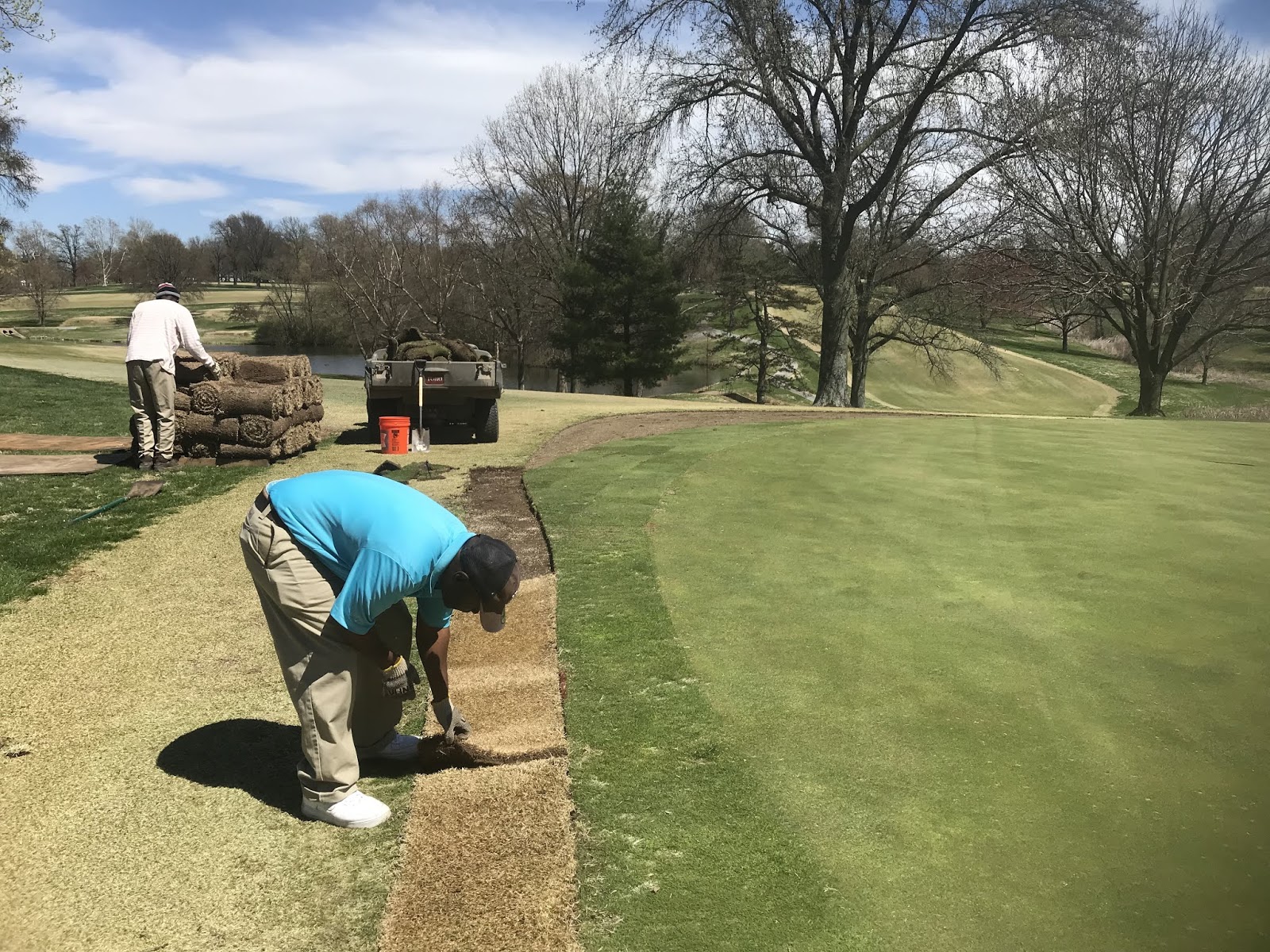
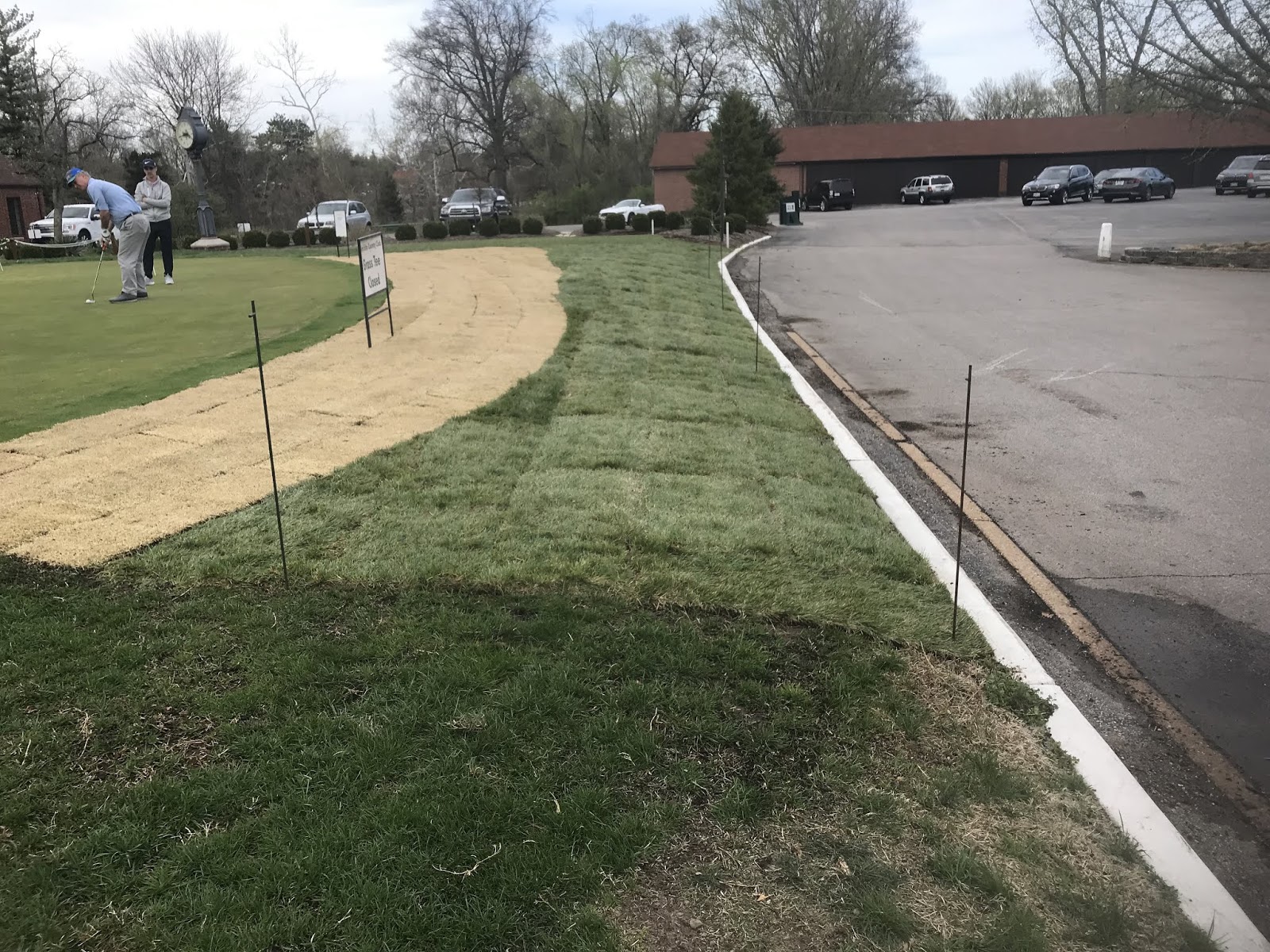
Not much of a zombie guy but the staff has been getting that sod zombie strut going pretty good the last couple of weeks. They laid another 500 yards on holes 5 left rough to finish the bunker surround area. 7 back right bunker entrance, 2, 11, and 15 approach's and the east side of the practice green area were all sodded. Also a couple of stump holes were covered up and some repair on 4 approach. Pulled up some good bent grass on the approaches and laid it on damaged collars. Normally when we have cut off larger areas for repair, we've used a tractor with a blade and the backhoe as well as a dump truck but its been too soft and the areas are pretty sensitive for large equipment. All these areas were hand picked up. We were able to place the sod nearby this week after our backhoe repaired which kept them from having to load into carts and then unload onto the ground. Staff did a killer job on all of this work!


Left collar on #11 repaired.

Right collar repair 11.

15 stripped and waiting on sod.

Right side of 15 laying sod.

15 complete


We had completed part of the practice green area near the pro shop and looked at the Pearson Lane side and had to clean it  up as well. Aerified it heavily and then put a couple yards of compost in place to help soil structure a little.


Guys laying the sod on practice area.

Its been mentioned could we place some zoysia around so you can practice approach bump and runs so we did a decent sized strip on the east side of the practice green. Not really a place to be chunking out areas of sod but should be able to practice and few bump and runs. We might have to close sections of this during the season when play has worn it down a bit.
We also put some entrance and exit areas on the  pro shop side to try to spread the walk on and off area. We hope the soil modification, irrigation and aerating we will be doing will help keep this area looking good as well.

From the pro shop walk way. Did a larger cut out of zoysia neared Doc Ott's clock area.

Finished the area between the bunkers. Still have to repair the sod trench line from new irrigation.
Another look on 5.

2 approach repair and clean up.

2 approach

The mowing of greens are becoming more regular along with rolling. The first mowing of rough, tees, tee surrounds, fairways occurred this week and bunkers were trimmed up. Finishing up on our pre-emergent applications and we do have a great deal of broad leaf weed control that will take place over the next couple of weeks. Dandelions, clover and some cool season weed control.

We did some finish grading around the new 2 tee complex. Trying to get our laser leveling contractor in over the next week. We are going to have to dig out part of the back tee. The soil is soft and pumping so we will dig it out this morning and put some good hard Glen Echo clay in its place. Little video below showing the smoothed out area.

https://www.youtube.com/watch?v=_KPSyWUcEn0


Update on the repair to the back of the tee. Dug out a 10' x 12' section of the back of the tee this morning and back filled with some Glen Echo clay. The soil that was originally used was excessively wet and plastic like not allow the surface to firm and ultimately would have settled. The new soil should improve the situation.

Skip dug out  about 2' of fill that ended up being too plastic/rubbery.

Back filled, packed and smoothed over.

Tuesday, October 16, 2018

Frost, Turf Renovation and More


We experienced our first frost of the season today and it was heavy enough to create a slight delay. Be aware that this will occur more frequently as evening temperatures dip into the 30's and soil temperatures begin to cool. Excellent article on Frost Delays from the USGA and a video below. I'll give the Glen Echo Grounds Department's view on frost in the next week or two with another blog post.

Not good when your first hole is at a low point on the course
#10 as well
 

 https://www.youtube.com/watch?v=eKR7z0fVeXs


We have a number of turf renovations projects completed and taking place as I type these words. Over the years we have been replacing the false front approaches on the greens that are bent grass. We replaced #12 last week. It will sit dormant over the winter and will begin to grow in during spring. We intend to replace a number of other approaches next spring including 7, 10, 13 and 15. 
Guys finishing a corner of the intermediate near 12 green.

Single lap collar on #12. Saves club time in mowing, water since zoysia requires less water than bent grass and chemical applications.

Replacement of collar on practice green walk on.

Same area.


 As most of you have seen and can see from the pictures above, the practice green walk on area is not in great shape. We tore it out this morning and began the process of restoring this area.

  • First thing we did was strip the existing sod to Doctor Ott's clock.
  • Next we rented a large walk behind tiller and tilled the area as deep as it would go, 6-8 inches.
  • Bought 2 yards of compost and tilled it in. Also added some bagged compost that we had stored.
  • The next thing we will do over the next few days is to get some small irrigation heads installed that will only apply water to this area.
  • Once that is completed we will purchase some new fescue sod and let it rest over winter
  • We will install some human traffic control measures to spread the wear and tear. Provide proper cultural practices including multiple aeration over the season. Fertilizer and chemical controls will also be need to improve the overall health of this area as well.Pictures and video discussion of the work we are doing at this site.
    Working in the darkness of morning. Frost on the turf so we had this work to do.

    This is after sod was stripped. We do have mats for you to walk across the dirt area. After tilling below, the dirt is very soft and we don't want you tracking the dirt on your greens and into the pro shop.

    9 hp tiller I used to till up the pretty severely compacted soil and till in the compost.

    As you can see from the tracks, soft soil.             


https://www.youtube.com/watch?v=nheNtg7Xjgc

Wednesday, April 12, 2017

Weakness in Some Fairways and Approaches

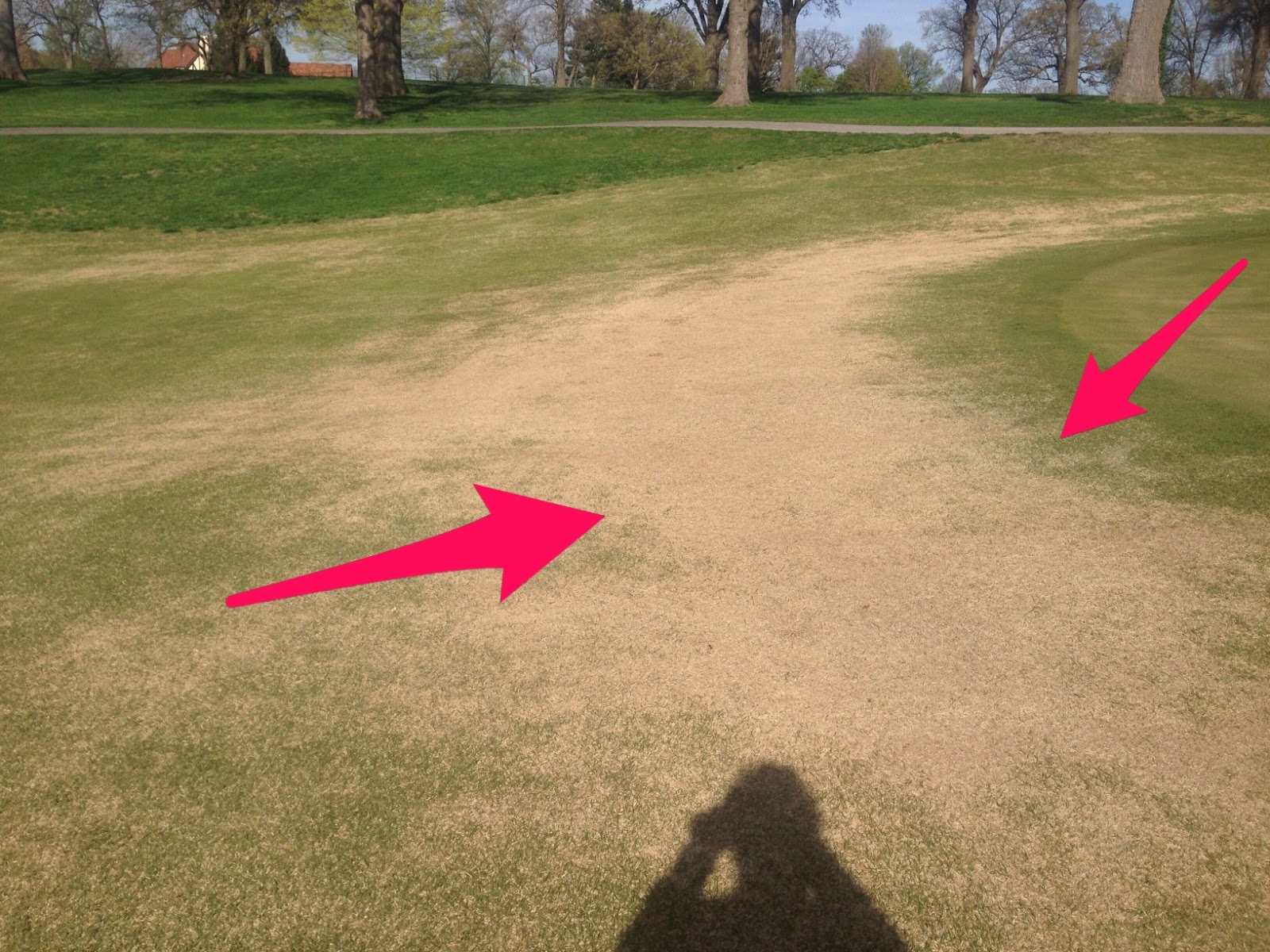
We've greened up nicely is many areas of our fairways but we do have some noticeable weakness in heavier trafficked areas such as approaches, shaded areas, north facing areas etc. There are a number of things that could be attributed to causing these issues. We talk mostly about the good and the work that takes place, every once in a while I have to talk about some bad.

I made the fall application like we normally do with our Bermuda reduction material. We were pretty dry in the fall which the Zoysia was under a bit more stress than normal. Of course going dormant, is a bit stressful as well. We normally come out of winter a bit more delayed than normal because of this spary material. The zoysia is tolerant to it but it can tinge it a little.

With the milder than normal temperatures this winter, our warm season turf staying in dormancy for our RoundUp application in February was a bit of concern. We do spray at the near lightest rate which is effective at killing the poa annua and not damaging the zoysia. The areas most effected, high traffic areas like approaches are a little thinner in dormant turf cover and more chemical material could have gotten down into the canopy and affected live tissue. We have pulled a couple of plugs and placed them in the greenhouse to see if they will green up in the next 10-14 days. If they do, we will be fine. If not, we might have to replace the approach area on a couple of holes.

The issue we are facing could have also been the 15-17 degree low temperature we had a few weeks ago when the plants were just greening up and were very susceptible to freeze damage.

Or it could have been a perfect combination of the 3 things happening all at the same time, weaker zoysia from the fall, just a bit more green up than normal in February and the cold temperatures after the early breakout of temperatures.

We will have a better feel about what is happening over the next couple of weeks. I think a majority of the spots will be fine. One thing I'm probably sure of is the Bermuda got its butt kicked as well.

Greens aeration was completed in 2 days by the guys. Looks good overall. Last major aeration work of the season besides monthly needle tining and maybe a hydrojet application in mid-summer.


# 1 green approach. This is about the width that I sprayed last fall with the Bermuda control product. Its also the width of the area sprayed in February. This also coincides with the turning area of the mowers and rollers which creates excessive wear in this area.

#2 looking across from left to right into front of the green.  Same as #1.

This is an area along #15 we always have issues with. Narrow band of area that is emersed in deep shade for  many hours of the day plus heavy cart traffic due to balls ending up on the down slope of the fairway. I did not spray this area last fall because of the weakness of the turf. Still having issues. Recommendation has been to remove at least 1/2 the trees in this area to allow more sunlight. It is also facing to the east southeast which is not a good situation for warm season turf growth.

Plugs pulled from the approach. Looks pretty weak. There appears to be life down in the stolen area but we will see for sure in 10-14 days.
2 green after aeration

2 green canopy. Holes filled. 


Monday, July 20, 2015

Aeration and More Aeration

Spent a lot of time last week aerating playing surfaces at Glen Echo. Tees, approaches and finished up with the range tees this morning before the storms hit. Also used our rough aerator with slicing blades and did back 9 last week and almost got through number 5 when we had a weld break. Should finish that later this week when the repair is made. Videos below describing our work. Links attached for those who video does not come up on your screen.

https://youtu.be/cOabWGH0DiQ


Picking up cores on short range tee.

All hands hurrying before the storm hit on Long Range Tee.


https://youtu.be/tby1MegAbnU

Tuesday, September 23, 2014

Update on 4 approach

The staff completed the replacement on 4 approach with zoysia today.  We did an additional three rows of zoysia on the front of 16 and will complete the remaining section tomorrow.  This will reduce our chemical applications by another 1000 square feet which  does not seem like a great deal but it is.  Asst Skip has informed me that a number of the false fronts have been reduced in size over the years since there initial installation in the 90's.  Since I have been here, we have eliminated them on 1,3,6, 1/2 11, 18 and 4/16 in the last few days.

Last weeks work with additional collar to be replaced to the right of the whit line in the middle.


The sod that was replaced today.  There is now a 24"  bentgrass collar in the front of the green.  The area will be a little shaggy until the warm weather arrives next spring.

We will be topdressing thw zoysiaj with sand in preparation for winter and to begin the smoothing process for next season.

Sunday, April 27, 2014

Bermuda grass encroachment on collars

With rain coming in later today, I came into work this morning and sprayed our collars and edges of greens that are contaminated with Bermuda grass.  The plants just emerged this week and protocol for Tupersan, the product we used says to spray at first emergence and then follow up every 4-6 weeks.  It also needs to be watered in within 3 days to activate it in the soil. 

I had sprayed a preventative application earlier in the week of a product that protects the greens from some summer diseases and needed a few days between applications so the bentgrass/poa annua would not be injured.  The Bermuda product inhibits the photosynthesis of the Bermuda grass and it will slowly begin to die.  Of course as you know, Bermuda is a horrific weed.  Its root system is fairly deep into the ground and braches out in many directions this the need for follow up applications.  One of the unique benefits of Tupersan is that seeding can take place right behind an application.  It is the only pre-emeregent product that is on the market that allows seeding. 

You can see the Bermuda in this picture off the back of 5 green collar with the long stolons that attach themselves to the soil surface. We are trying to injure it at emergence since it is weaker and more vulnerable and the chemical can create significant injury.  Follow up treatments will insure that plants trying to creep into the area are kept out of the collars and greens.

Monday, March 17, 2014

Spring Greens Aeration 2014


We were slowed a few hours by some very cold temperatures this morning but once we got a rhythm going, our small group of 8 guys banged out 11 greens.  PG, 1-9 and 16 is aerated and top-dressed.  At the same time, we were charging our water system so we could have water over the next few days to help dissolve our fertilizer application and settle the topdressing material.  We will aerate greens 15-18 tomorrow and might try to complete 10-14 over the next couple of days if we can do it without disrupting play.  We lost about 2 hours of work time this morning so potentially it might take us until Monday to do the last few greens.

I made a couple videos explaining a couple of our processes today.  The first video shows our vertical mowing that we did after mowing the greens.  Vertical mowing helps to cut bent grass blades which by their natural growth habit like to lay over.  This process will also rejuvenate new leaves from the crown of the plant.  We did get deep enough to get into the beginning of the thatch layer.  Diluting the thatch layer with sand creates a surface that drains well, allows the thatch to breakdown more quickly and provides a firmer surface which reduces the size of ball marks.  The sand also protects the crown of the plants which is where the roots and shoots are joined together to form the plant.  Realize when I'm speaking of a plant, I'm talking about 2,000 plants per square foot on a green measuring 5,000 sq feet or 10,000,000 plants per green. I great deal of living breathing plants to keep alive.


The video below describes in great detail the work we are trying to accomplish today.  It shows the deep-tine Verti-drain machine which was used to punch solid holes in our greens.  We top dressed the green with sand after the mowing and vertical mowing.  Topdressing the green before the holes were punched reduces the tracking potential that can occur taking a heavy load of topdressing sand over a softened green surface that has been aerated.


We used our blower that we pull with a cart to blow sand into the holes and excess sand is then moved around with backpack blowers to the holes that remain open.

We then brush the green to smooth out the remaining sand and the green is then rolled with our vibratory roller.  The roller helps to smooth the greens.  The greens are not completely smooth yet.  More rolling and water applications and time will help to smooth the greens out over the next couple of weeks.  We will probably not mow the greens for a few days but will be rolling.  Our first mowing will be a dry mow which means we do not mow until the surface is dry so we do not drag sand around on the green surface and disrupt play.  I would expect the greens to be back in normal condition by April 1st.


2 green completed.


Monday, November 4, 2013

Lowering the front collar of #5 green

The collars on the front of some of our greens that are flatter can become artificially raised from the years of topdressing sand.  Sand can be blown to these areas during major aeration projects or the natural turning on the topdressor and turning off the machine can lead to more sand being applied to these areas right off the edge of the green surface.  Raised collars can slow water from going off the front of the green and or trap water from going off the green.  In a way, the higher collars create a bath tub effect which is never good for bent grass turf.  Excessive moisture creates a number of issues:
  • Softened conditions which contribute to bigger ball marks, spike marks and poor ball roll out.
  • Removes oxygen from the soil and creates a anaerobic or oxygen deprived soil profile which contributes to poor root systems and easily damaged turf.
  • Encourages disease both surface borne and root.
  • Encourages poa annua to become the dominant turf because it loves excess moisture.
  • Elevated soil temperatures during the summer heat which can damage root systems.  Moisture is a great conductor of heat.

One of our worst greens for this issue was #5.  I was hoping to get this situation corrected last fall during the bunker project but we were just too strapped for time.  The moisture from last week softened conditions enough today and we tackled the problem right before lunch.  We removed one pass 18" of green height sod from the front of 5 green since it was beginning to elevate up to the collar.  We removed about 12' of collar/approach sod and laid it out to use over once the soil was leveled.  We left about 6' of sod on the outer edge of both sides of the approach.  Once the sod was removed, we took out 1-3" of excess sand which had built up over the years.  Upon removal of the sand, the sod was laid back in place.  We will be lightly sanding the sod cracks to reduce the potential for the sod to dry out and will do some light topdressing before winter sets in.  Once the turf begins growing again next spring, we will do some additional smoothing of the surface with sand.  The overall health of 5 green should improve with the evacuation of excessive water from the front area of the green.  

Staff cutting pieces of the approach on #5 and laying it on the boards in the order it was removed.

Same  as above.

After the sod was removed, we hand shoveled and raked the area smooth.  We then used our  laser level to insure the water would move away from the green.  Once that was complete, we used our compactor to smooth the surface of the area before laying the sod back in place.  Of course Lady is checking out our work as usual!  She did approve.

The staff edging the sod back in place to the existing grade on the side of the approach.    As you can see the green does slope from back to front but does flatten out at the front of the green.  When we pulled the row of sod off the green, there was a anaerobic black layer of disgusting smelling sand in the front of the green.  The fronts of our greens do have a tendency to hold extra water since we do not have drainage but they will not hold as much with water being able to move more freely off of the green with the lowered collar during rain events.

The finished product.  This area will be painted as Ground Under Repair.  Please walk around this area the rest of this season and please move your ball from this area before playing your next chip or putt.
   

Friday, November 30, 2012

Approach replacement #1/#2 green fairway expansion

Our bunker renovations of #17 required some additional bentgrass to replace some of the collar that was removed during the construction.  Both our collar and greens nursery have soil structure issues that can grow bentgrass adequately but when transferred to an green on the course, it normally fails.  Over the last couple of years, we have begun the process to remove the false bent grass fronts on the greens.  An explanation of my reasoning regarding this removal is listed below.   

  • Provide a consistent playing surface of Zoysia on the fairway, approach until reaching the collar/green.
  • Bentgrass requires many more inputs of water, fertilizer, fungicide and insecticides.  Also, it must be walk mowed which requires additional labor.  It also must be hand watered during the summer to reduce stress.
  • USGA agronomists in site visits to the course since I have been at Glen Echo has recommended that the bentgrass approaches be removed for the reasons listed above as well.  Other clubs in the area have removed or have been in the process of removing the false fronts.  My staff has informed me that the false fronts have been drastically reduced in size over the last 10 years or so. 
The green committee evaluated a recommendation made by Kye Goalby before the bunker project that included the removal of a few trees near #2 green and providing an expanded approach/fairway and green side fairway area.  The committee agreed with the recommendation and during our bunker tree removal, we removed the trees on #2.  To insure we had adequate money for the bunker project, we delayed the work until after the project was completed.  The committee gave us the go ahead on Tuesday and we began stripping away the sod.  A majority of the sod was laid on Thursday and we will finish this area today.


Sod being removed from the front of #1.

Zoysia being laid on the approach.

The finished product.

Sod being stripped away from the right of #2.

Big roll sod being laid on #2.

More sod.

Near complete.  We have about 2 rolls of sod to finish the job and some additional cool season turf along the edge of the area.